Insider Brief
- Siemens has opened six physical AI application scenarios across five factories in China to test and refine systems on real production lines, while also introducing more than 20 products and signing cooperation agreements with more than 40 Chinese companies.
- The six factory scenarios cover bulk-material sorting and feeding, autonomous container movement, depalletizing and palletizing, process operation and quality inspection, precision screw tightening and flexible packaging.
- Siemens also updated its Eigen Engineering Agent and helped release a Chinese national standard for reconfigurable intelligent factory systems designed to make it easier to connect equipment, production lines, digital twins and AI models.
Siemens has opened six factory application scenarios across five plants in China to test and refine physical AI systems in real production environments.
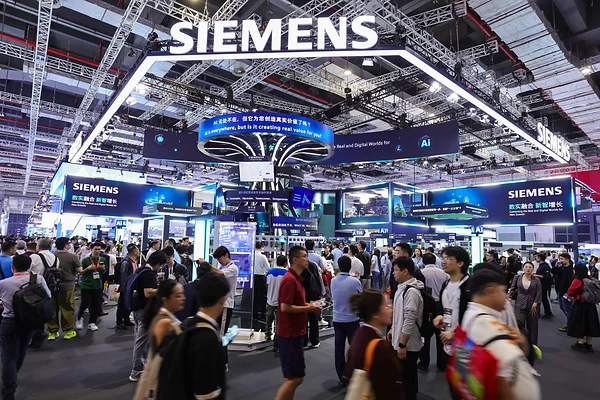
According to Siemens, the company also introduced more than 20 new products at the China International Industry Fair in Shanghai, including 13 developed in China, and signed cooperation agreements with more than 40 Chinese companies spanning machinery manufacturing, materials processing, infrastructure, automotive, photovoltaics and water treatment.
“China is not only one of the world’s most important industrial markets, but also a key application venue for future industrial AI. Abundant scenarios, rapidly evolving customer needs, and a complete industrial ecosystem provide fertile ground for industrial AI to move from proof-of-concept to large-scale implementation,” Xiao Song, president of Siemens Greater China, said in the announcement. “Faced with this opportunity, Siemens will continue to leverage the combined strengths and advantages of global technology, Chinese innovation, and Chinese speed to create greater value for our customers.
Smart Factories with Physical AI
The factory initiative is focused on giving physical AI systems access to real production lines where they can be tested, improved and generate operational data. Siemens said industrial environments present challenges including changing operating conditions, varied tasks, strict production schedules and high safety requirements that are difficult to reproduce outside working factories.
The six scenarios cover sorting and feeding unordered bulk materials, autonomous movement of material containers, depalletizing and palletizing, process operation and quality inspection, precision screw tightening and flexible packaging, according to Siemens.
Siemens also said it plans to work with partners at the five Chinese factories to test whether physical AI capabilities can move between different production lines and operating environments to determine which systems can be replicated and scaled for broader industrial use.
New Products
The new products introduced at the fair include programmable logic controllers, servo drives, supervisory control systems, edge AI products and DC power-distribution equipment. Siemens noted that 13 were developed locally in China. Since beginning its locally developed industrial automation program in March 2025, the company has introduced more than 40 such products and is taking selected technologies into markets including Southeast Asia, India, Europe, the Middle East and South America.
Eigen Engineering Agent
Siemens also updated its Eigen Engineering Agent, an AI system for industrial engineering. The new version can automatically generate project structures that follow specified standards, which Siemens said can cut program-development time by as much as 50%. It also adds multi-axis drive configuration for more complex motion control. The company said Eigen has been used by hundreds of Chinese manufacturers since its July launch across industries including automotive, machinery, electrical equipment, chemicals and life sciences.
National Standards
At the fair, Siemens and the China Machinery Industry Instrumentation and Technology Economic Research Institute also released a national standard for reconfigurable intelligent factory production systems. The standard is designed to give equipment, production lines and software platforms a common way to describe capabilities, states and behaviors, making it easier to connect and reconfigure systems and deploy technologies including digital twins and AI models.