As the conversation around Artificial Intelligence (AI) continues to evolve, a critical question arises: Who stands to gain the most? Instead of focusing solely on the development of autonomous “intelligence”, there’s a growing emphasis on AI’s “machine usefulness”. This perspective prioritizes how AI can be tailored to assist workers and catalyze widespread prosperity.
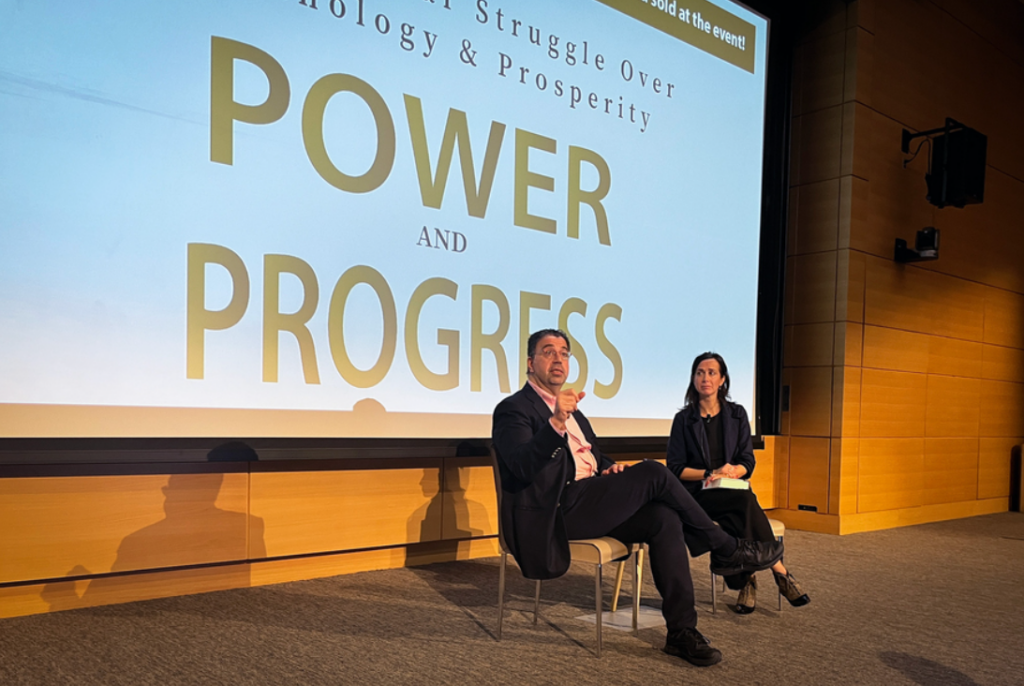
This question was brought up by MIT Economist Daron Acemoglu at an MIT public campus lecture at the Wong Auditorium last month in front of a near-capacity audience.
Acemoglu — an economist who has taught at MIT since 1993 and has dedicated years to researching the effects of automation on employment and society— highlighted that society is shifting towards a scenario where AI not only supplants jobs and amplifies surveillance but also intensifies economic disparities and consolidates political influence among the ultra-rich.
Benefitting the Many or the Few?
“There are transformative and very consequential choices ahead of us,” said Acemoglu.
Acemoglu observed that when it comes to AI, the development direction of these technologies is critical because they can either bring benefits to many or might solely benefit a narrow elite. He pointed out that technology usually aids society in boosting productivity, but the real concern lies in how these economic advantages are distributed. Historically, he suggested, major innovations, particularly those linked to automation, intertwine deeply with societal power dynamics and control issues, though added that when innovations enhance workers’ tasks instead of replacing them, it fosters conditions that allow prosperity to be shared among the workforce.
“The objective is not to make machines intelligent in and of themselves, but more and more useful to humans,” he said.
Drawing from his book Power and Progress: Our 1000-Year Struggle Over Technology and Prosperity, co-authored with Simon Johnson of the MIT Sloan School of Management, Acemoglu stated in his talk that technology’s benefits depend on its application. He highlighted that it took a century post the Industrial Revolution for its productivity gains to be democratized. Initially, earnings stagnated, work hours surged, and textile workers faced deteriorating conditions. He also pointed out that Eli Whitney’s cotton gin exacerbated U.S. slavery conditions, underscoring that innovations can sometimes benefit only a select few.
“We’re not saying that this time is different,” said Acemoglu. “This time is very similar to what went on in the past. There has always been this tension about who controls technology and whether the gains from technology are going to be widely shared,” adding that society has reaped numerous benefits from technology, but humanity shouldn’t assume this is always the case.
Healthier & More Prosperous
“Yes indeed, we are immeasurably more prosperous, healthier, and more comfortable today than people were 300 years ago,” said Acemoglu. “But again, there was nothing automatic about it, and the path to that improvement was circuitous.”
Acemoglu also made it clear that society should strive for what he and Johnson describe as “The Productivity Bandwagon” in their book. This approach tailors technological innovation to assist workers rather than replace them, ensuring that productivity gains result in broad-based prosperity.
“The Productivity Bandwagon is not a force of nature that applies under all circumstances automatically, and with great force, but it is something that’s conditional on the nature of technology and how production is organized and the gains are shared,” said Acemoglu, though importantly, he pointed out, that the “double process” of innovation also requires substantial worker power, which has diminished in recent years in areas like the U.S.
“Power and Progress”
The decline in worker power makes it less probable that diverse technologies will benefit the workforce, Acemoglu observed. However, he pointed to tech leaders like Norbert Wiener and Douglas Engelbart who strived to make machines more beneficial for humans, suggesting AI could follow suit.
He cautioned, however, against over-prioritizing automation, which might not always yield productivity benefits. During the event, Fotini Christia praised Acemoglu’s book “Power and Progress”, mentioning technology’s historical influence as well as ancient Greek myths. She also posed questions on AI’s potential distinct effects, especially in developing nations. In a Q&A, Acemoglu addressed issues like earnings distribution and global inequality, emphasizing that workers should not only voice concerns but also advocate for policy changes.
“There is some degree of optimism in saying we can actually redirect technology and that it’s a social choice,” said Acemoglu.
To end his talk, Acemoglu also pointed out the vulnerabilities of countries in the global South to AI’s impact, noting China’s export of AI surveillance tech to developing nations, as shown by MIT economist Martin Beraja. Additionally, countries relying on low-wage industries for economic growth may see AI undercut labour force participation. Acemoglu further cautioned against the unchecked accumulation of personal data by companies or governments, noting its potential anti-democratic and inequality-inducing effects. He stressed the risk of AI becoming a global technology that exacerbates inequality if steered towards automation.
Acemoglu is only too aware of the societal implications of AI. The potential for the technology to either democratize prosperity or concentrate it among a few is a near and present danger. It will take experts like him — to focus our attention on the threat AI could create if we don’t regulate and control it.
Featured image: MIT