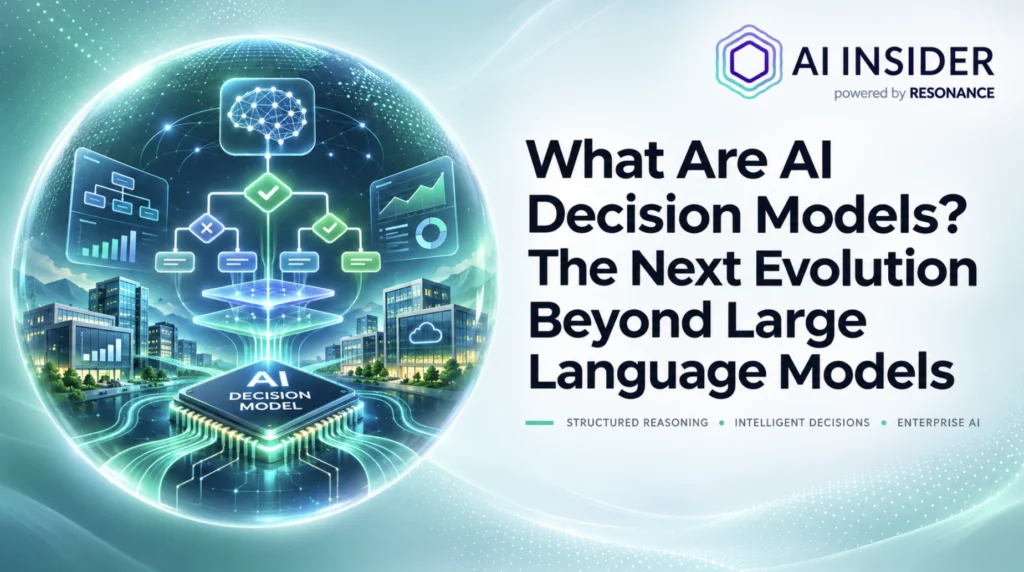
What Are AI Decision Models? The Next Evolution Beyond Large Language Models
 By James Dargan · · 5 min read
For most of the generative AI era, progress has been measured in words. Large language models (LLMs) have been judged on how well they write, summarise, translate and reason in prose. Yet a growing share of the AI industry now argues that most real software workloads do not need a paragraph at all. They need an answer. That shift has given rise to AI decision models, systems built to choose rather than to talk.
WHAT IS AN AI DECISION MODEL?
An AI decision model is a system that returns a bounded, structured answer instead of free-form text. The application supplies the input, poses a question and defines the permitted answers in advance. The model then scores those options and returns a typed result, such as a selected label, a yes/no probability or a score on a defined scale, usually alongside a confidence value. As jnaapti’s explainer on the category illustrates, a support ticket about a missing payment might be scored against billing, shipping and returns, with the model selecting billing and returning a probability for each option, so the calling code never has to extract a label from generated prose.
The same analysis notes that several of these models compute their scores in a single forward pass rather than generating output token by token, and that many accept new questions and answer options at call time. IT services group Coforgeframes the distinction in enterprise terms: instead of asking a language model to write text and then inferring a decision from it, decision models are optimised to produce the decision itself, in the form of classifications, rankings, probabilities and confidence scores.
WHY THE SHIFT FROM LANGUAGE TO DECISIONS
The case for the category rests on a simple observation: most business processes exist to make judgments, not content. Coforge points to claims platforms deciding whether more evidence is required, underwriting systems choosing between approval, review and denial, and AI agents deciding whether to continue, retry, escalate or stop. Each is a choice among known options, and each affects cost, risk and compliance.
DiploFoundation makes a similar argument from the infrastructure side. Its analysis of decision-only AI observes that sensor anomalies in utilities and fault reports in public services are classification problems, where a label and a calibrated confidence score fit existing control logic far better than parsed prose.
JEV AND THE RISE OF SYSTEM ONE MODELS
Spam filters and intent classifiers have made bounded decisions for years, but 2026 changed the packaging. In September, TypeSafe AI introduced Jev, positioning it as a System One model, a nod to the distinction between fast intuitive judgment and slower deliberate reasoning [4]. Diplo describes Jev as a learned, probabilistic engine that behaves like a smart if-then-else construct. Humans define the allowed answers, but the model learns the patterns linking inputs to them, allowing it to generalise to unfamiliar phrasing while remaining unable to invent a category outside its schema.
Adoption was rapid. Vercel reported that Jev became the fastest-adopted model in its AI Gateway’s history, reaching more than twice as many paid teams in its first 24 hours as any previous launch [5]. Benchmarks cited by Diplo put Jev’s response times at 70 to 500 milliseconds, compared with 3 to 329 seconds for frontier LLMs in the same tests, with charges applied only to input tokens because no output text is generated.
Larger providers followed within weeks. According to jnaapti’s timeline, AWS published Strands Decider 2B in early October, OpenAI opened a Decisions API in public beta, Liquid AI released open d1 models spanning text, vision and audio, while Cloudflare and Microsoft brought decision models to Workers AI and Foundry respectively.
WHAT ENTERPRISE TESTING REVEALS
Early enterprise evaluations suggest the value of decision models lies as much in auditability as in accuracy. A study by Momentuum blue, Coforge’s specialised AI unit, compared four decision architectures across customer support routing and insurance underwriting [2]. In the underwriting benchmark, Jev matched all eight rule-derived business outcomes, outperforming the larger frontier models tested.
The more instructive finding concerned how failures occurred. In one scenario, a model approved an application despite missing claims history, and only a downstream control prevented the error from reaching the final result. Only auditing the intermediate decisions exposed the flaw. Coforge concludes that enterprise AI will increasingly separate functions, with generative models producing language, reasoning models synthesising information, decision models evaluating structured choices and governance layers enforcing oversight [2].
FROM DECISION SUPPORT TO DECISION PARTNER
Academic research places this moment within a longer arc. A 2026 editorial in Group Decision and Negotiation by Edona Elshan, Muhammed-Faith Kaya and Dominik Siemon traces AI in the field from rule-based and agent-centric systems in the early 1990s, through automated negotiation agents and machine learning in the 2000s and 2010s, to today’s collaborative and generative architectures [6]. The authors highlight work on an agentic reference architecture that separates generative agents handling interpretive tasks from logical agents performing deterministic weighting and ranking. They also point to research showing that LLMs display systematic violations of expected utility theory under risk, a reminder that generative systems should not be presumed to decide rationally.
LIMITS AND GOVERNANCE GAPS
Decision models carry their own risks. jnaapti cautions that a wrong answer can still be perfectly well-formed, that a confidence value is not automatically a probability of being correct, and that thresholds should be tested on an organisation’s own labelled data rather than copied between providers [1].
Diplo identifies a policy blind spot. Most AI rules focus on foundation models that generate text, images or code, leaving no clear category for embedded engines that output only labels and numbers [3]. The analysis argues that procurement guidance should distinguish conversational AI from decision AI and weigh efficiency and energy use.
WHAT COMES NEXT
AI decision models are unlikely to replace large language models. They are more likely to sit beside them, handling high-volume, low-latency judgments while generative systems take on explanation and open-ended reasoning. For organisations building agentic AI, the defining question is no longer whether machines can understand language, but whether they can make consistent, auditable decisions.