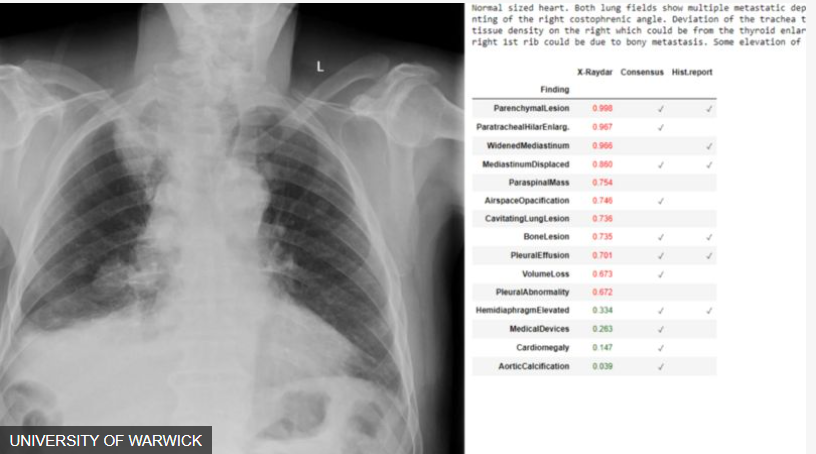
Recent advancements in Artificial Intelligence (AI) have made it possible for these technologies to analyze X-rays and diagnose medical conditions with a proficiency comparable to that of doctors. This groundbreaking development, covered by the BBC recently, was highlighted in a study that demonstrated the impressive capabilities of AI in medical diagnostics.
In this study, an AI software, developed for analyzing chest X-rays, underwent rigorous training with over 1.5 million patient images. The software’s primary task was to identify 37 different possible conditions from these X-rays. Remarkably, the University of Warwick reported that the AI’s diagnostic accuracy was on par with or even exceeded that of doctors in 35 of the 37 conditions evaluated at the time the X-rays were initially reviewed.
This AI tool, not only has the potential to significantly reduce the workload of doctors and mitigate delays in diagnosis but also serves as an invaluable “ultimate second opinion” for radiologists, according to the researchers. The software’s sophisticated design allows it to prioritize abnormalities, distinguishing those that require urgent attention from less critical issues, thus enhancing the efficiency of medical care.
To validate the accuracy of the AI’s analyses, over 1,400 X-rays examined by the software were further scrutinized by senior radiologists. These experts then conducted a comparison between the AI’s diagnostic conclusions and those made by radiologists at the time of the initial analysis. The study’s lead author, Dr. Giovanni Montana, Professor of Data Science at Warwick University, emphasized the software’s ability to eliminate human error and bias. He named the software “X-Raydar”.
“If a patient is referred for an X-ray with a heart problem, doctors will inevitably focus on the heart over the lungs,” said Montana. “This is totally understandable but runs the risk of undetected problems in other areas”.
Professor Vicky Goh of King’s College London, a co-author of the study, envisaged AI as a transformative force in medicine, describing it as a “co-pilot for busy doctors.” The development of the AI X-ray tool was a collaborative effort involving Warwick University, King’s College London, and the NHS, with funding support from the Wellcome Trust.
In a move to accelerate research and development in this field, the university has made the software available as open source for non-commercial purposes. This initiative underscores the potential of AI in revolutionizing medical diagnostics and shaping the future of healthcare.
Featured image: Credit: University of Warwick