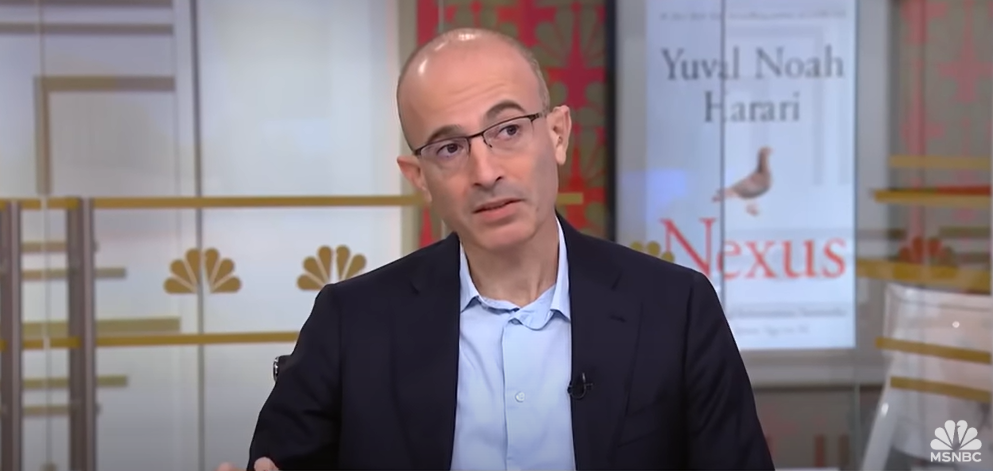
In an insightful interview, acclaimed author Yuval Noah Harari explained how artificial intelligence could dramatically change political systems around the world. According to him, we are just scratching the surface of this new application in the use of AI as it advances in its role within democratic discourses.
Harari pointed out a critical shift in AI’s capabilities: “Now, AI is the first technology in history that can actually make decisions by itself and create new ideas by itself. It can create text and images and videos and so forth. We are just seeing the beginning of this new wave.”
This poses unprecedented challenges to the democratic process.
“Democracy is a group of people talking with each other,” he said, before continuing: “Now, imagine these joining the conversation, speaking eloquently and emotionally, and you can’t tell the difference. You don’t know who in the circle is a human being and who is a robot.”
The author drew attention to AI’s unique ability to forge intimate connections with users, a feature that sets it apart from previous technologies.
“The other thing that AI is capable of doing, which no previous technology could, is create intimate relationships with human beings, hold conversations with them,” he stated.
This blurring of lines between human and machine-generated content threatens the very foundation of democratic discourse. As AI-generated personas become increasingly sophisticated, distinguishing genuine human interaction from artificial constructs becomes nearly impossible, especially in digital spaces.
Harari doesn’t just sound the alarm; he also proposes solutions.
“One obvious decision is to ban fake humans,” suggested Harari. “You know, previously, in history, we banned fake money because it was possible to counterfeit money. Nobody ever bothered to ban fake people because there was not the technology to create fake people. Now, we have the technology to create fake people, so politicians should ban this.”
However, Harari acknowledged the political challenges in implementing such measures, particularly in a polarized environment. He noted that this issue should transcend party lines: “We have our differences, but when it comes to humans versus the robots, everybody should be on the same side.”
The author also explores AI’s potential impact on authoritarian regimes, suggesting that while these systems may seem better equipped to control information flow, they face unique vulnerabilities. Harari explained: “For AI to manipulate a single dictator, it is much, much easier than to manipulate a democratic structure. You basically need to figure out this one extremely paranoid individual, how to press their emotional button, and you have control of the country.”
At this vital moment of technological innovation versus democracy preservation, Harari’s views awake us. The problem lies not in the responsible development of AI but also in the adaptation of our political and social structures to protect the basic essence of human discourse in a world that is becoming increasingly driven by AI.
Featured image: Credit: MSNBC