Insider Brief
- Virginia, Ohio, Tennessee, Georgia and Texas rank as the five U.S. states best positioned for AI data center growth, according to a TRG Datacenters study weighing capacity, electricity use and environmental pressures.
- Virginia ranked first despite not having the most facilities or capacity, while Ohio led the study in total AI data center power capacity at 1,410 megawatts.
- Texas ranked fifth despite having the most large AI data center sites, in part because nearly 59% of its mapped facilities are located in high water stress areas.
The best U.S. states for AI data center growth aren’t necessarily those with the most facilities, as access to electricity, water and room for expansion increasingly shape where the next wave of computing infrastructure can be built.
Virginia, Ohio, Tennessee, Georgia and Texas rank as the five states best positioned for AI infrastructure growth, according to a new study from data infrastructure provider TRG Datacenters. The analysis examined 24 states that already have significant AI infrastructure and compared their existing computing capacity with electricity use and environmental pressures.
The ranking offers a snapshot of a fast-changing U.S. data center map as technology companies race to secure the computing power needed to train and run artificial intelligence systems. AI infrastructure investment could exceed $3 trillion by 2030, according to estimates cited by TRG.
But building that infrastructure requires more than servers and computer chips.
Large AI data centers can demand hundreds of megawatts of electricity, putting them in the same general power-consumption range as substantial industrial facilities. They also generate large amounts of heat, creating cooling requirements that can increase water demand in some facilities.
Those constraints are making geography increasingly important to the AI industry.
TRG compared states using the number of large AI data center sites, total AI data center power capacity and the percentage of statewide electricity consumed by the facilities. The study also considered estimated carbon dioxide emissions and the share of mapped data centers located in areas experiencing high water stress.
Lower environmental impacts improved a state’s ranking.
The result is a list that looks different from one based solely on the number of data centers.
The Top States for AI Data Centers
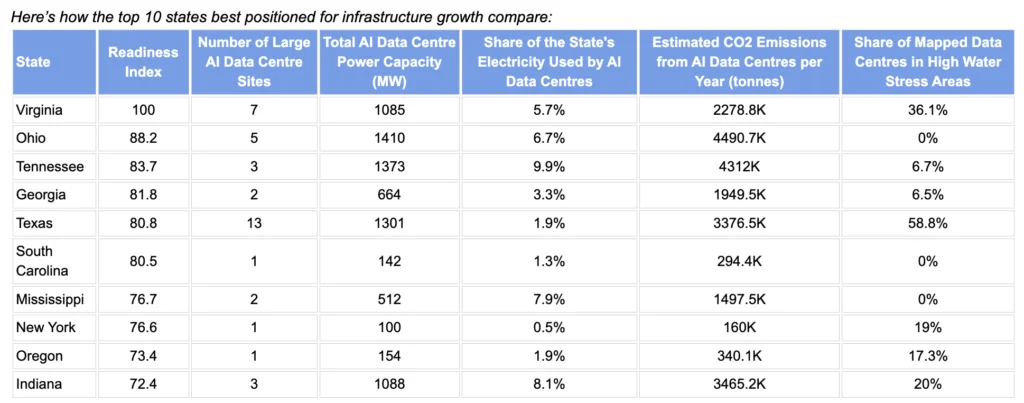
Virginia ranked first with a readiness index of 100, followed by Ohio at 88.2, Tennessee at 83.7, Georgia at 81.8 and Texas at 80.8.
South Carolina ranked sixth, followed by Mississippi, New York, Oregon and Indiana.
Virginia has seven large AI data center sites with a combined power capacity of 1,085 megawatts, according to TRG. The study estimates those facilities consume 5.7% of the state’s electricity and generate about 2.28 million metric tons of carbon dioxide annually.
That combination helped Virginia take the top position even though it doesn’t lead the country in either the number of major AI facilities or total power capacity.
Ohio has more capacity.
The state’s five large AI data center sites have a combined capacity of 1,410 megawatts, the highest figure among the states in the study. TRG estimates they consume 6.7% of Ohio’s electricity.
Ohio also scored well because none of the mapped data centers included in the study were located in areas experiencing high water stress.
Its weakness is emissions. TRG estimates Ohio’s AI data centers generate about 4.49 million metric tons of carbon dioxide annually, nearly twice the Virginia estimate.
Tennessee ranked third despite having only three large AI data center sites. Those facilities have a combined capacity of 1,373 megawatts, placing the state just behind Ohio in total capacity.
The trade-off is electricity consumption. TRG estimates Tennessee’s AI data centers consume 9.9% of the state’s electricity, the highest percentage among the top five states.
Georgia offers a different profile.
Its two large AI data center sites provide 664 megawatts of capacity and consume about 3.3% of statewide electricity. TRG estimates they produce about 1.95 million metric tons of carbon dioxide annually, the lowest total among the five highest-ranking states.
Only 6.5% of Georgia’s mapped data centers were located in high water stress areas.
Texas Shows Why Size Isn’t Everything
Texas illustrates why measuring the best states for data centers is becoming more complicated.
The state has 13 large AI data center sites, the most of any state identified in the study, and 1,301 megawatts of capacity.
Yet Texas ranked fifth rather than first.
One of its advantages is the scale of its electricity system. Existing AI data centers account for an estimated 1.9% of statewide electricity consumption, according to TRG, considerably less than the corresponding shares in Virginia, Ohio or Tennessee.
Its potential constraint is water.
About 58.8% of the Texas data centers mapped by TRG are located in high water stress areas, the highest proportion among the top five states.
That contrast highlights a central issue facing the data center industry. A state may have abundant land, electricity and existing infrastructure but still face limits on expansion if large computing facilities compete for constrained local resources.
An AI development analyst from TRG Datacenters said those effects should be considered when evaluating future projects.
“AI can be supported and developed without spending the resources communities around data centers desperately need. When a data center takes all its water from a region that already doesn’t have enough, it is hard to talk about how productive or innovative its projects are. That’s what needs to be assessed first: how much electricity new infrastructure will take from the residents, and how much water. Any negative impact should be considered in close detail, not treated as an inevitability.”
Electricity Is Becoming an AI Constraint
The rapid growth of generative AI is changing what companies need from data centers.
Traditional data centers were designed to handle a wide range of computing and storage tasks. AI facilities increasingly use dense clusters of graphics processing units, or GPUs, and other specialized chips capable of performing many calculations at once.
Training large AI models can require thousands of these processors operating together.
That means the industry’s expansion is becoming closely tied to the availability of electricity. TRG itself notes that the growth of AI computing is putting additional pressure on power grids and changing data center design, including greater use of high-density equipment and liquid cooling.
The study’s rankings show how differently those demands are distributed.
New York, which ranked eighth, has only one large AI site included in the study, with 100 megawatts of capacity. The facility accounts for an estimated 0.5% of statewide electricity consumption.
Indiana, ranked 10th, has three sites totaling 1,088 megawatts, but they consume an estimated 8.1% of statewide electricity.
Mississippi has two sites with 512 megawatts of capacity, equivalent to an estimated 7.9% of statewide electricity consumption. None of its mapped facilities were in high water stress areas.
South Carolina also had no mapped facilities in high water stress areas, but its single large site provides only 142 megawatts of capacity.
Those differences suggest there is no single measure that determines which states are best for AI data centers.
The Next Data Center Race Is About Resources
For years, data center locations were heavily influenced by factors such as inexpensive land, tax incentives, access to fiber-optic networks and proximity to major customers.
AI is adding power and cooling capacity to that calculation.
The largest AI facilities planned today can require electricity on a scale that forces developers to negotiate directly with utilities over new generation and transmission infrastructure. At the same time, communities and regulators are paying closer attention to how data centers affect electricity prices, water supplies and carbon emissions.
That could alter the geography of the U.S. data center industry.
Established hubs such as Virginia and Texas retain major advantages because they already have large concentrations of infrastructure, operators and network connections. But states such as Ohio, Tennessee, Georgia, Mississippi and Indiana have emerged as significant markets as developers look for locations capable of supporting much larger computing facilities.
The TRG ranking should be read as an assessment based on its selected measures rather than a definitive forecast of where AI companies will build next. Factors including electricity prices, utility interconnection queues, tax policies, available land, construction costs and future power projects can also influence individual data center decisions.
The study nevertheless points to a broader change in the AI race.
Computing power is physical infrastructure. The servers behind AI systems have to be built somewhere, connected to the grid and kept cool around the clock.
As investment accelerates, the states that benefit most may not simply be those that attract the greatest number of data centers. They may be the ones that can provide enough electricity, water and infrastructure to support AI growth without exhausting the resources needed by the communities around them.