Dyna Robotics has launched Dyna 2.1, a semi-humanoid robot designed to autonomously complete full commercial work such as laundry shifts, food preparation and data-center tasks.
According to Dyna, the robot is being deployed in hotels, laundromats and restaurants and ather than automating a single task, Dyna 2.1 is designed to handle sequences of physical jobs requiring manipulation, mobility and reasoning over hours of continuous operation.
The Robot
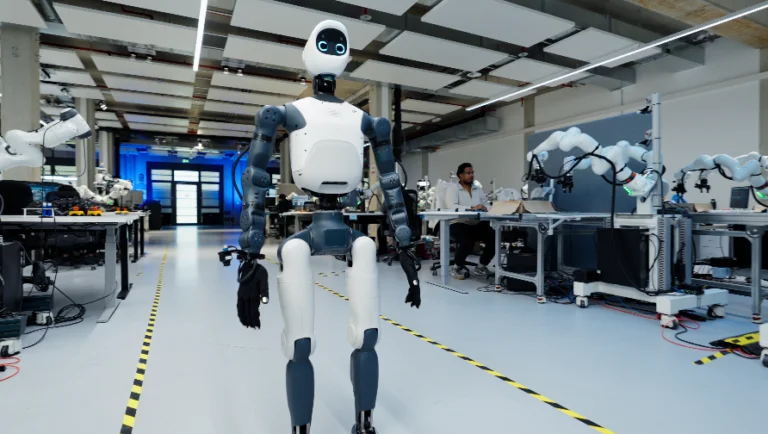
Dyna 2.1 combines an upper torso and two arms with a wheeled mobile base. Its arms can use parallel-jaw grippers or dexterous hands, while four steerable wheels allow the robot to move without the balance requirements of a legged humanoid.
Key hardware and software features include:
- Two arms compatible with parallel-jaw grippers or dexterous hands
- Four steerable wheels for mobile operation
- A vision-language orchestrator for reasoning through multi-step workflows
- A whole-body controller coordinating driving, reaching, bending and lifting
- Dyna 2 world action model trained on 1 million hours of human and robot data
“Our goal is to make general purpose robots commercially viable for real-world scenarios,” noted co-founder and CEO Lindon Gao. “Our customers need robots that complete an entire workflow for a full shift — without human babysitters — not just specific tasks.”
Taking on a Laundry Shift
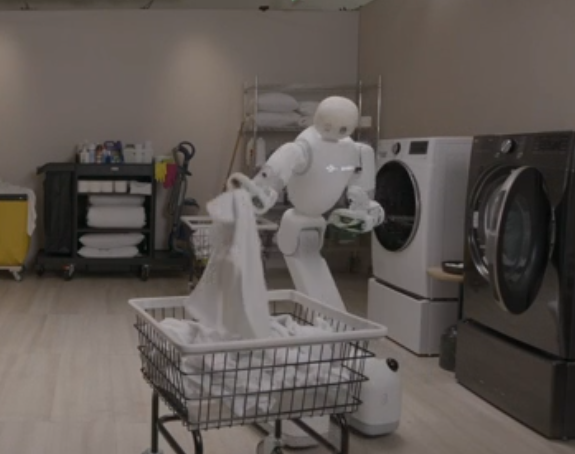
Dyna demonstrated Dyna 2.1 performing an end-to-end commercial laundry work.
The robot can load washers and dryers and activate the machines, retrieve towels from the back of a dryer, carry them in a basket and prepare them for storage. According to Dyna, it can snap towels flat, fold them and organize stacks according to size before placing them on shelves at different heights.
Dyna 2.1 is also designed to recover from physical errors on its own. Dyna said the robot can retrieve a dropped towel or abandon an unsuccessful grasp and attempt the action again without asking a person for assistance. The company indicated it is also optimizing the system around mean time between interventions, or MTBI, which measures how long a robot can continue working before a person needs to step in.
As Dyna 2.1 operates, it records information ranging from the reasoning system’s decisions to joint loads generated by the controller. Dyna said that operating data is fed back into the system to improve performance and increase the amount of work the robot can complete between human interventions.