Tesla Begins Optimus Production in Fremont, Working Toward 20K Robots Per Week
 By Greg Bock · · 4 min read
Insider Brief
- Tesla says it has started building Optimus humanoid robots on a high-volume line in Fremont, Calif.
- CEO Elon Musk said on the earnings call that reaching 20,000 robots a week will take at least a year and that deliveries to outside companies should begin around the end of 2027.
- Tesla began giving Robotaxi rides in Cybercabs in Austin on Sept. 3 and reported nearly 2 million cumulative unsupervised miles for the service, eight times the prior-quarter total.
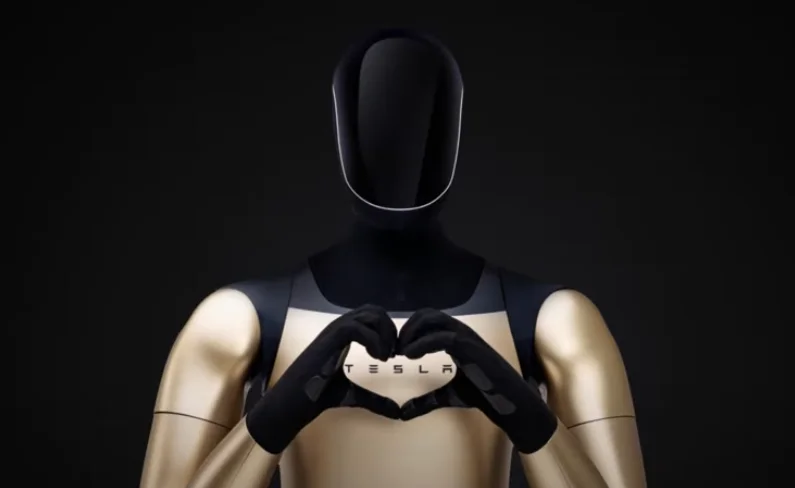
Tesla has started producing what it calls production-quality Optimus humanoids in Fremont, Calif., with Elon Musk saying the company is working toward output of roughly 20,000 robots a week.
The company reported the start of production in its third-quarter update, adding that it will keep changing the hardware and the manufacturing process but has shown the current process can support a commercial product. Tesla did not provide a current Optimus production count and the update’s capacity table lists the Fremont Optimus line as in an early ramp with no capacity figure. A second Optimus site in Texas as under construction.
Musk offered a longer timeline on the call. Most of a line built to turn out 1 million robots a year has already landed in Fremont, he said, but getting to that rate of roughly 20,000 units a week will probably take at least a year because parts of the design are still changing. He expects the remaining AI and hardware problems, including how long a robot can work before wearing out, to be solved around the end of 2027. That is when Musk said Tesla would start delivering Optimus to other companies, beginning with dangerous or repetitive industrial jobs that need to run around the clock. Robots for the home would come later as production grows.
Sooner than that, Tesla may release a video in a month or two showing Optimus doing tasks that are not pre-programmed, Musk said. The company plans to put its AI5 chip, which he described as carrying roughly an order of magnitude more compute than the current AI4, into the robot around April 2027. He added that Tesla needs on the order of 10,000 or 20,000 bots practicing tasks to generate enough training data and is building an Optimus Academy for that work.
Cybercab
Cybercab rides on the company’s Robotaxi service started in Austin on Sept. 3, and the update put cumulative unsupervised Robotaxi miles at nearly 2 million by quarter’s end. Austin service now runs from 6 a.m. to midnight. Tesla lists installed capacity for its Cybercab line in Texas at more than 125,000 vehicles a year, a figure it cautioned does not equal the current production rate. Musk said the Austin Cybercab fleet has grown tenfold since launch, though the current fleet size was not given.
Ashok Elluswamy, Tesla’s vice president of AI, said Cybercab service will launch in Dallas next month and customer-owned cars could start joining the Robotaxi fleet around the second quarter of 2027. Tesla is trying to get Cybercabs to customers by the end of 2026, according to Lars Moravy, vice president of vehicle engineering, though every unit coming off the Texas line currently goes to the company’s own fleet. Musk add the “vast majority” would be Tesla owned and offered through transportation-as-a-service with “our other cars would be more the cars that you would want to own.”
The National Highway Traffic Safety Administration opened an audit query in September into Tesla’s certification that the Cybercab meets all applicable Federal Motor Vehicle Safety Standards. According to the agency, the inquiry will look at the technical data and processes Tesla relied on to certify a vehicle without traditional human controls, including whether the company treated some standard requirements as not applying to its automated vehicles.
Tesla reported that active subscriptions to FSD (Supervised), which requires a driver to keep watching the road, rose 67% from a year earlier to 1.74 million, and the software is now approved in nine EU countries. To train both its driving and humanoid software, Tesla plans to reach 400 megawatts of training compute by year-end.
Bottom Line
Revenue for the quarter was $28.05 billion, roughly flat from a year earlier. Net income attributable to common stockholders fell 43% to $787 million and operating margin slipped to 2.6% as operating expenses climbed 39%, an increase Tesla (Nasdaq: TSLA) tied to SI and other R&D projects, stock-based compensation and selling, general and administrative expenses. Free cash flow came to $1.53 billion. Chief Financial Officer Vaibhav Taneja said 2026 capital spending should total about $20 billion.