Tutor Intelligence Raises $75M in Series B Funding to Expand Robot Production and AI Training
 By Greg Bock · · 3 min read
Insider Brief
- Tutor Intelligence has raised $75 million in Series B funding led by Andreessen Horowitz to expand robot production and deployment and develop AI models trained on real-world manufacturing and warehouse tasks.
- The round brings total funding to $117 million, with Union Square Ventures and Neo also participating, as Tutor aims to have more than 1,000 robots under contract by the end of 2027.
- Tutor’s robots collect operational data to improve their AI models, while customers pay by the hour or item picked without upfront equipment purchases or long-term contracts.
Tutor Intelligence has raised $75 million in Series B funding led by Andreessen Horowitz to expand production and deployment of its robots while developing AI models trained on work performed in factories and warehouses.
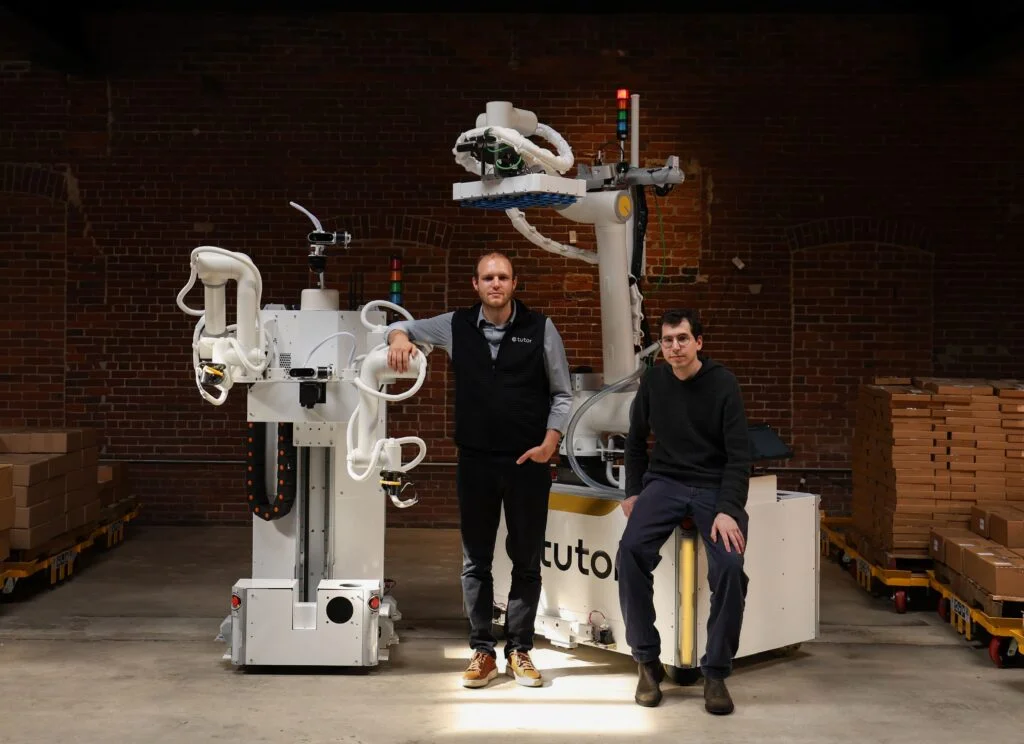
The investment brings its total funding to $117 million. Union Square Ventures and Neo, which led Tutor’s Series A and seed rounds, respectively, also participated According to Tutor, the funding will go into research into robot foundation models, along with manufacturing and deployment of Tutor’s Sonny and Cassie robots.
Tutor develops its own robots and AI software, using data collected from customer operations to improve how its machines perform different tasks. Tutor’s approach combines robot deployments with ongoing AI training and its internet-connected robots work in manufacturing and logistics, handling tasks such as lifting, moving and manipulating goods. Remote human operators, known as tutors, provide assistance when needed.
Its robots currently operate in major U.S. manufacturing and logistics networks, handling consumer goods that include cereals, snacks, candy, cosmetics and toys.
The Massachusetts startup pointed out that the robots collect data as they work, which Tutor uses to train its AI models. Updated models can then be distributed to the company’s robot fleet, allowing the systems to take on additional tasks as their capabilities improve.
Tutor reported that its robots are now operating in almost four times as many facilities as a year ago. The company said it is on track to have more than 1,000 robots under contract by the end of 2027, with all systems built in and deployed from the United States.
Usage-Based Robots-as-a-Service
Rather than requiring customers to purchase robots, Tutor charges for work by the hour or by the item picked. Customers do not have to make an upfront equipment purchase or sign long-term contracts. Tutor handles deployment, maintenance and regular software updates.
The company also reported repeat business among its customers. Nearly one-third of organizations that received Tutor robots during the past 12 months were existing customers adding more machines to their operations.
Raghu Raghuram, general partner at Andreessen Horowitz and former CEO of VMware, said Tutor’s approach treats real-world robot deployment not simply as the end goal of research, but as a way to address its limitations.
“With each deployment in a real scenario, Tutor could work backwards to create their model from the deployment data,” Raghuram noted in an a16z blog post. “The approach offers a win-win for customers and Tutor. For customers, the operating model delivers value right away. For Tutor, the company is able to collect the training data that really matters and build an increasingly capable model, cost efficiently. Every robot put to work makes the next robot smarter, cheaper, and easier to deploy.”
Founded out of MIT’s Computer Science and Artificial Intelligence Laboratory, Tutor is led by co-founder and CEO Josh Gruenstein, who founded the company with Alon Kosowsky-Sachs.
“It’s not only that Tutor’s models let robots do jobs that robots have never been able to do before,” Gruenstein said. “This type of intelligence also makes robots affordable on a whole new level. We’re unlocking much broader access to the solutions that businesses need to survive and that make basic goods cheaper for everybody. And the demand is there. We can hardly build robots fast enough.”