Galileo Robotics Deploys Quadruped Robot for Warehouse Inspections in Poland
 By Greg Bock · · 2 min read
Insider Brief
- China’s Galileo Robotics has deployed its C1-W quadruped robot at a logistics park in Poznan, Poland, to automate warehouse inspections and security patrols.
- The system is designed to address labor shortages, high staffing costs, inspection gaps and limited recordkeeping, with the facility shifting from two manual patrol shifts daily to robotic patrols every three hours.
- Galileo reported that the robot has logged more than 400 operating hours, covering over 2,000 square meters of warehouse space, while reducing response times to detected problems from hours to minutes.
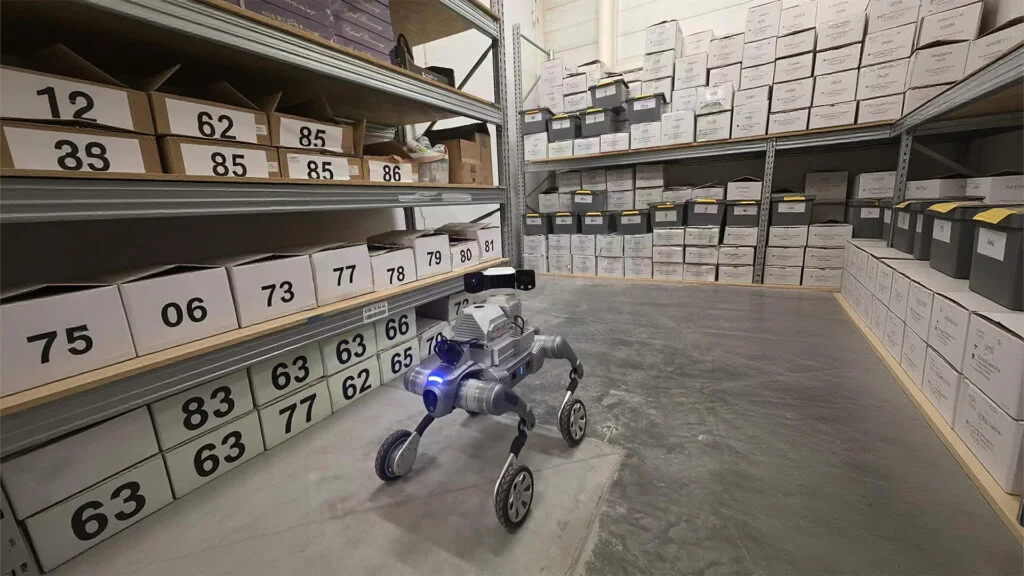
China‘s Galileo Robotics has deployed its C1-W quadruped robot at a logistics park in Poznan, Poland, to automate warehouse inspections and security patrols.
According to the company, developed with a local Polish company, the system uses the four-legged robot to patrol warehouse aisles and loading areas, collecting information about operating conditions and identifying potential problems.
Poznan is a major European logistics hub with numerous large warehouse facilities and according to Galileo, traditional security patrols face several challenges such as high labor costs, shortages of night-shift workers, infrequent inspections, areas that go unchecked and limited records of patrol activity. The company’s robotic system is designed to address those problems through regular automated inspections, more complete coverage and digital records that operators can review.
Galileo said the facility has moved from two manual patrol shifts a day to robotic patrols every three hours with the response times to detected problems falling from hours to minutes. The robot has logged more than 400 hours of operation, covering over 2,000 square meters of storage space and 2,250 meters of shelving, Galileo reported.
Galileo’s C1-W
The C1-W uses autonomous navigation to move through warehouse environments, collecting visual, thermal and acoustic information to identify potential risks. The data is transmitted to a central platform where operators can review inspection records and analyze conditions.
Designed for industrial use, the robot has an IP65 protection rating, operates in temperatures ranging from minus 20°C to 55°C and can climb slopes of up to 30 degrees, according to the company.
Galileo noted that the system can be customized for local operating requirements and plans to work with partners to expand deployments to additional European warehouses.