
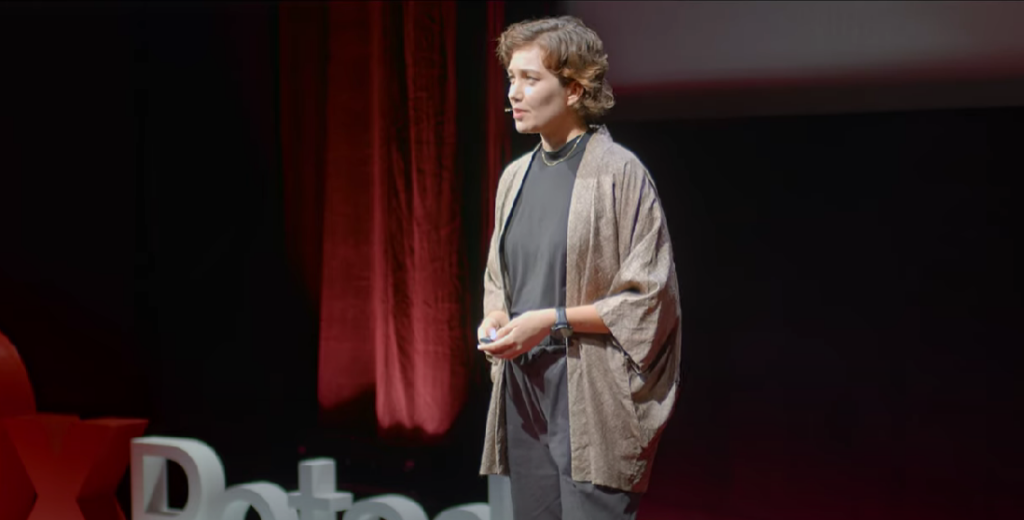
In an era where the buzz around Artificial Intelligence (AI) oscillates between utopian promise and dystopian warning, Josefine Hintz’s TEDxPotsdam talk, Why We Should Care About AI to Tackle the Climate Crisis, serves as a necessary interjection. With sarcasm, one might suggest: “Oh, let AI save us from climate apocalypse — because clearly, changing human behavior is off the table.” Indeed, as Hintz elaborated, the conundrum isn’t merely about whether AI can assist in climate action but about the scale of its potential impact and the environmental and social cost of its deployment.
Amidst the powerful narratives that cast AI as either the hero we don’t deserve or the harbinger of mankind’s obsolescence, Hintz invites us to a grounded discussion on AI’s role in urban sustainability and climate action.
“AI can be used to predict and to analyze,” she said, encapsulating the technology’s potential in fields ranging from financial trends to the detection of oil spills. However, she quickly underscores, “that wasn’t really the climate action that I was looking for.”
Hintz’s journey into the realm of AI and sustainability began with a podcast that painted AI as a disruptor of everything. This moment of enlightenment, coupled with her academic pursuit at University College London, catalyzed a deep dive into how AI might intersect with climate action. Her findings, however, painted a complex picture:
“AI is actually not that artificial after all,” she stated. This points to the tangible environmental and social impacts of AI’s implementation — from the extraction of rare earth elements to the often exploitative labor conditions in the global South.
The revelation of AI’s darker undertones doesn’t deter Hintz; instead, it sharpens her focus on leveraging AI responsibly.
“What gave me hope was my work with cities and governments,” she said, which draws attention to the possibilities of transforming harmful systems and utilizing AI in service of reducing urban emissions. Cities, responsible for a staggering 70% of global greenhouse gas emissions, emerge as pivotal arenas for AI-enabled climate action.
Hintz presented urban planning and transport as critical sectors where AI can significantly contribute to sustainability. From optimizing district heating and cooling networks to enhancing public transport and cycling infrastructure, AI possesses the capability to refine urban energy consumption and mobility patterns. However, the path from potential to implementation is fraught with challenges.
“Only a few [cities] have the capacity and resources to take this long and winding path,” said Hintz, noting the gaps in expertise, finance and political will that currently hinder broader adoption of AI for climate action.
Amidst the technical potential and ethical pitfalls of AI, Hintz’s message is clear: AI should be viewed as a tool, not a panacea, for the climate crisis. The critical task ahead is not to shun or blindly embrace AI but to navigate its application thoughtfully and inclusively.
“Let’s understand AI as a tool and not the fix,” she said, advocating for interdisciplinary collaboration to ensure AI’s deployment in climate action is both effective and equitable.
In the end, Hintz’s call to action resonates beyond the technical community to all stakeholders in society: “look at how you can bring in your perspective, how you can be courageous because we need you.” Her talk is not just an assessment of AI’s potential in combating the climate crisis but a reminder of the collective responsibility and critical engagement required to steer technological advancement toward a sustainable future.
As we stand at the crossroads of technological innovation and environmental stewardship, Hintz’s insights compel us to consider not just the capabilities of AI but the values and visions that guide its development and deployment. The future of AI in climate action, as Hintz poignantly encapsulates, hinges not on the sophistication of algorithms but on the wisdom with which we wield them for the common good.
Featured image: Credit: TEDx Talks