Where AI Software Spending Could Go by 2035: Three Scenarios and the Assumptions Behind Them
 By James Dargan · · 5 min read
The outlook to 2035
ABOUT THESE FIGURES. Figures are estimates from AI Insider’s AI Market Model, H1 2026 edition, updated Nov. 3, 2026 for Anthropic’s S-1 filing. They are annualized run rates sized from company disclosures, filings and other evidence, with ranges, and are not audited company results. This article is for informational purposes and is not investment advice.
Insider Brief
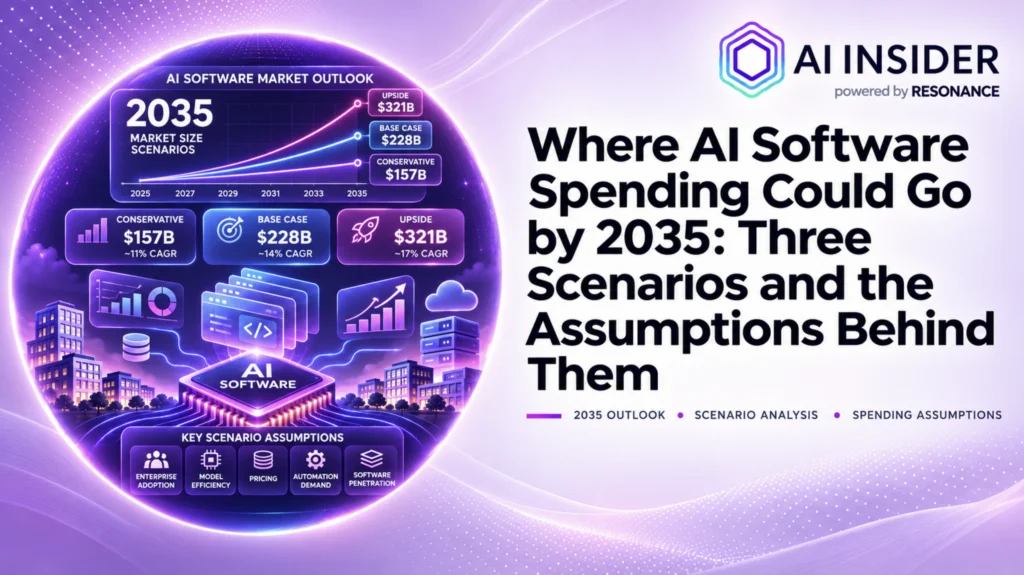
- In the base case of AI Insider’s AI Market Model, end-customer AI software spending grows from about $144 billion annualized in 2026 to about $564 billion in 2030 and about $1.23 trillion in 2035.
- A lower case reaches about $629 billion by 2035 and a higher case about $2.19 trillion; the gap reflects how uncertain the pace of adoption is.
- The three cases differ in only three assumptions: how much of software spending AI could eventually reach, how fast adoption happens and how fast software spending itself grows.
Projections of AI spending often arrive as a single number with a confident growth rate. AI Insider’s AI Market Modeltakes a different route. It starts from its estimate of today’s market, about $144 billion a year in the first half of 2026, and sets out three scenarios to 2035. They are built on stated assumptions, not offered as forecasts. This second article in the series explains how they work.
The approach mirrors one governments use. The UK Government Office for Science‘s AI Scenarios 2030 groups five futures under three trajectories in which AI progress slows, continues or takes off, and stresses that the real outcome will likely mix elements of several.
HOW ARE THE SCENARIOS BUILT?
The model treats AI software as a share of all software spending, and two things move. Global software spending, about $1.44 trillion in 2026, grows at an assumed rate. AI’s share of that spending, about 10% today, rises along an S-shaped adoption curve toward an assumed ceiling.
Technologies typically spread this way: slowly, then faster, then slowly again near saturation. Anchoring the curve to today’s share means each scenario needs only three inputs.
WHAT ASSUMPTIONS SEPARATE THE THREE PATHS?
| Assumption | Lower | Base | Higher |
|---|---|---|---|
| Ceiling share of software spend AI could reach | 25% | 40% | 55% |
| Software spend growth a year, 2026 to 2030 | 10% | 12% | 15% |
| Software spend growth a year, 2030 to 2035 | 6% | 8% | 10% |
The ceiling matters most. At 25%, AI becomes a large category within software but most spending stays on conventional products. At 55%, most new software spending goes to AI products. Nobody knows which is closer to the truth, which is why the model shows both alongside a middle case.
WHAT DO THE THREE PATHS LOOK LIKE?
| End-customer AI software spend, annualized | Lower | Base | Higher |
|---|---|---|---|
| 2026 | $144bn | $144bn | $144bn |
| 2030 | $353bn | $564bn | $983bn |
| 2035 | $629bn | $1,230bn | $2,186bn |
| AI share of software spend, 2030 | 17% | 25% | 39% |
| AI share of software spend, 2035 | 22% | 37% | 54% |
In every case, growth slows as AI’s share nears its ceiling. In the base case, annual growth starts above 40% and falls to around 12% by 2035. From the same 2026 starting point, the lower and higher paths are more than three times apart by 2035.
HOW DO OTHER FORECASTERS SEE IT?
In its Wave 11 survey, the Forecasting Research Institute‘s expert panel found the median superforecaster expecting OpenAI and Anthropic to reach a combined run rate of about $300 billion by 2030, with a 34% chance of exceeding $400 billion and an 18% chance of staying below $100 billion. Company revenue is not like-for-like with the model, which removes sales between AI vendors, but the width of the distribution tells a similar story.
The panel’s reasoning also maps onto the ceiling assumption. Forecasters with high estimates argued that AI products will be priced against the cost of a worker rather than a software seat, while those with low estimates tied revenue to existing software budgets.
WHY SHOW THREE PATHS RATHER THAN ONE?
The future depends on decisions not yet made: how many businesses move AI from pilots into everyday use, how quickly agents take on whole tasks, and how prices change as models become more efficient. Falling prices could expand use or hold spending down.
A single number would hide that uncertainty. A reader who expects AI to remain a feature inside existing software will lean toward the lower path; one who expects AI products to take most new software budgets will lean toward the higher. The full report places the three paths beside published bank and broker forecasts.
WHAT WOULD SHIFT THE PICTURE?
Three kinds of evidence would move the model between paths: how much business AI spending reaches everyday use at scale, price per task and whether lower prices bring more use, and the growth of software budgets themselves.
New disclosures feed in each quarter. Anthropic‘s S-1 filing, for example, reported third-quarter 2026 revenue of $16.96 billion, broadly in line with the run rate the model already held for the company.
The full H1 2026 report and the Excel dataset, including the scenario inputs, are available from AI Insider Intelligence.
ABOUT THESE FIGURES. Figures are estimates from AI Insider’s AI Market Model, H1 2026 edition, updated Nov. 3, 2026 for Anthropic’s S-1 filing. They are annualized run rates sized from company disclosures, filings and other evidence, with ranges, and are not audited company results. This article is for informational purposes and is not investment advice.
REFERENCES
- AI Insider, AI Market Model, H1 2026 edition, updated Nov. 3, 2026 (Outlook and Assumptions). https://theaiinsider.tech/intelligence/ai-market-model/
- AI Insider, “How Big Is the AI Software Market? A Bottom-Up Estimate Puts It Near $144B,” Nov. 13, 2026. https://theaiinsider.tech/2026/11/13/how-big-is-the-ai-software-market-a-bottom-up-estimate-puts-it-near-144b/
- Gartner, global software spending forecast for 2026 ($1.44 trillion), via free reprint, as used in the model.
- Anthropic PBC, Form S-1/A, Amendment No. 1, Nov. 2, 2026 (third-quarter revenue).
- Government Office for Science, “AI Scenarios 2030: Helping policymakers plan for the future of AI,” June 15, 2026. https://www.gov.uk/government/publications/ai-scenarios-2030-helping-policymakers-plan-for-the-future-of-ai/ai-scenarios-2030-helping-policymakers-plan-for-the-future-of-ai
- Forecasting Research Institute, Longitudinal Expert AI Panel, “Wave 11: AI Industry Economics,” Aug. 27, 2026. https://leap.forecastingresearch.org/reports/wave11