Insider Brief
- Researchers developed a small vehicle equipped with AI and sensors that can pick up signals about the child’s emotional state, and react accordingly.
- AI and sensors in the robotic car can capture the child’s facial expressions, heart rate and breathing patterns and adapt to how the child is feeling by changing the music, or colours, or producing smells to help them relax.
- The project is an example of affective computing and social robotics.
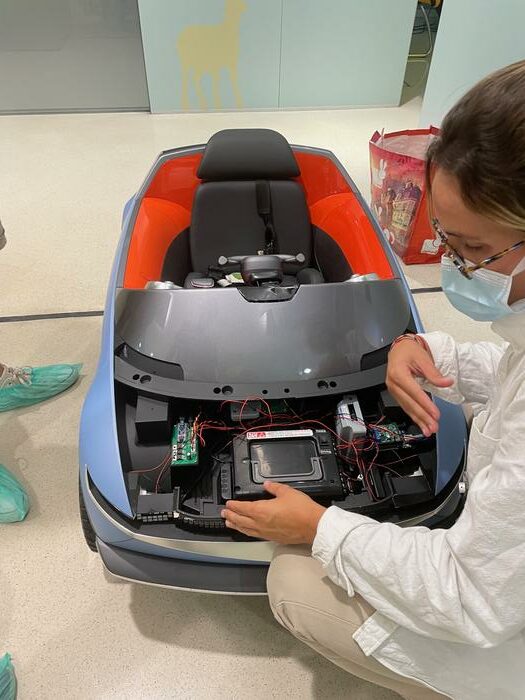
- Image: The participants involved in designing the vehicle included doctors, nurses and experts in affective computing, social robotics, data science, sensor design, machine learning and computer vision. Credit: Àgata Lapedriza, Universitat Oberta de Catalunya (UOC)
PRESS RELEASE — Undergoing medical treatment, having surgery or simply being admitted to hospital are situations that make children fearful and anxious, especially during early childhood. And in addition to having a short-term impact, their subsequent psychological, social and educational development may also be affected.
To overcome this problem, an international team of researchers working with Sant Joan de Déu Barcelona Children’s Hospital have developed and tested a small robot vehicle which aims to reduce stress among children aged between 3 and 10 years old before they undergo minor surgical procedures.
According to the results of this first pilot test, this type of robot could be a successful strategy for reducing anxiety and fear before surgery, and could be an effective alternative to the medication strategies commonly used to relax children.
This first prototype also provides information about the potential and challenges involved in integrating affective technologies in paediatric hospital environments.
“Children are admitted to a hospital, which is already an unwelcoming environment for them, and they have to go with people they don’t know, like medical staff, and undergo unpleasant procedures, such as an injection. This all creates situations of stress which can end up causing chronic pain in the long term,” explained Jordi Albo, the scientific director of Lighthouse DIG and co-principal investigator of the project.
“We try to minimize the stress that children experience during this process by using a robot car that changes colour, makes music and creates smells, and talks to them and interacts with them,” added this expert in social robots. “We try to minimize the stress that children experience during this process by using a robot car that changes colour, makes music and creates smells, and talks to them and interacts with them”
Children’s stress before surgery
According to a study conducted by Sant Joan de Déu Barcelona Children’s Hospital, six out of every ten young patients who have to undergo surgery suffer from stress before they receive anaesthesia. The hospital has explored various alternatives in order to improve the children’s emotional state, ranging from doing activities and playing games with the children before surgery to therapies involving dogs and clowns, and even letting parents into the operating theatre.
However, the most widely used strategy is usually pharmacological, which can paradoxically make the children’s experience even more stressful due to the bitter taste of the drugs used and their side effects.
Previous studies had already shown that using small motorized electric vehicles is effective in reducing children’s unease. The researchers used those results as the basis for developing their prototype, as well as the research on assisted driving for adults that was being carried out at the Massachusetts Institute of Technology (MIT) Media Lab.
“We installed AI and sensors in our robotic car, as well as a surface for interaction. This enables the car to capture the child’s facial expressions, heart rate and breathing patterns, which are indicators of their emotions, and adapt to how the child is feeling by changing the music, or colours, or producing smells to help them relax,” said Àgata Lapedriza, researcher at the Universitat Oberta de Catalunya (UOC), member of its Faculty of Computer Science, Multimedia and Telecommunications, and leader of the Artificial Intelligence for Human Wellbeing (AIWELL) research group at the UOC’s eHealth Center.
The project is an example of affective computing “which focuses on developing AI systems that perceive emotions, understand emotions and can respond to emotions in an emotionally intelligent way”, emphasized Lapedriza, who led the project with Albo.
The participants involved in designing the vehicle included doctors, nurses and experts in affective computing, social robotics, data science, sensor design, machine learning and computer vision. The prototype was manufactured by the Hyundai car company in South Korea, and sent to Sant Joan de Déu Barcelona Children’s Hospital, where it was tested with 86 children between 3 and 9 years old (mean age of 5.23 years) who had to undergo a procedure between December 2020 and May 2023.
Positive effects on both the children and their parents
“Driving the car into the operating theatre had positive effects on both the children and their parents,” said Carmen Jerez, a paediatric nurse at Sant Joan de Déu Barcelona Children’s Hospital. “It gave the children the feeling of control, of being in the driving seat, and having an active role in the process without realizing it, in a way that was fun. The parents were able to walk with them, talking about their driving, and they could see that their child was experiencing less anxiety and fear.”
Despite the pitfalls the project had to address, such as a large proportion of the study taking place during the Covid pandemic and the masks worn by children preventing the sensors from capturing facial expressions, the scientists behind the project, whose results were presented at the Human-Robot Interaction conference in Colorado in mid-March, believe that the smart car has proven that it could be an effective and scalable strategy for reducing children’s stress before surgery.
“The pilot project has enabled us to evaluate the adoption response of this type of technology in a real hospital environment, and to fine-tune the design of the robot, see which sensors are useful and which ones aren’t, and which actions are viable and which ones aren’t,” concluded Lapedriza, who is also a principal research scientist at Northeastern University in Boston (USA).
The next step is to manufacture a new prototype, applying all the conclusions drawn from the pilot test in order to conduct a clinical trial. However, the project is currently on hold due to a lack of funding.
This project contributes to United Nations Sustainable Development Goals (SDGs) 3, Good Health and Well-being