Nvidia Introduces GR00T 2 Robotics Model, New Simulation Tools and Benchmarks at CoRL
 By Greg Bock · · 3 min read
Insider Brief
- Nvidia introduced GR00T 2, an open AI model for complex robotic tasks, alongside new simulation tools and benchmarks at the Conference on Robot Learning in Austin, Texas.
- GR00T 2 achieved a 71% average success rate across 50 tasks with one demonstration per task, rising to 95% with five demonstrations, while Nvidia’s Isaac Lab 3.0 delivered up to 2.5 times faster training throughput in one benchmark.
- Nvidia also introduced industrial robotics benchmarks DexBench and VABAR, while two of its research papers, GRAIL and RoboTTT, were named among six finalists for CoRL’s Best Paper Awards.
Nvidia has introduced GR00T 2, an open AI model designed to help robots learn complex physical tasks, alongside new simulation tools and benchmarks for training and evaluating robotic systems.
Unveiled at the Conference on Robot Learning (CoRL) in Austin, Texas, GR00T 2 achieved a 71% average success rate across 50 tasks with one demonstration per task, increasing to 95% with five demonstrations, according to Nvidia. The model also completed 40 of the 50 tasks at least once without task-specific demonstrations.
Built on Nvidia Cosmos, GR00T 2 uses human and robotic training data, including 100,000 hours of video recorded from a person’s point of view. Nvidia said the model can transfer manipulation skills between robot designs and allow AI agents to combine skills into complex tasks.
Expanding Simulation-Based Training
Nvidia also introduced Isaac Lab 3.0, an update to its open-source robot-learning framework for training and evaluating robots in simulated environments. The software integrates more closely with Newton, an open-source physics engine capable of simulating flexible materials such as cables and cloth, along with complex robotic hands.
Nvidia reported that In one dexterous manipulation benchmark, Isaac Lab 3.0 with Newton achieved up to 2.5 times the training throughput of Isaac Lab 2.3 using PhysX.
Nvidia also presented AlphaNIST, which trains one robotic model to complete 20 precision assembly tasks involving millimeter-scale components. It achieved more than 98% training success, compared with 81% for separate task-specific models, while using approximately 39 times less GPU time.
New Tools for Evaluating Robots
The company introduced two open benchmarks for measuring robot performance under changing conditions:
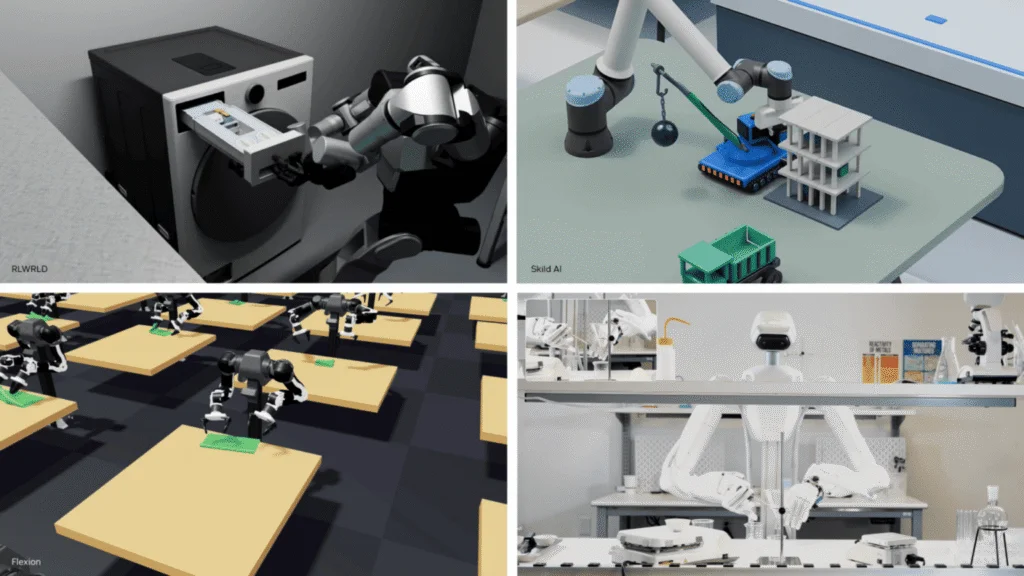
- DexBench: Developed with RLWRLD, it evaluates 15 tasks across retail, logistics, manufacturing and hospitality.
- VABAR: Developed with UC Berkeley, it tests six industrial tasks using standardized variations and difficulty levels.
Both use Nvidia’s Isaac Lab-Arena simulation framework to evaluate robotic systems and identify causes of failure.
UC Berkeley also introduced Graph-as-Policy, which uses AI agents to combine robotic skills into programs and refine them through simulation.
Two Nvidia research papers were among six finalists for CoRL’s Best Paper Awards. GRAIL introduces a system for generating simulated environments for humanoid robot training, while RoboTTT explores how robots can process substantially longer sequences of visual and movement information without increasing the time needed to produce actions.
Robotics Companies Test Nvidia’s New Models and Simulation Tools
Several robotics and industrial companies are working with Nvidia’s new models and simulation software across manufacturing, logistics and other applications.
For GR00T 2, Foxconn is applying the model to server manufacturing, Nexuni is testing robotic laundry handling and Siemens is evaluating industrial uses. MicroAGI is using the model to perform Ethernet cable swapping with a robotic arm, training its control system with Isaac Lab 3.0 and Newton.
Other companies are focusing on simulation-based training. Flexion is using Isaac Lab and Newton to train its Reflect robotics model, while FieldAI is applying Nvidia’s simulation tools to robots operating in unpredictable environments. Dyna Robotics is training controllers for its Taku semi-humanoid, and Walden Robotics is using Isaac Sim for manufacturing and logistics tasks. Dexmate is exploring how AI coding agents can practice robotic movements in simulation before executing them on physical robots.
Skild AI has developed STEEL, a physics solver built on Newton to accelerate robot training.
In robot evaluation, RLWRLD worked with Nvidia to develop DexBench, which Genesis AI and mimic robotics are testing through early access. Bifrost is making the benchmark available through its Manifold simulation platform.
Meanwhile, Ambi Robotics, Bosch Research and Siemens are exploring UC Berkeley’s Graph-as-Policy framework, which uses AI agents and simulation to combine individual robotic skills into more complex programs.
Noitom Robotics also contributed training data for Nvidia’s EgoHand model, which reconstructs three-dimensional hand movements from video.