Wednesday · October 21, 2026

 ·  Daily  ·  Newsletters

Resonance network: Quantum InsiderSpace Insider

Scientists Argue for More FDA Oversight of Healthcare AI Tools

Insider Brief

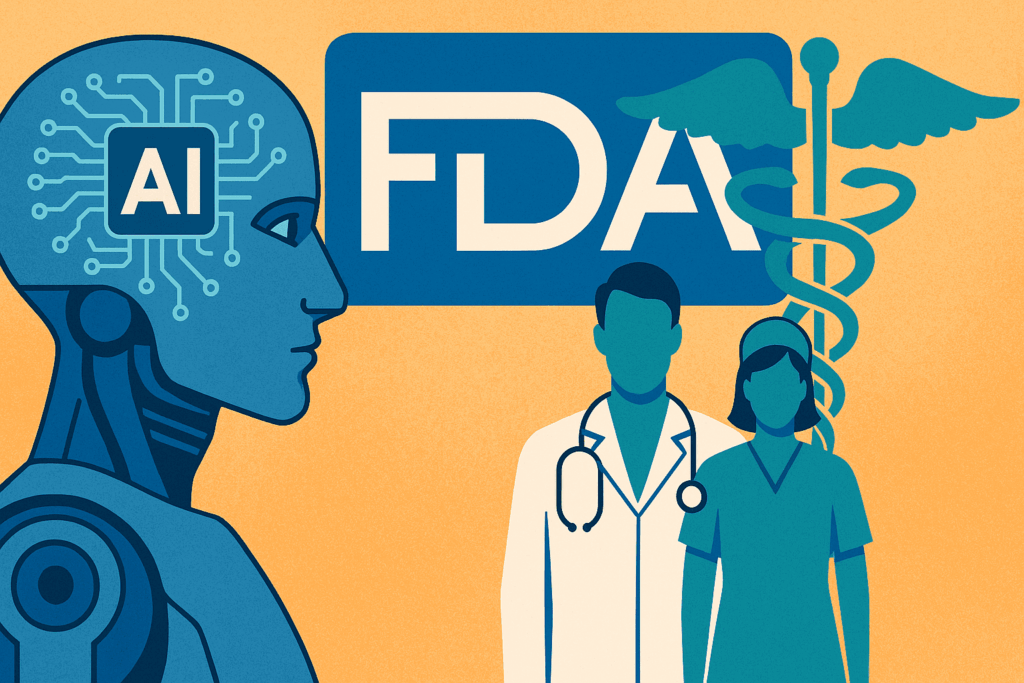
  • A new report published in PLOS Medicine by MIT researcher Leo Celi and colleagues recommends that the FDA adopt an adaptive, transparent, and ethically grounded oversight system for AI-enabled medical technologies.
  • The current regulatory framework lacks mechanisms to monitor how AI tools evolve after approval, raising concerns about transparency, bias, and patient safety, especially for vulnerable populations.
  • The authors propose public performance tracking, training reform, and incentives for ethical compliance as key steps to safeguard innovation without compromising equity or clinical reliability.

PRESS RELEASE – An agile, transparent, and ethics-driven oversight system is needed for the U.S. Food and Drug Administration (FDA) to balance innovation with patient safety when it comes to artificial intelligence-driven medical technologies. That is the takeaway from a new report issued to the FDA, published this week in the open-access journal PLOS Medicine by Leo Celi of the Massachusetts Institute of Technology, and colleagues.

Artificial intelligence is becoming a powerful force in healthcare, helping doctors diagnose diseases, monitor patients, and even recommend treatments. Unlike traditional medical devices, many AI tools continue to learn and change after they’ve been approved, meaning their behavior can shift in unpredictable ways once they’re in use.

In the new paper, Celi and his colleagues argue that the FDA’s current system is not set up to keep tabs on these post-approval changes. Their analysis calls for stronger rules around transparency and bias, especially to protect vulnerable populations. If an algorithm is trained mostly on data from one group of people, it may make mistakes when used with others. The authors recommend that developers be required to share information about how their AI models were trained and tested, and that the FDA involve patients and community advocates more directly in decision-making. They also suggest practical fixes, including creating public data repositories to track how AI performs in the real world, offering tax incentives for companies that follow ethical practices, and training medical students to critically evaluate AI tools.

 “This work has the potential to drive real-world impact by prompting the FDA to rethink existing oversight mechanisms for AI-enabled medical technologies. We advocate for a patient-centered, risk-aware, and continuously adaptive regulatory approach—one that ensures AI remains an asset to clinical practice without compromising safety or exacerbating healthcare disparities,” the authors say.


Greg Bock
About the author
Greg Bock

Greg Bock is an award-winning investigative journalist with more than 25 years of experience in print, digital, and broadcast news. His reporting has spanned crime, politics, business and technology, earning multiple Keystone Awards and a Pennsylvania Association of Broadcasters honors. Through the Associated Press and Nexstar Media Group, his coverage has reached audiences across the United States.

Trending today

Physical AI

Zap Surgical Raises $36M in Funding to Scale Non-Invasive Robotic Brain Surgery

Technology & Infrastructure · Models & LLMs

Skyfall AI Unveils Frontier Engineering World Model SKY-001

A glossy glass cube with the Microsoft logo on a dark surface
Technology & Infrastructure · Applications & agents

Microsoft Adds Guardian Agents to Treat Enterprise AI Agents as Potential Insider Threats

Business & Markets · Enterprise

‘Humanoids Making Humanoids’ as Schaeffler Opens Lighthouse Factory in China

Business & Markets · Enterprise

Anthropic Details AI-Driven Workforce Shift and Commits 5% of Shares to Public Benefit Fund as Replit Moves Default to OpenAI

The AI economy, every weekday morning

The daily briefing on LinkedIn. Free, one tap to follow.

Exclusives

Exclusive

South Korea’s AI G3 Strategy: Decoded

Scale-ups to Watch

10 Switzerland-Based AI Scale-Ups You Need to Know in 2026

network, blockchain, digital, hand, web, community, artificial, intelligence, steering, interfaces, bokeh, future, digitization, transformation, change, blockchain, blockchain, blockchain, blockchain, blockchain, transformation
Exclusive

Why Crypto Could Be AI’s Payment Layer: BlackRock Sees Stablecoins Connecting Commerce and Compute

AI Predictions
Exclusive

Why AI Predictions Often Get The Technology Right But The Timeline Wrong

Scale-ups to Watch

10 CEE & Baltics-Based AI Scale-Ups You Need to Know in 2026

More in Business & Markets

Latest from the same section
a purple and green background with intertwined circles
Business & Markets · Enterprise

OpenAI Adds Locked Chats to ChatGPT and Acquires Orchestra Bio to Strengthen Life Sciences AI

2 hours ago
Technology & Infrastructure · Applications & agents

Meta’s Muse AI Agent Hits 10M U.S. Downloads in First 40 Days

3 hours ago
Business & Markets · Enterprise

Anthropic and Nscale Reportedly Near Second $45B AI Compute Deal

Yesterday
A glossy glass cube with the Microsoft logo on a dark surface
Technology & Infrastructure · Applications & agents

Microsoft Adds Guardian Agents to Treat Enterprise AI Agents as Potential Insider Threats

Yesterday

The AI economy, every weekday morning

The daily briefing plus the weekly Scale-ups to watch edition. Free, no spam, unsubscribe any time.