Insider Brief
- NASA will extend operations of its Astrobee free‑flying robots on the ISS via a reimbursable Space Act Agreement with Arkisys to sustain and maintain the platform for research partners, according to the agency.
- The deal preserves Astrobee as an in‑orbit autonomy testbed as NASA prepares Moon return and longer missions, with robotic helpers expected to take on routine maintenance and support spacecraft at the Moon and Mars without continuous human oversight.
- Arkisys will keep Astrobee’s hardware and software available for industry and academic experiments in microgravity across navigation, mobility, human‑robot teaming and inspection; since 2018 the Bumble, Honey and Queen units have logged multiple firsts alongside astronauts.
NASA said it will extend operations of its Astrobee free‑flying robots on the International Space Station through a collaboration with Arkisys, a California company selected to sustain and maintain the platform and keep it available for research partners, according to the agency.
The move, a reimbursable Space Act Agreement, secures its Astrobee platform as a testbed for in‑orbit autonomy as NASA prepares to return astronauts to the Moon and looks ahead to longer missions. The agency said robotic helpers could eventually take over routine maintenance and provide independent support to spacecraft at the Moon and Mars, reducing the need for continuous human oversight.
NASA issued a call for partners earlier this year to back ongoing space research initiatives; Arkisys was chosen to maintain the Astrobee platform and continue enabling industry and academic teams to trial new technologies in microgravity, NASA said. The arrangement keeps Astrobee’s hardware and software available for experiments that range from navigation and mobility to human‑robot teaming and onboard inspection.
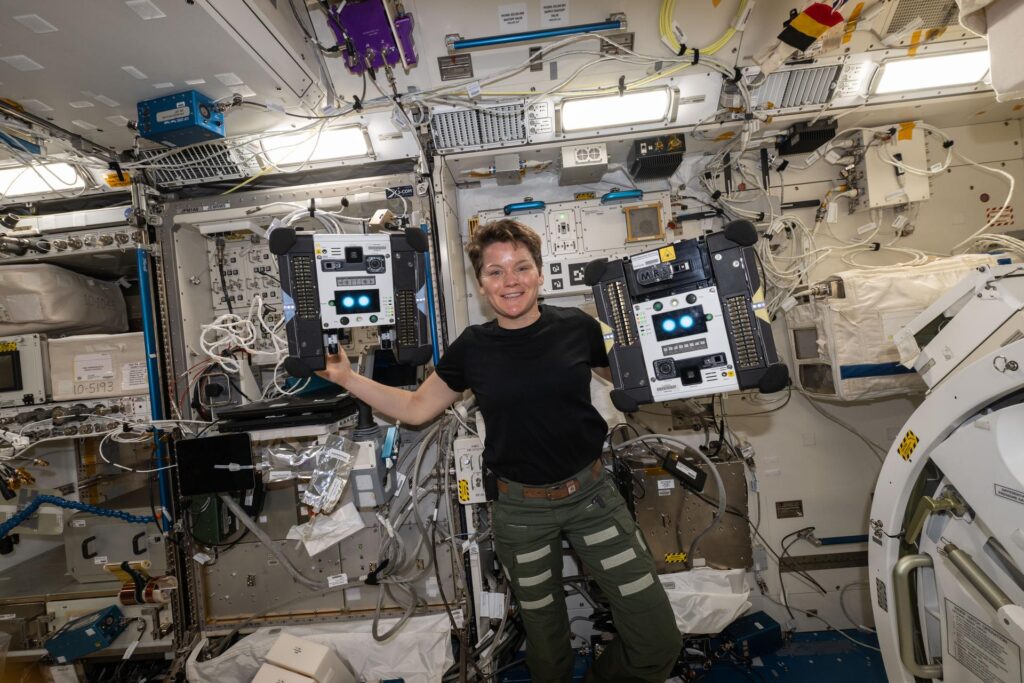
Launched to the station in 2018, Astrobee consists of three cube‑shaped robots—Bumble, Honey and Queen—and a docking station for recharging and a software stack that lets the units fly untethered inside the ISS. NASA said the system has logged multiple firsts for robots working alongside astronauts, supporting spacecraft monitoring and alert simulations while advancing methods for autonomous tasking in a confined, crewed environment.
Astrobee’s role is to help mature the robotic systems and operations that future missions will need as humans venture farther and stay longer in space. By demonstrating navigation, perception and task execution without continuous human control, the platform provides a path to offloading routine chores and augmenting crew awareness, NASA said.
The space station remains a cornerstone for that work, NASA said. As an orbiting laboratory with nearly 25 years of continuous U.S. human presence, the ISS enables research and technology demonstrations not possible on Earth. NASA frames Astrobee as part of that broader portfolio, positioning the platform to spur new commercial capabilities in low‑Earth orbit while informing exploration architectures for the Moon and Mars.