
Insider Brief
- Path Robotics said it has launched Rove, a mobile robotic welding system that combines its Obsidian physical AI model with a quadruped robot to bring autonomous welding to field environments
- The company said the system is designed for applications such as shipbuilding, heavy construction and large-scale fabrication, where parts cannot be easily moved into fixed automation cells and labor shortages are increasing
- Path Robotics said early deployments include evaluation by Saronic Technologies, as manufacturers test mobile, AI-driven welding systems for use in high-variability industrial settings
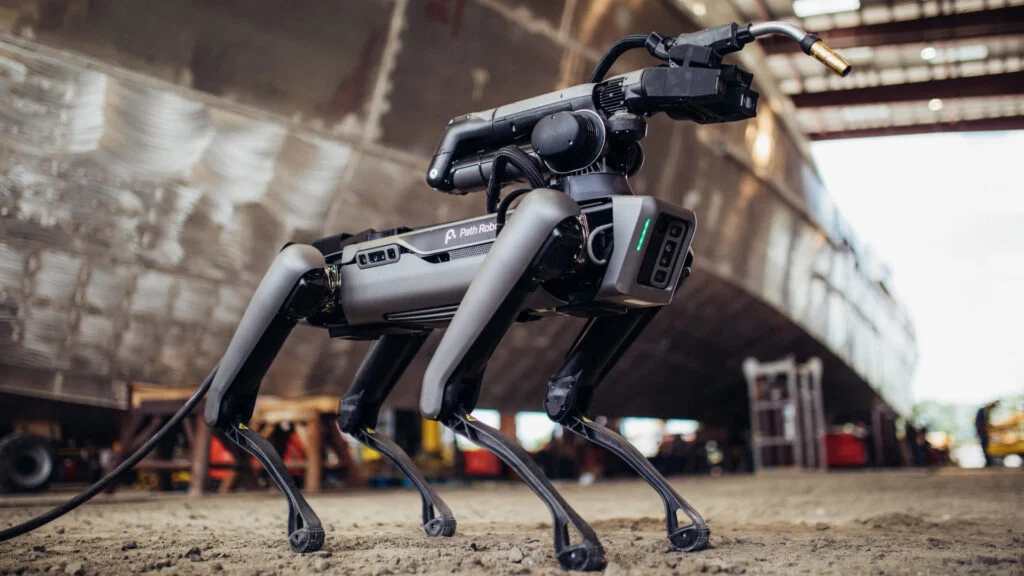
PRESS RELEASE —Path Robotics, the global leader in physical AI for manufacturing, announced the launch of Rove™, a mobile robotic welding system that pairs the company’s Obsidian™ physical AI model with a quadruped robot. The launch marks a major expansion for Path Robotics – where Obsidian already delivers autonomous, adaptive welding inside fixed cells, Rove extends that capability to the field, bringing intelligent welding to the part rather than the part to the workpiece.
Shipbuilding, heavy construction, and large-scale fabrication face a shared constraint: massive assemblies, inconsistent fit-up, and workpieces that cannot be moved, let alone fixtured inside of a welding cell. These conditions have limited welding automation in the environments that need it most – just as skilled welder shortages are reaching critical levels. Rove brings welding automation to these exact environments.
“Obsidian has proven that physical AI can solve some of the hardest welding challenges inside the cell,” said Andy Lonsberry, CEO and co-founder of Path Robotics. “Rove is a significant next step and one our customers have been seeking. Manufacturers can now deploy Obsidian wherever welding is needed – across large assemblies, production sites, and in environments where moving the part isn’t an option.”
Legged robots have long been considered too unstable for precision welding. Rove changes that narrative. Obsidian empowers Rove with the perception and adaptability needed to operate in high-variability environments, like shipbuilding.
Saronic Technologies, a leader in autonomous maritime vessels, is one of the first early adopters to evaluate the system, integrating Rove’s intelligent mobile welding into its physical AI-powered shipbuilding operations in Franklin, Louisiana.
“Building the next generation of autonomous vessels means rethinking not just how ships operate, but also how they’re made,” said John Morgan, Head of Manufacturing, Saronic. “Rove represents the kind of intelligent, adaptable tooling we need to bring shipyard operations into the modern era—we look forward to seeing what Rove can do and are excited to partner with Path Robotics as we scale production of the next generation of autonomous vessels.”
Attendees of Sea-Air-Space 2026, the largest maritime expo in North America, presented by The Navy League of the United States, can see Rove demonstrated at Path Robotics’ booth T76 in National Harbor, Maryland, April 19–22.
Companies interested in exploring how Rove can support their operations can visit path-robotics.com/rove.
Image credit: Path Robotics