

Insider Brief
- KAIST researchers developed APT-RL, a control method that lets a four-legged robot choose and switch among walking, running, jumping and other movements on rough terrain.
- The team tested the system on KAIST HOUND, which moved across indoor obstacle courses, campus terrain and forest trails while switching gaits in real time based on terrain and target speed.
- KAIST said the method uses simulation-generated training data, reinforcement learning, a depth camera and LiDAR, with potential applications in disaster response, defense missions and industrial inspections.
A team led by the Korea Advanced Institute of Science and Technology, and backed by South Korean government and defense R&D funding, developed a control method that lets a four-legged robot choose how to move across rough terrain.
The work tackles a basic problem in legged robotics that rreal environments do not present one obstacle at a time, according to KAIST. A robot may need to walk up stairs, step over roots, clear a ledge, jump a gap and keep moving across grass or leaves, all without a person telling it which movement pattern to use next.
KAIST said the team, led by professor Hae-Won Park of its Department of Mechanical Engineering, developed a learning-based control technology called APT-RL, short for Action Pretrained Transformer-based Reinforcement Learning.
How it Works
The system allows a single controller to select and switch among different forms of movement, including walking, running, jumping and clearing ledges. That matters because many four-legged robots can move quickly on flat ground or handle simple obstacles, but struggle when several types of terrain appear together.
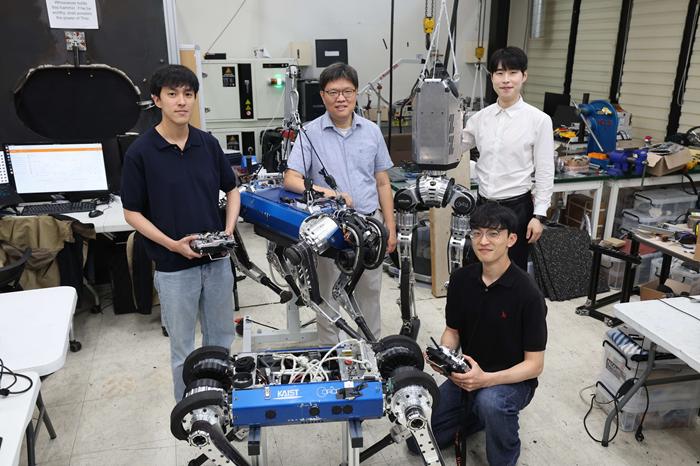
The researchers tested the system on KAIST HOUND, a four-legged robot developed by the team. In experiments, the robot moved across indoor obstacle courses and outdoor settings, including KAIST’s campus and forest trails.
KAIST said HOUND crossed urban terrain such as stairs, grass and slopes, as well as natural terrain with fallen trees, exposed roots and fallen leaves. The robot changed its movement pattern in real time depending on the terrain and target speed.
In rugged terrain with obstacles, the robot reached a peak instantaneous speed of six meters per second, or about 22 kilometers per hour, according to KAIST. The team said the result shows the robot can combine fast movement with stability in outdoor environments.
The main technical advance is not a single fast run or jump. It is the ability to put several movement skills under one control system, according to the researchers. The robot could switch between a trot, in which diagonal legs move together, and a bound, a leaping gait that uses the front and back leg pairs together. It could also combine walking, running, jumping and ledge-clearing through the same controller.
Simulation Data Over Motion Capture
The method begins in simulation rather than relying on motion capture from real people or animals. The team generated 15.5 hours of training data for different gaits using computer simulations, KAIST pointed out that data was produced in just eight minutes.
That training data was created using robot dynamics, which are mathematical rules that describe how the robot moves, and trajectory optimization, the way of calculating efficient movement paths. The team then used reinforcement learning, an AI method in which a system improves through trial and error, to help the robot decide which movement strategy to use in more complex terrain.
The final system also uses a depth camera and LiDAR, researchers noted. A depth camera estimates distance to objects, while LiDAR uses lasers to map the surrounding environment in three dimensions, and together those sensors help the robot recognize terrain and choose an appropriate gait in real time.
The researchers say the approach is faster and more efficient than methods that depend on collecting movement data from humans or animals through motion-capture systems.
KAIST cited disaster sites, defense missions and industrial facility inspections as potential uses for walking robots that can move across rugged terrain rather than wheeled models.
“We expect this to become a foundational technology that expands the potential uses of physical-AI-based walking robots in rugged environments such as disaster sites, defense missions, and industrial facility inspections,” noted Park.
The study, published in Science Robotics, was led by co-first authors Jun-Gill Kang, who was affiliated with the Agency for Defense Development at the time of the research, and Jaehyun Park, a Ph.D. candidate in KAIST’s Department of Mechanical Engineering. Park and Professor Seungwoo Hong of Korea University served as corresponding authors.
The research was supported by the Ministry of Trade, Industry and Resources and the Korea Planning & Evaluation of Industrial Technology, as well as the Agency for Defense Development’s Future Challenge Defense Technology R&D program.
Featured image: The research team. From left: Ph.D. candidate Jaehyun Park (KAIST, co-first author); Professor Hae-Won Park (KAIST, corresponding author); Professor Seungwoo Hong (Korea University, corresponding author); Researcher Jun-Gill Kang (Agency for Defense Development at the time of the research, co-first author). (Credt: KAIST)