Insider Brief
- Northrop Grumman launched its Mission Robotic Vehicle and three Mission Extension Pods to support autonomous satellite servicing, life extension, refueling and future AI-enabled space operations.
- The MRV is designed to dock with and service satellites in orbit, with potential uses including inspection, relocation, repair, debris removal, upgrades, experimentation and in-space assembly.
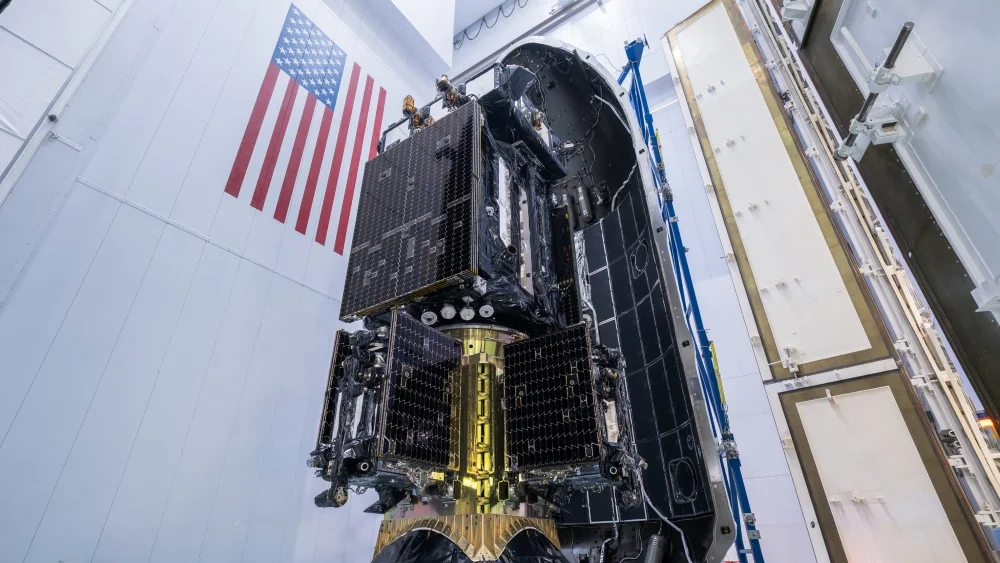
- The system includes a DARPA robotics payload with two articulated arms, three propulsion-focused Mission Extension Pods and a Space Force-approved refueling interface for future on-orbit refueling.
Northrop Grumman announced the launch of its Mission Robotic Vehicle and three Mission Extension Pods as it continues its work in autonomous satellite servicing.
According to the aerospace and defense company, the spacecraft are designed to support in-space servicing, satellite life extension, refueling and future AI-enabled operations. The launch took place from Cape Canaveral, Fla.
“The MRV is a whole new class of advanced autonomous space robotics that will learn and evolve to support novel missions for our nation,” noted Ryan Tintner, vice president and general manager, space superiority. “These are not demonstrations. Our world-leading investments in these capabilities are finally providing options in space that are only limited by our imagination.”
What is an MRV?
The Mission Robotic Vehicle, or MRV, is built to dock with and service client satellites in orbit. Northrop Grumman said the platform could support inspection, relocation, repair, debris removal, upgrades, experimentation and in-space assembly.
The program combines Northrop Grumman’s investment with work done through a partnership with the Defense Advanced Research Projects Agency (DARPA). The MRV includes a robotics payload developed by the U.S. Naval Research Laboratory for DARPA. That payload includes two fully articulated robotic arms and specialized tools for satellite servicing missions.
The three Mission Extension Pods, or MEPs, are designed to act as propulsion modules for satellites. Northrop Grumman described them as smaller “jetpack” systems that can extend a satellite’s life and allow it to maneuver.
The MRV also launched with a Passive Refueling Module, a Space Force-approved docking and refueling interface standard. The company said the module is intended to let MRV be refueled on orbit and support future sustained maneuver missions.
Northrop Grumman noted that MRV also carries advanced processing hardware for future AI-powered operations. The company said it uses AI to improve reliability, reduce costs and support mission assurance, with future work aimed at more capable in-space servicing.
The new system is intended to build on earlier Mission Extension Vehicles with a smaller and more affordable life-extension option that can be deployed across a wider range of satellites. The company pointed out its previous two on-orbit MEVs have docked with three commercial communications satellites in geosynchronous orbit and provided more than 10 years of combined mission-extension services.
The company also said its thermal control products, electronics and electric-propulsion components support MRV’s robotic arms and maneuvering capability in space.
Image credit: SpaceX