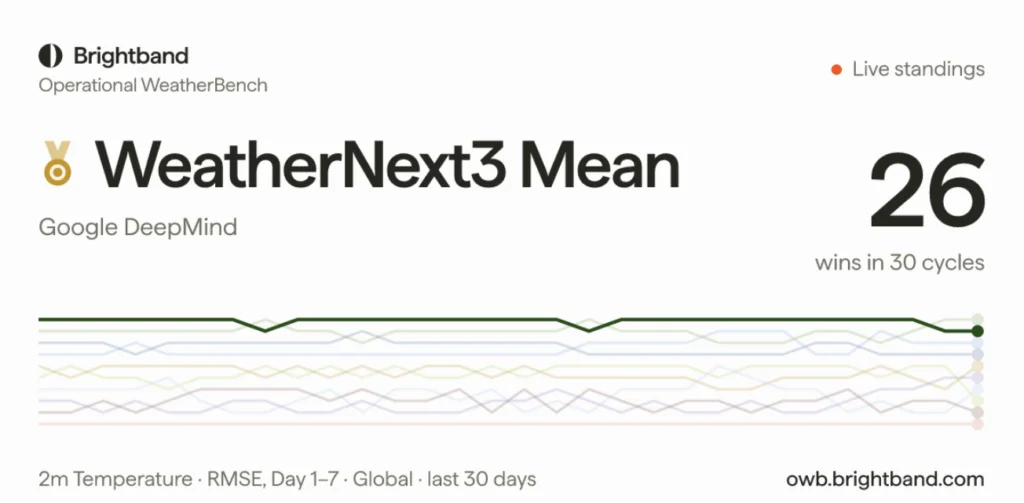
Google DeepMind and Google Research have released WeatherNext 3, a new AI weather forecasting model that the company says will begin powering weather information across Search, Google Maps, and Gemini, while also being available to researchers on Google’s cloud platforms. According to senior staff engineer Samier Merchant, this marks the first time such core forecasting variables will directly feed major Google products.
The model has already outperformed leading competitors from Microsoft, Nvidia, and the European Center for Medium-Range Weather Forecasting on Operational WeatherBench, a benchmark built by startup Brightband, as well as traditional forecasts from national weather agencies. WeatherNext 3 achieves 5 km resolution on key variables, a 60% improvement in rain prediction over its predecessor, and can generate hourly forecasts rather than the standard six-hour intervals, aided by its ability to ingest real-time satellite data.
Ferran Alet, a DeepMind research scientist manager, explained that machine learning approaches weather forecasting by learning patterns from vast data to approximate the chaotic, noisy physics traditional systems struggle to compute efficiently. Brightband’s Daniel Rothenberg noted that the model’s new ability to target forecasts to specific weather stations brings AI predictions closer to real-world, ground-truth applications, such as forecasting conditions at a specific airport.
Google says WeatherNext 3 is the first high-resolution global model to directly incorporate raw satellite observations, though rival WindBorne has used similar raw-data techniques since late 2025.
Featured image: Credit: Google DeepMind