Insider Brief
- University of Maryland researcher Matt Landreman used AI to help discover two families of exact mathematical solutions for magnetic configurations relevant to fusion energy research.
- Landreman manually verified every equation, showing that strongly asymmetric configurations can maintain nested magnetic surfaces while balancing plasma pressure.
- The solutions could help test fusion simulation software, but the theoretical study does not establish plasma stability, practical reactor designs or improved energy output.
Just as artificial intelligence is helping scientists make advances in mathematics and biotechnology, researchers may focus AI on emerging tech, like fusion energy.
As evidence, a University of Maryland researcher reported that AI helped him find exact mathematical descriptions of magnetic configurations relevant to fusion energy, offering new tools for checking the software used to study plasma confinement and fusion energy.
In a study posted to the prepreint server arXiv, Matt Landreman presents two families of solutions showing that strongly asymmetric, doughnut-shaped magnetic configurations can maintain perfectly nested magnetic surfaces while balancing plasma pressure. Such arrangements matter for stellarators, fusion devices that rely on complex magnetic geometry to confine hot, electrically charged gas.
Landreman reports that the solutions were discovered using GPT-6 Astra Pro, which also helped draft parts of the manuscript. He writes that he manually confirmed every equation.
The findings address a longstanding question about whether certain smooth, three-dimensional magnetic equilibria can exist. They also provide explicit formulas that researchers can use as reference answers when testing numerical calculations.
The theoretical work does not report a fusion experiment, increased energy output or a reactor design ready for construction, but does have immediate value in establishing what is mathematically possible and giving researchers a more precise way to check tools used in fusion research.
The researcher relied on AI within the mathematical discovery process, while allowing a human to check on its output.
The resulting mathematics is presented for inspection. Landreman gives formulas for the magnetic field, pressure and magnetic surfaces, then shows how they satisfy the governing equations. He also points to supplemental scripts that compare numerical equilibrium calculations with the exact solutions.
“Core” Question
Magnetic-confinement fusion seeks to hold plasma in conditions that allow atomic nuclei to combine and release energy. A central challenge is arranging magnetic fields so that the plasma remains confined.
The study examines magnetohydrodynamic equilibrium — s a description of the balance between magnetic forces and plasma pressure. A simpler way to put it is this is the mathematics that asks whether the magnetic arrangement can counter the plasma’s tendency to expand.
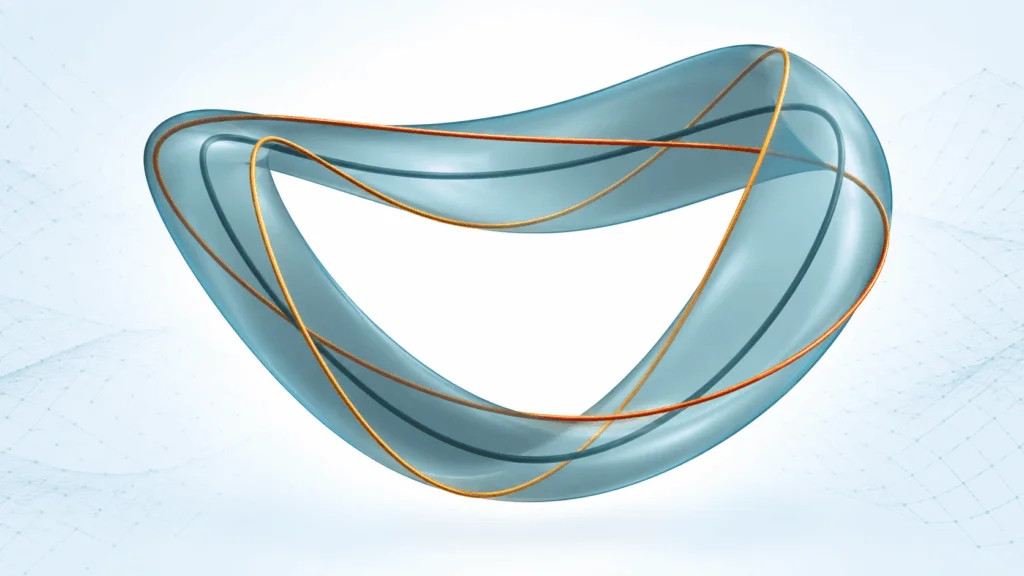
For the configurations studied, magnetic field lines lie on nested, doughnut-shaped surfaces. These surfaces resemble layers fitted inside one another, with pressure decreasing from the center toward the edge.
Producing that structure mathematically becomes difficult when the configuration changes as it goes around the doughnut. Stellarators depend on such three-dimensional geometry. Tokamaks, another major fusion approach, also have departures from perfect rotational symmetry, whether unavoidable or deliberately introduced.
In 1967, physicist Harold Grad questioned whether smooth toroidal equilibria with varying pressure could generally exist without an additional symmetry. The resulting conjecture and related formulations have remained subjects of mathematical research.
Landreman’s paper presents counterexamples to a formulation of that conjecture. It also credits recent work with having already disproved the conjecture by establishing the existence of another family of asymmetric solutions.
The new contribution is therefore more specific than settling the question for the first time. Landreman supplies two additional families whose magnetic fields and pressures can be written explicitly using elementary mathematical functions.
Unlike approaches that approximate a configuration near its central magnetic line or assume only a small departure from symmetry, these solutions allow substantial asymmetry without those approximations.
Two Families of Exact Solutions
The two families differ in how their magnetic field lines wind around the nested surfaces.
In the first, every field line makes two turns around the doughnut’s cross-section for each circuit around its central opening. The line then closes back on itself. This winding ratio, known as rotational transform, remains the same across all the surfaces.
Landreman constructs this family by stretching an initially rotationally symmetric magnetic field. A particular property of the starting field allows the stretched configuration to retain exact force balance.
The paper then derives the resulting magnetic surfaces and shows that the magnetic field, electric current density and pressure remain smooth throughout the selected toroidal region. The pressure gradient vanishes only on the magnetic axis, the central line around which the surfaces are nested.
In the second family, the winding ratio changes from one surface to another, a property called magnetic shear. Some field lines close on themselves, while others do not.
This second family broadens the mathematical examples beyond configurations with a single, fixed winding ratio. It also retains exact nested surfaces and smooth fields and pressure.
Both families contain adjustable parameters, allowing researchers to vary features of the geometry. They are sets of related solutions rather than isolated examples.
The study also derives quantities useful for comparing calculations, including average field strength, pressure and the ratio of plasma pressure to magnetic pressure.
According to Landreman, these exact results could serve as benchmarks for numerical equilibrium codes. Researchers can calculate a configuration with their software and compare the output with a known mathematical answer, helping identify errors or assess accuracy.
The same mathematics also describes certain steady flows of an idealized incompressible fluid, giving the findings relevance beyond fusion physics.
Limitations and Future Research Directions
An exact equilibrium is only one requirement for a useful fusion configuration.
The study establishes a mathematical balance of forces, but does not show that a physical plasma in these configurations would remain stable when disturbed, retain heat sufficiently well or be practical to produce with engineered magnets.
It also should be noted that the existence of these particular solutions establish that every desired asymmetric configuration can support perfect nested surfaces. The formulas resolve specific existence questions while leaving broader design problems open.
Landreman identifies several directions for further research, including finding solutions with different numbers of repeating magnetic sections and configurations whose field lines have other winding patterns.
Additional solutions without the symmetry retained by the examples in this paper could help test more general capabilities in equilibrium software.
Other questions concern whether similarly explicit solutions exist under different magnetic constraints, including fields without electric current in the region being studied. The paper also leaves open the existence of asymmetric equilibria with exact quasisymmetry, a special property of magnetic field strength relevant to confinement.
For stellarator research, the present result provides reassurance that strongly asymmetric equilibria with perfect magnetic surfaces do exist in principle, according to the study. The practical next step is to use those known solutions to test calculations and investigate how far the mathematics can be extended.
The research received U.S. Department of Energy support.
The supplied manuscript is marked as under consideration for publication in the Journal of Plasma Physics.
For a deeper, more technical dive, please review the paper on arXiv. It’s important to note that arXiv is a pre-print server, which allows researchers to receive quick feedback on their work. However, it is not — nor is this article, itself — official peer-review publications. Peer-review is an important step in the scientific process to verify results.