Insider Brief
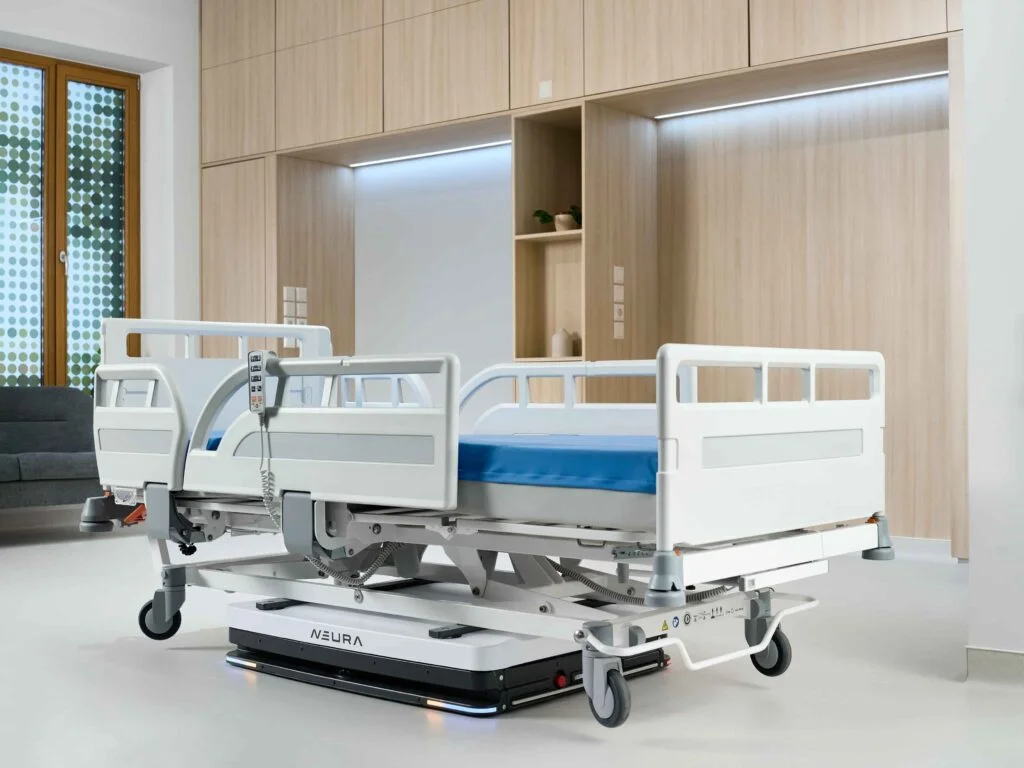
- Neura Robotics is expanding into healthcare with Neura HealthTech and an autonomous mobile robot designed to move empty beds and sterile goods through hospitals.
- The platform connects to Neuraverse, Neura’s physical AI ecosystem, and the company estimates that about 20 moves a day could free more than 1,300 staff hours annually for patient care.
- Neura plans additional healthcare applications using its Maira cognitive robot arms and Mipa service robot, while offering the systems through partners under a Robotics-as-a-Service model.
Neura Robotics is expanding into healthcare with a dedicated business unit and an autonomous mobile robot designed to move empty beds and sterile goods through hospitals.
According to the German robotics maker, Neura HealthTech will focus on physical AI applications for healthcare and life sciences, beginning with a mobile platform intended to reduce the time clinical staff spend moving equipment and other payloads.
Citing a World Health Organization forecast that the European Union could face a shortage of 4.1 million healthcare workers by 2030, at about 20 moves a day, the company estimates the platform could free more than 1,300 staff hours annually for patient care.
“One of the key challenges of our time lies in the healthcare sector,” founder and CEO David Reger said in the announcement. “Societies are aging, skilled people are scarce, and the demands on care keep rising. I am convinced Physical AI is part of the answer, because it takes the physical burden off the people who provide care and gives them back time for what only humans can do.”
How it Works
The first product is a low-profile, omnidirectional robot that can move empty beds between wards and floors after receiving a single request. Neura said it can rotate on its own axis to navigate tight corridors and patient rooms while keeping its safety systems active as it works.
The robot is not a standalone device but rather connects to Neuraverse, Neura’s physical AI ecosystem linking sensors, AI and intelligent machines. Neura said its cognitive robotics technology allows the platform to perceive its environment, act on it and learn from real-world experience, and in a sensor-equipped hospital, information from rooms, devices and robots can be combined so the system can identify what is happening and direct a machine to a task.
Neura pointed out that the healthcare platform is designed to meet hygiene, safety and machinery requirements for clinical environments and handles empty beds only, not patients. Before deployment, it is validated against a facility’s corridors, door widths and elevator dimensions.
The company also plans additional healthcare applications. Its Maira cognitive robot arms are intended for instrument and tool assistance and internal logistics, while its Mipa service robot, planned for the unit’s next release, is being trained for patient-room assistance and medication support.
Robots-As-A-Service
Neura will offer the systems through partners under a Robotics-as-a-Service model, with a fixed monthly rate covering integration, operation, maintenance, software updates and 24/7 standby. Data will be hosted on European cloud infrastructure.
Neura HealthTech is led by Sven Lange and includes professionals with experience in medical engineering, healthcare and regulatory affairs, according to the company.
The platform is being presented at the VDMA HealthTech Smart Health Automation Summit in Düsseldorf on Sept. 29 and 30 by integration partner Auroniq Robotics, which will handle system integration and healthcare deployments.