Insider Brief
- Amap and Sands China have begun deploying Tutu robot dogs at Sands Resorts Macau to provide autonomous visitor guidance while supporting indoor navigation and 3D resort mapping.
- Amap said the robots can navigate around people and obstacles, answer questions in Chinese and English, maintain conversational context and guide visitors to destinations, with one 11-hour test logging 214 direction requests, 4,546 questions and more than 40 kilometers traveled.
- The companies plan to expand Tutu into broader resort operations while refining multi-robot coordination, task scheduling and integration with Sands China’s existing hospitality workflows.
Amap and Sands China have begun deploying Tutu robot dogs at Sands Resorts Macau, expanding the use of autonomous robots for visitor guidance while adding indoor navigation and 3D mapping services across the resort complex.
According to Amap, the quadruped robots can maintain the context of conversations when visitors switch languages or ask follow-up questions. They can also respond to simple requests and gestures, such as sitting, shaking hands and leading visitors to food locations.
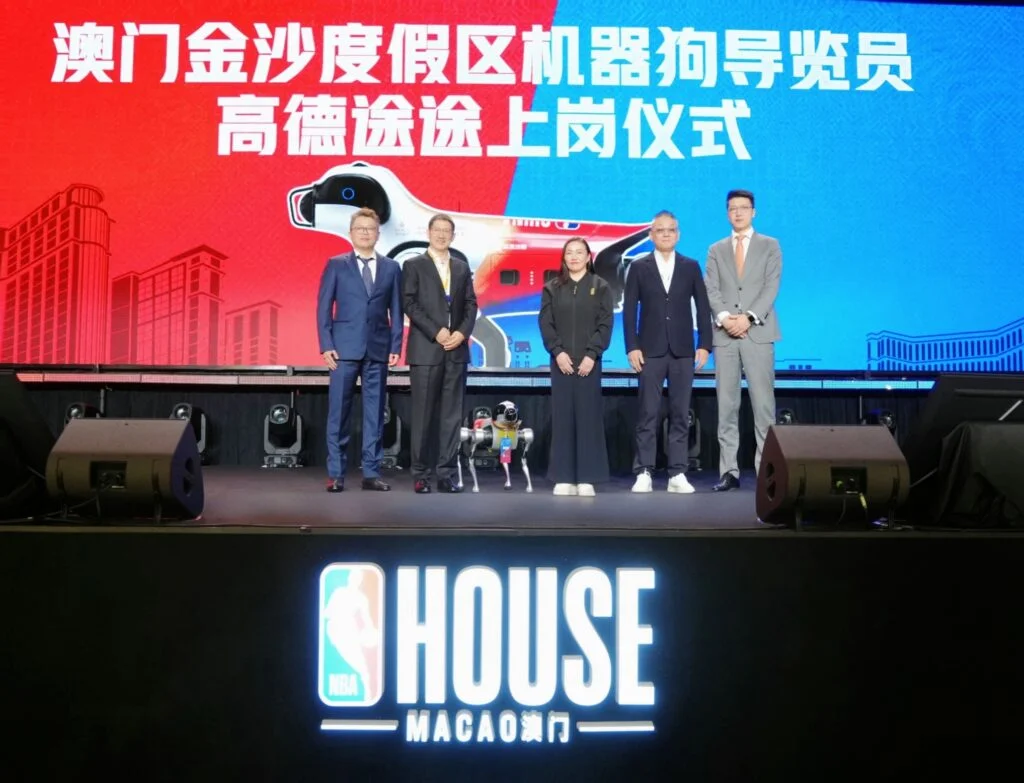
Amap, Alibaba Group’s location-services platform, delivered the first batch of Tutu robots to Sands China at an event at NBA House at The Venetian in Macau. The robots will serve as guides, helping visitors find destinations and providing information around the resorts.
“We are delighted to welcome Tutu,” DeVonne Iao, senior vice president and chief marketing officer of resort marketing at Sands China said at the kick-off ceremony. “This is our new step to bring tourism and technology together, and we look forward to Tutu making the resort experience more convenient and welcoming for visitors.”
When presented with its employee badge, Amap said it raised a front paw for a handshake and said,”It is an honor to become Sands China’s Robotic Guide No. 001. I look forward to providing more services in the future.”
Resort Mapping Effort
The companies are also working on resort-wide indoor navigation using information about floors, walkways, shops and public facilities. Amap plans to create 3D models of selected areas that visitors can explore from different angles through its app before arriving.
Tutu is designed to navigate autonomously around people and obstacles without a remote control or leash. Amap and Sands China plan to test how the robots can be used in different areas of the resorts and integrated with existing staff operations.
The robots have already been tested at NBA House, where they handled visitor questions, provided directions and interacted with guests. During an 11-hour workday, the robots completed 214 requests for directions to locations including restrooms and service counters and answered 4,546 questions in Chinese and English, according to Amap. They traveled more than 40 kilometers while operating around changing crowds and background noise.
Moving from NBA House into the wider resort environment will require the robots to operate over longer periods and handle requests spread across a larger area. Amap said those deployments will also require task scheduling and coordination among multiple robots.
What’s Next?
The companies plan to continue refining the system as the robots enter regular resort operations. The work will combine Sands China’s hospitality operations with Amap’s spatial intelligence and navigation technology. Amap said the partnership is meant to provide practical experience deploying embodied AI in tourism and hospitality, where robots must navigate crowded public spaces while interacting directly with visitors.
“Today is more than Tutu’s first day on the job — it is the start of long-term service,” added Zhou Haijing, Chief Financial Officer of Amap. “The true value of this partnership lies in Tutu’s ability to deliver reliable service during peak periods and become an integral part of the resorts’ service operations.”