A policy analysis from October 2026
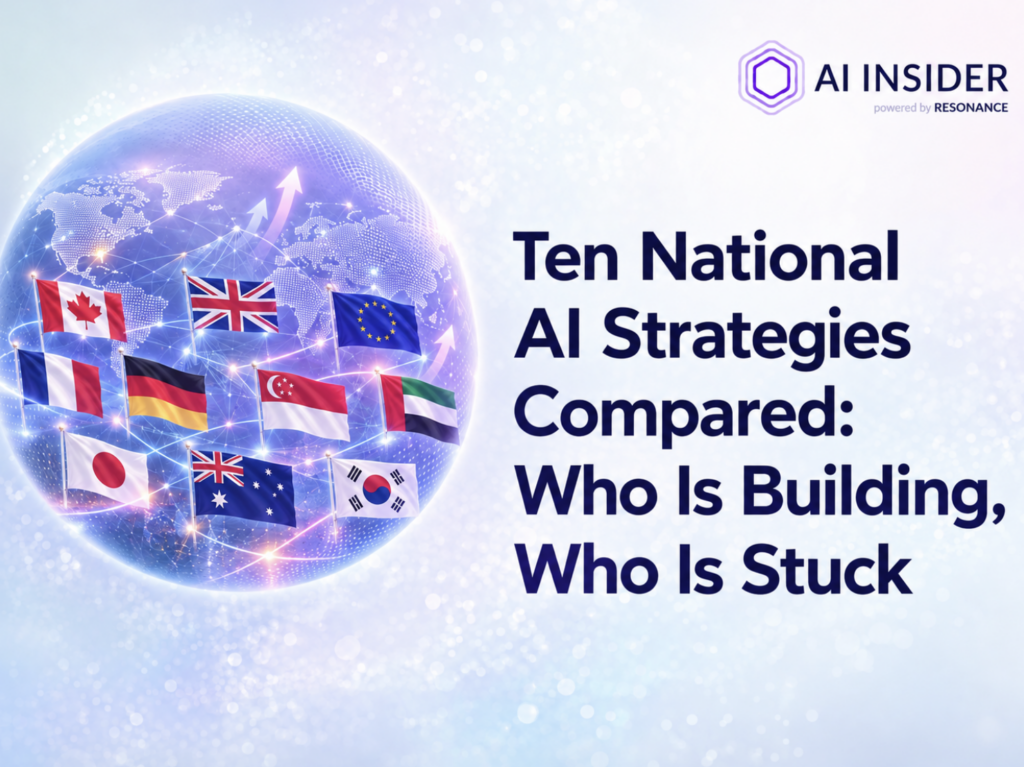
Between May and September 2026, The AI Insider published a series of policy analyses examining ten of the world’s most closely watched national and regional AI strategies: Canada, the United Kingdom, the European Union, France, Germany, Singapore, the United Arab Emirates, Japan, Australia, and South Korea. Each piece was written to stand on its own, decoding a single plan on its own terms. Read together, they tell a larger story that no individual strategy document quite captures.
That story has a remarkably consistent shape. Almost every government in this group began by building foundations: research institutes, supercomputers, talent programmes, safety bodies, and investment vehicles. Almost every one has now arrived at the same uncomfortable point, where the foundations are largely in place and the harder question is whether they translate into AI that is actually used, across the economy and the public sector, at a scale that changes productivity. Canada has world-class research but not commercial scale. The UK has delivered most of its action plan commitments, yet its public sector is caught between pilot and integration. The EU has built AI Factories faster than its businesses have adopted AI. France has Mistral AI and a pointed audit from its own Court of Auditors. Germany has more money flowing into AI than ever and a pilot purgatory problem to match. Singapore has redesigned its strategy around the adoption gap. The UAE and South Korea are betting that concentrated state power can close that gap faster than anyone else. Japan and Australia are betting that a light regulatory floor will let industry close it on its own.
Where the ten diverge is just as revealing. Between them, these strategies represent at least four distinct philosophies of AI regulation, three distinct models of technological sovereignty, and sharply different assumptions about who should own the compute, who should build the models, and how hard the state should steer. This analysis sets the ten side by side to examine where they converge, where they split, and what the comparison suggests about which approaches are most likely to deliver by the end of the decade.
A DECADE OF STRATEGIES: TWO GENERATIONS OF AMBITION
The chronology matters, because when a strategy was written shapes almost everything about what it was designed to do.
Canada was the first country in the world to publish a national AI strategy, announcing the Pan-Canadian Artificial Intelligence Strategy (PCAIS) in 2017 with the Canadian Institute for Advanced Research (CIFAR) as its institutional backbone. The UAE followed in October of the same year with a move no government had made before: appointing a Minister of State for Artificial Intelligence with no other portfolio. Omar Sultan Al Olama took the post at 27, and the National Strategy for Artificial Intelligence 2031 has been built around his ministry ever since. France launched its AI for Humanity strategy in March 2018, drawing on a report by Fields Medal laureate Cédric Villani and promising €1.5 billion in investment by 2022. Germany published its first National Artificial Intelligence Strategy in November 2018, backed by €3 billion through 2025 and topped up with a further €2 billion from the 2020 stimulus package. Japan had already folded AI into its wider Society 5.0 vision in 2016 before translating it into a formal AI Strategy in 2019, and Singapore published its first national AI strategy the same year.
These first-wave documents, written between 2017 and 2019, share a common DNA. They were designed before generative AI, before the global scramble for GPUs, and before AI became a central object of great-power competition. With the partial exception of the UAE, they were overwhelmingly research-led: fund institutes, create professorships, attract and retain researchers, and trust that commercial value would follow.
The second wave looks very different. Singapore relaunched with NAIS 2.0 in December 2023 and refreshed it again in May 2026. The UK’s AI Opportunities Action Plan arrived in January 2025. The European Commission published its AI Continent Action Plan in April 2025. Australia replaced its archived 2021 AI Action Plan with a National AI Planin December 2025. South Korea assembled its AI G3 strategy through a rapid sequence of institutional moves from mid-2025, anchored by an AI Basic Act that took effect in January 2026. Meanwhile the first-wave countries have been rewriting their own playbooks: France entered a third phase in February 2025, Germany folded AI into a six-technology High-Tech Agenda in July 2025, and Canada has spent much of 2026 waiting for a revised strategy that, as of May, had still not been tabled despite an original promise of delivery by the end of 2025.
The difference between the two generations can be summarised in a single shift of question. The first wave asked how a country could build an AI research base. The second asks how a country can own a meaningful share of the AI economy. Compute, chips, sovereign models, data centre energy, and national champions barely featured in the 2018 documents. They dominate the 2025 and 2026 ones.
FROM RESEARCH FIRST TO ADOPTION FIRST
The single clearest pattern across all ten strategies is a pivot from research excellence toward economic diffusion, and the countries that started earliest have learned that lesson most painfully.
Canada is the purest example. Its three national institutes, Amii in Edmonton, Mila in Montréal, and the Vector Institute in Toronto, along with more than 125 researchers supported as Canada CIFAR AI Chairs, have given the country a research reputation that consistently places it among the world’s top five AI ecosystems on the Stanford HAI Global Vibrancy Tool. Yet Canadian businesses trail international peers on AI adoption and commercialisation, and one senior strategist summarised the country’s challenge as having moved from invention to diffusion, scale, and execution.
France followed a similar arc with more explicit sequencing. Its first phase, from 2018 to 2022, created four Interdisciplinary Institutes for Artificial Intelligence, later expanded into nine IA Clusters funded at roughly €350 to €360 million, and the country now ranks third in the world for AI research and training. Its second phase, budgeted at €1.1 billion from 2021 to 2025, was designed specifically to push that capability into SMEs and the public sector. The Cour des comptes concluded in November 2025 that the expected acceleration of AI across the French economy had simply not taken place, and that support for business demand for AI solutions had received only very modest measures.
The second-wave strategies built adoption into their design from the outset. The UK’s stated ambition is to become the fastest-adopting AI country in the G7. The EU’s Apply AI Strategy, launched in October 2025, makes adoption itself a policy objective through eleven sectoral flagships backed by €1 billion in funding calls, and encourages organisations to treat AI as a default candidate solution. Australia’s National AI Plan devotes an entire pillar to spreading the benefits, with explicit commitments to regional and disadvantaged communities.
Singapore offers the most deliberate example of a country redesigning a strategy around the adoption problem. The 2026 update to NAIS shifts the centre of gravity from building foundational capacity toward production-grade deployment, organised through new National AI Missions in Advanced Manufacturing, Financial Services, Connectivity, and Healthcare, sectors that together account for more than 40 percent of Singapore’s GDP. Canada’s own forthcoming strategy points in the same direction, with the six pillars teased in the Spring 2026 Economic Update including AI adoption across the economy and public services, and AI Minister Evan Solomon confirming in May 2026 that the strategy would formally track AI’s impact on the labour market.
The lesson running through all ten documents is the same. Research excellence is a necessary condition for an AI economy, but it is nowhere close to a sufficient one. The countries that assumed diffusion would happen naturally are now spending their second decade trying to engineer it deliberately.
THE MONEY: COMMITMENTS, PLEDGES, AND WHAT ACTUALLY ARRIVES
Comparing financial commitments across ten strategies is treacherous. Figures are quoted in eight different currencies, over different time horizons, and with very different definitions of what counts as investment. The most useful way to read them is to separate three categories that headline announcements tend to blur together: direct public spending, public-private investment vehicles, and investment pledges from private and sovereign capital.
Direct public spending is the most reliable measure and, in most cases, the smallest. Canada committed C$208 million through Budget 2021 to renew its institute and talent programmes, a further C$125 million for commercialisation through its Global Innovation Clusters, and C$2 billion over five years through Budget 2024 for its Canadian Sovereign AI Compute Strategy. Germany’s research ministry, the BMFTR under Dorothee Bär, plans to invest more than €1.6 billion in AI over the current legislative period, with the wider High-Tech Agenda allocation rising from €500 million in 2025 to €1 billion annually from 2026, roughly €5.5 billion across the period. France committed €1.1 billion to its second phase and €2.5 billion in direct public investment to its third. Singapore has committed more than S$1 billion to public AI research and talent between 2025 and 2030, alongside a S$150 million Enterprise Compute Initiative. South Korea approved a KRW 1.8 trillion supplementary budget for AI capability and roughly KRW 1.46 trillion, close to US$1.1 billion, for GPU procurement. The UK’s direct commitments are spread across many instruments, including up to £500 million for the Sovereign AI Unit, more than £100 million for the National Data Library, up to £250 million to scale cloud capacity for the AI Research Resource, and a joint commitment of up to £600 million with the Wellcome Trust for the Health Data Research Service. Japan’s most visible direct support is up to ¥72.5 billion in METI subsidies for domestic cloud compute. Australia’s most specific new allocation is A$29.9 million for its AI Safety Institute, a strikingly modest figure next to its peers.
Public-private vehicles operate at a far larger scale. The EU’s InvestAI initiative aims to mobilise €200 billion, with €20 billion ring-fenced for AI Gigafactories under a structure in which the EU contribution can cover up to 17 percent of capital expenditure. South Korea announced a KRW 100 trillion public-private fund, worth close to US$74 billion, for infrastructure, talent, R&D, and data. Abu Dhabi’s MGX, launched in 2024 with backing from Mubadala and G42, has become a lead co-investor in a US$30 billion AI infrastructure fund alongside Microsoft and BlackRock, while Stargate UAE is backed by up to US$10 billion. Chancellor Friedrich Merz has framed Germany’s broader push, combining public and private capital, as a €130 billion effort, with a separate industry-led initiative pledging more than €800 billion by 2028.
Pledges are where caution is most needed. France’s Paris AI Action Summit in February 2025 produced €109 billion in announced commitments, but roughly €50 billion of that came from a single MGX pledge with no legal obligation to arrive on any particular timeline. By November 2025, the Cour des comptes and independent analysts could confirm only around €26 billion in concretely committed investment, even as the Élysée maintained that €90 billion was secured. The Choose France summit in June 2026 then added a further €93 billion in pledges, including €45 billion from SoftBank for 3.1 gigawatts of data centre capacity in Hauts-de-France. The UK counts £68 billion in investment pledged to its AI sector since January 2025, alongside a more verifiable figure of £6 billion in venture capital raised by UK AI firms in 2025, up from £4 billion in 2024. Australia points to around A$7 billion in foreign investment into Australian AI technologies over five years and A$2 billion in venture capital flowing into local AI applications in 2023.
Two patterns stand out. The first is that the UAE and South Korea are committing capital at a scale wildly disproportionate to the size of their economies, reflecting strategies in which the state treats AI as a national industrial project rather than a policy area. The second is that Gulf sovereign capital has become a load-bearing element of other countries’ sovereignty narratives. The largest single component of France’s sovereign AI pledge came from Abu Dhabi. In AI infrastructure, sovereignty often describes where the compute sits rather than whose money built it.
COMPUTE: THE NEW MEASURE OF NATIONAL AMBITION
If one variable has replaced research citations as the headline measure of national AI ambition, it is compute. All ten strategies now treat domestic AI computing capacity as a strategic asset, but they are approaching it in very different ways.
The UK has moved furthest from a weak starting position. Its One Year On progress report, published in January 2026, confirmed that public AI compute capacity had already increased tenfold, from 2 to 21 ExaFLOPs, with a target of 420 ExaFLOPs by 2030. The Isambard-AI supercomputer launched at the University of Bristol in July 2025, and five AI Growth Zones have been designated, with the Lanarkshire zone alone backed by £8.2 billion in private investment.
The EU has built a genuinely continental network. By April 2026, 19 AI Factories were operational across the EuroHPC network, supported by 13 AI Factory antennas, with access rules designed to prioritise startups and SMEs. The Gigafactory programme, aiming for up to five facilities equipped with more than 100,000 advanced AI processors each, attracted 76 expressions of interest across 60 sites in 16 member states, and one confirmed site in Norway has begun construction on hydropower. Yet, as of June 2026, not a single Gigafactory was operational.
France combines public and private compute. Mistral AI’s Mistral Compute platform features 18,000 NVIDIA Grace Blackwell GPUs in a 40 megawatt facility in Essonne, while the Jean Zay supercomputer has been extended with AMD GPUs and European-designed SiPearl CPUs as a deliberate signal of silicon sovereignty.
Germany’s March 2026 cabinet targets aim to at least double overall data centre capacity by 2030 and quadruple capacity earmarked for AI workloads. Deutsche Telekom, working with Nvidia and Brookfield, is building an industrial AI cloud in Munich expected to add roughly 50 percent to Germany’s AI computing power, and the JUPITER exascale supercomputer at Forschungszentrum Jülich now anchors a national AI Factory.
The Asian strategies vary in their degree of state direction. South Korea’s National AI GPU Infrastructure Initiative is procuring 13,000 high-performance GPUs distributed across Naver Cloud, NHN Cloud, and Kakao, as part of a national capability plan that targeted more than 50,000 GPUs in 2025 and a longer-range goal of 260,000 advanced GPUs by 2030. Japan’s ABCI 3.0 provides national AI computing infrastructure. Singapore, constrained by land and energy, focuses on access rather than ownership: its Enterprise Compute Initiative helps companies secure cloud compute and engineering support from a panel of partners.
The UAE sits in a category of its own. Stargate UAE, a 1 gigawatt cluster built by G42, OpenAI, Oracle, Nvidia, Cisco, and SoftBank, sits inside a 5 gigawatt UAE-US AI Campus spanning more than 19 square kilometres. G42’s data centre subsidiary Khazna reported in spring 2026 that construction of the first 200 megawatt phase, expected to run roughly 35,000 Nvidia GB300 chips, was ahead of schedule for completion in the third quarter of 2026. The build-out was enabled by a policy shift in Washington easing export restrictions on advanced chips to the UAE.
Canada and Australia are earlier in the cycle. Canada launched its AI Sovereign Compute Infrastructure Program call for applications only in April 2026. Australia’s operational data centre capacity, around 0.3 gigawatts in 2024 to 2025, is projected to grow to between 2.2 and 3.2 gigawatts by 2035, equivalent to 8 to 11 percent of national electricity consumption, and the government is developing nationally consistent standards for data centres and AI training facilities that it describes as the first such legislated regime anywhere.
The comparison reveals an important asymmetry. Energy is becoming as decisive as capital. France’s nuclear fleet, the UAE’s combination of the Barakah nuclear plant and large-scale solar, Norway’s hydropower within the EU Gigafactory programme, and the UK’s small modular reactor pilot at Culham all point to the same conclusion: the countries most likely to win the compute race are those that can deliver large volumes of cheap, reliable, low-carbon electricity to data centres quickly. Australia’s projection that data centres could consume up to 11 percent of national electricity by 2035 shows why energy policy and AI policy are now becoming the same conversation.
THREE MODELS OF SOVEREIGNTY
Every one of the ten strategies invokes sovereignty. Very few mean the same thing by it. Reading them side by side, three distinct models emerge.
The first is sovereignty through ownership. The UAE is its clearest expression: the state owns or co-owns its investment vehicle, its infrastructure developer, its research university, its open model lab, and increasingly its own legislative process. South Korea pursues a related logic through its Sovereign AI Foundation Model project, which funds competing consortia to build a domestically developed large language model. Its first-round evaluation in January 2026 eliminated Naver Cloud, reportedly because its vision encoder was built on a Chinese-origin foundation, a striking demonstration of how literally Seoul defines the word. The EU has adopted a softer version of ownership through Council Regulation (EU) 2026/150, which creates the legal basis for EU co-ownership of Gigafactory computing time to be redistributed to European startups.
The second is sovereignty through certification. France’s SecNumCloud framework, operated by ANSSI, requires data to be physically hosted in France but does not exclude foreign providers, which can offer certified services if they meet French security requirements. As Oxford Insights has observed, sovereignty in this model is defined by a provider’s ability to meet state requirements rather than by its nationality. Australia has taken a similar route. In March 2026 it published its Expectations of data centres and AI infrastructure developers, and Anthropic became the first company to sign a memorandum of understanding committing to align its future Australian operations with those terms. Germany’s version operates through procurement: several federal agencies and at least three federal states hold AI contracts requiring vendors to be controlled in Europe, a condition that shaped the most consequential AI deal of the year.
The third is sovereignty through partnership. Canada has been building a network of bilateral technology alliances, signing an AI joint declaration with Germany and launching a Sovereign Technology Alliance at the Munich Security Conference in February 2026, followed by a joint statement with Norway in March and a partnership with Finland in April. Singapore has turned partnership into a hub strategy, recruiting frontier labs to embed operations inside its borders: OpenAI’s partnership worth more than S$300 million includes its first Applied AI Lab outside the United States, Google has signed a parallel memorandum of understanding, and more than 70 companies have established AI Centres of Excellence in the city-state since NAIS 2.0 launched.
The most interesting development of 2026 sits at the intersection of all three models. On 24 April, Canada’s Cohereannounced a merger with Germany’s Aleph Alpha, creating a combined company valued at roughly US$20 billion, headquartered in Toronto with a European centre of excellence in Berlin. The deal is anchored by a US$600 million commitment from Germany’s Schwarz Group, whose STACKIT sovereign cloud will host the combined company’s European operations, and Cohere has committed in writing to keep European public-sector data, model weights, and inference traffic within that perimeter. It was backed publicly by both governments under the new Canada-Germany Sovereign Technology Alliance. In a single transaction, two first-wave strategies that had each struggled to produce a frontier-scale champion on their own pooled their assets, certified their sovereignty through infrastructure rather than ownership, and justified it through a bilateral partnership. If there is a template for how mid-sized democracies compete with American and Chinese scale, this may be it.
NATIONAL CHAMPIONS AND FOREIGN LABS
The strategies also diverge on a related question: should the state try to build domestic AI champions, or position the country as the best place for foreign champions to operate?
France has the strongest champion in this group. Mistral AI, founded in April 2023 by alumni of DeepMind and Meta, raised a €1.7 billion Series C in September 2025 at an €11.7 billion valuation, with ASML as lead investor. France’s strategy can claim partial credit through its talent pipeline, research network, and an EU regulatory stance that French negotiators shaped to treat open-source models favourably.
South Korea is building champions through structured competition. LG AI Research, whose K-EXAONE consortium scored highest in the first round of the sovereign model contest, advanced alongside SK Telecom and Upstage, and the government expects only two consortia to survive as designated national AI champions by 2027. The approach deliberately echoes how Korea built its dominant positions in semiconductors and telecommunications, backing domestic rivals against each other before they competed globally.
The UK has chosen a more interventionist route than its history would suggest. The Sovereign AI Unit, launched in April 2026 with up to £500 million and chaired by James Wise of Balderton Capital, has a mandate to take stakes in UK AI companies, provide compute and data access, and cultivate globally competitive British firms, building on an ecosystem that already includes Google DeepMind, ARM, and Wayve. The UAE builds champions through state-linked institutions: the Technology Innovation Institute’s Falcon family of open models, G42’s Inception lab, and the Mohamed bin Zayed University of Artificial Intelligence.
Singapore takes a different view of what a champion is. Rather than chasing frontier models, it has invested in regionally specific capability: SEA-LION, a family of open-source models built for Southeast Asian languages and downloaded millions of times, and MERaLiON, a multimodal speech and language model tuned to Singaporean and regional accents, downloaded more than 90,000 times since December 2024 and already applied to elder care and scam-call detection. Its primary strategy, however, is to host other people’s champions, as the OpenAI and Google agreements demonstrate. Australia, with around 650 AI companies headquartered domestically, has so far leaned toward the hosting model, using the Anthropic agreement as the flagship proof that its sovereignty framework produces commercial commitments.
Canada’s position is the most paradoxical. Ottawa finalised a federal investment in Cohere in early 2025, signalling willingness to back homegrown champions. A year later, Cohere is the vehicle through which Germany has acquired a sovereign AI champion. Whether that represents Canadian success or Canadian dilution depends on how one defines the national interest, and the comparison makes clear that this question will recur across every middle power in this group.
REGULATION: FOUR PHILOSOPHIES
On no dimension do the ten strategies diverge more sharply than regulation. Reading them together, four distinct philosophies are visible.
The first is comprehensive, binding, risk-tiered legislation. The EU AI Act remains the global reference point, but its implementation has been substantially reshaped. After six months of negotiation, EU legislators reached a provisional agreement on the AI Omnibus in the early hours of 7 May 2026, delaying high-risk AI rules covering employment, education, biometrics, critical infrastructure, and migration from August 2026 to December 2027, pushing the national sandbox obligation to August 2027, and extending SME privileges to small mid-cap companies. It satisfied almost nobody: industry saw partial relief, while civil society groups including Amnesty International characterised it as deregulation driven by Big Tech lobbying.
South Korea and the UAE have both adopted comprehensive laws, but with very different instincts. Korea’s AI Framework Act, passed in December 2024 after four years of debate and in force since 22 January 2026, consolidates nineteen bills into a single framework. Seoul positions it as the first comprehensive AI law anywhere to be enforced in practice. Crucially, it adopts an innovation-first principle under which companies may develop and deploy AI without prior government approval, while imposing risk assessment and reporting duties on operators of high-impact AI in domains such as medical devices, energy, hiring, and nuclear facilities, and mandating both visible labelling and invisible watermarking of AI-generated content. Penalties of up to KRW 30 million were suspended for a one-year grace period. The UAE moved from a non-binding Charter for the Development and Use of Artificial Intelligence in 2024 to its first comprehensive federal AI legislation from March 2026, a four-tier risk-based system loosely comparable in structure to the EU model but calibrated to UAE priorities such as smart-city infrastructure and financial services, overseen by a new federal AI Authority.
The second philosophy is a promotional statute. Japan enacted its AI Promotion Act on 28 May 2025, explicitly prioritising research and development over prescriptive obligations. It created an AI Strategic Headquarters chaired by the Prime Minister, which took effect in September 2025 and approved an AI Basic Plan in December 2025, while METI’s non-binding AI Guidelines for Business reached version 1.2 in March 2026. The Act still has teeth, with corporate fines of up to ¥100 million for failure to comply with government orders, but its philosophy is resolutely voluntary.
The third philosophy is sector-led regulation without an AI-specific statute. The UK has made a deliberate choice to rely on existing regulators, including the FCA, PRA, CMA, ICO, and MHRA, each setting expectations within its own domain, supported by an AI Growth Lab regulatory sandbox and a requirement for regulators to report annually on how they have enabled AI innovation. Australia has taken a proportionate approach built around its new AI Safety Institute and published infrastructure expectations rather than an omnibus AI Act. Canada has arrived in the same category by accident rather than design: the Artificial Intelligence and Data Act, part of Bill C-27, died when Parliament was prorogued on 6 January 2025, and Minister Solomon confirmed in June 2025 that it would not return in its old form. He has described his preference for a new standalone bill that is light, narrowly targeted, and well calibrated, but as of mid-2026 Canada operated without a federal AI framework at all. France and Germany occupy a hybrid position, relying on the EU AI Act while assembling national enforcement architecture: Germany’s KI-MIG legislation designates the Federal Network Agency as its primary AI market surveillance authority, while France is moving toward a multi-authority model in which the CNIL oversees fundamental rights and sectoral regulators such as ARCOM and ACPR handle conformity assessments.
The fourth philosophy treats governance as an exportable product. Singapore’s AI Verify testing framework benchmarks systems against eleven internationally recognised governance principles and has been updated for generative AI, while Project Moonshot offers an open-source toolkit combining benchmarking and red-teaming for large language models. Both are voluntary and designed for adoption well beyond Singapore’s borders. Where the EU exports rules, Singapore exports tools.
The UAE also deserves separate mention for the most radical governance experiment in this group. Its Regulatory Intelligence Office, announced in April 2025, uses AI to draft, review, and continuously update federal and local legislation. No other strategy in this comparison contemplates AI participating directly in the making of law.
Beneath these differences sits one striking point of convergence: the AI safety institute. The UK’s AI Safety Institute has built international credibility through its Frontier AI Trends Report, ten peer-reviewed papers at NeurIPS 2025, a study on AI-driven persuasion in Science, and its chairing of the International Network for AI Measurement, Evaluation and Science. Canada established the Canadian AI Safety Institute (CAISI), which awarded its first ten Catalyst Grants in June 2025. Japan runs its own AI Safety Institute, linked to the Hiroshima AI Process, the G7 framework it originated in 2023. Australia’s new institute is explicitly modelled on the UK body. South Korea’s AI Basic Act created one by statute. France established INESIA in February 2025. Whatever their regulatory philosophy, nearly every government in this comparison has concluded that it needs an in-house technical capability to evaluate frontier systems.
One further issue cuts across regulatory philosophies and remains unresolved almost everywhere: copyright. The UK’s March 2026 report on copyright and AI declined to introduce a commercial text-and-data mining exception, leaving one of the action plan’s headline recommendations stuck. French publishers and authors sued Meta in Paris in March 2025 over the use of their works to train AI models. For countries with globally significant creative sectors, the tension between protecting those industries and enabling domestic model training may prove the hardest regulatory question of all.
THE ADOPTION GAP: THE PROBLEM EVERY STRATEGY SHARES
If regulation is where the strategies diverge most, adoption is where they converge most uncomfortably. Every government in this comparison now identifies the gap between AI capability and AI use as its central challenge, and every set of data shows the same pattern: large firms moving quickly, small firms and public bodies lagging behind.
The figures are not directly comparable, because they come from different surveys, years, and definitions, but their direction is unmistakable. The EU’s own Apply AI documentation found that only 13.5 percent of EU businesses and 12.6 percent of SMEs were using AI, with Eurostat recording a 38 percentage point gap between large enterprises and small firms. Singapore’s Digital Economy Report found SME adoption had tripled to 14.5 percent in 2024, while adoption among larger firms rose from 44 percent to 62.5 percent. Germany has produced the most dramatic shift: Bitkom’s 2026 study recorded AI use among German companies at 41 percent, more than double the 17 percent of 2025, while development bank KfW puts SME adoption at 20 percent, up from just 4 percent in 2020, equivalent to roughly 780,000 small and mid-sized firms. In the UK public sector, around 65 percent of organisations were experimenting with AI in 2025 but only about 30 percent had fully integrated it, and 41 percent of public sector staff said they felt unprepared or unsupported.
Germany’s experience also illustrates the next problem, which is likely to become universal. Once adoption begins, the bottleneck shifts from access to execution. Research cited alongside the Bitkom figures describes widespread pilot purgatory, with one Gartner-based projection suggesting around 30 percent of generative AI pilots will be abandoned by the end of 2026 and an ISG study putting the pilot-to-scale failure rate as high as 69 percent. One in three German firms reported AI turning out more expensive than expected once compute, integration, and governance costs were included, and a YouGov survey commissioned by Infor found only 14 percent of German decision-makers comfortable delegating critical processes entirely to AI.
The policy responses are converging on a common toolkit: subsidised access to proven solutions, advisory support, and leadership training. Singapore’s National AI Impact Programme aims to support 10,000 enterprises over three years, paired with a target of training 100,000 workers, and plans to raise the share of AI-enabled solutions on its pre-approved Productivity Solutions Grant list from 30 percent to 50 percent. France’s AI Booster programme, run through Bpifrance, offers advisory support and subsidised tools to companies with between 10 and 2,000 employees. The EU has refocused European Digital Innovation Hubs as AI experience centres. The UK’s BridgeAI programme, expanded in the Autumn Budget 2025, offers tailored guidance and funding to help thousands of businesses deploy AI. Germany’s network of AI service centres gives smaller firms access to compute and data protection-compliant tools.
GOVERNMENT AS FIRST CUSTOMER
Several strategies have concluded that the most direct way to drive adoption is for government to use AI itself, both to improve services and to create early demand for domestic vendors. The results vary widely.
The UK has produced some of the most concrete evidence. According to government data, one third of chest X-rays in the NHS are now AI-enabled, AI is helping to halve treatment times for stroke patients, and AI fraud detection tools have cut the time needed to spot fraud risks by 80 percent, reportedly saving half a billion pounds. The Minute transcription tool has been scaled to 1,000 officials across 22 local authorities, and the Extract planning tool processes planning documents in under two minutes.
Germany has moved quickly in 2026 under Merz’s Modernisation Agenda, which targets a 25 percent reduction in bureaucracy costs by 2029. The Agentic AI Hub, launched in March 2026, paired seventeen municipalities with ten start-ups across eighteen pilot projects, selected from around 400 start-up and nearly 200 municipal applications, covering tasks such as housing benefit and naturalisation applications. The SPARK tool for accelerating planning approvals was released as open source in April 2026, and courts in Baden-Württemberg and Frankfurt are piloting AI-assisted case categorisation and judgment drafting under mandatory human oversight.
Australia has written government adoption into a dedicated plan. The AI Plan for the Australian Public Service, launched in November 2025, promises foundational generative AI training for every public servant, commits to working with unions, and delivers GovAI, a centralised, Australian-hosted infrastructure service designed to give agencies secure, low-cost access to AI while preventing vendor lock-in.
The UAE treats government as both first customer and testbed. Its Ministry of Justice has adopted the national strategy’s eight objectives nearly verbatim and deployed an interactive legal assistant, a virtual assistant drawing on federal legislation, and an optical character recognition system for case files. The pattern repeats across health, education, and transport authorities, making the 2031 strategy an operating template rather than a communications document.
France sits at the other end of the spectrum. The Cour des comptes judged the transformation of public action through AI to have been very disappointing, despite isolated successes such as AI-driven fraud detection at the tax administration and France Travail’s collaboration with Mistral AI.
The comparison suggests that government adoption succeeds when three conditions hold: a central delivery function with authority across departments, shared infrastructure that removes the need for each agency to procure its own tools, and a willingness to publish results. The UK, Australia, and the UAE meet all three. France, despite its strong interministerial AI coordinator, has struggled with the second and third.
TALENT: THE COMPETITION FOR PEOPLE
Every strategy treats talent as foundational, but the comparison reveals that the challenge differs fundamentally depending on a country’s position in the global labour market.
For Canada, the problem is retention rather than production. AI Minister Solomon has described the talent situation as a crisis, and a 2025 report titled The Leaky Bucket found that highly educated immigrants, including the ICT professionals and researchers the AI strategy most needs, leave Canada at twice the rate of those with lower skills. Doctoral holders are nearly twice as likely to leave as bachelor’s degree holders. Canada is very good at attracting talent and poor at keeping it, and the gravitational pull of US salaries remains the dominant force.
Germany’s problem is demographic. Its working-age population has shrunk by roughly four million over the past decade, and it counts more than 1.8 million unfilled vacancies. The High-Tech Agenda’s talent provisions, announced by Merz in November 2025, promise expedited visas, stock-option tax relief, and automatic recognition of foreign degrees for AI and semiconductor specialists, modelled loosely on France’s Tech Visa, but still require enabling legislation.
The UK and Singapore have set the most ambitious workforce targets. The UK aims to give 10 million workers AI training by 2030, and had delivered one million AI courses since June 2025, ahead of schedule, while doubling the resourcing of its Global Talent Taskforce in January 2026. Singapore’s target of training 100,000 workers to become what it calls AI bilingual, combining domain expertise with practical fluency in applying AI, builds on its TechSkills Accelerator, which has upskilled more than 440,000 people since 2016. Relative to population, Singapore’s commitment is among the most intensive in this comparison.
The UAE has addressed talent through institution-building and immigration. The Mohamed bin Zayed University of Artificial Intelligence, established in 2020 as the world’s first graduate research university dedicated entirely to AI, anchors the academic pipeline, while a target of training one million people in AI by 2027 and Golden Visa categories naming AI and data science as priority fields address scale and mobility.
The comparison underlines a structural truth. Strategies can fund training at scale, but they cannot easily overcome the compensation and compute advantages offered by frontier labs in the United States. The most realistic talent strategies either persuade those labs to bring the jobs home, as Singapore and the UAE have, or make AI skills a mass workforce competency, as the UK is attempting.
DEFENCE, ALLIANCES, AND THE GEOPOLITICS OF AI
The most recent strategies are distinguished by how explicitly they link civilian AI to national security, a dimension almost entirely absent from the first-wave documents.
South Korea has gone furthest. In May 2026, the Korea Institute for Defense Analyses and the National Information Society Agency signed a memorandum formally linking public and defence AI transformation under the G3 goal, with plans to expand KIDA’s defence AI research office into a larger Defense AI Policy Center. Within months, the Agency for Defense Development had launched Add-i, a secure in-house AI system built on open models, while Naver and Korea Aerospace Industries announced a defence-specific sovereign foundation model.
Australia’s 2026 Defence Innovation, Science and Technology Strategy names AI as one of six focal technologies, alongside quantum, autonomous systems, long-range fires, high-energy lasers, and undersea warfare, with the Ghost Bat and Ghost Shark platforms cited as examples. Deputy Prime Minister Richard Marles has argued that the nations able to innovate and adopt fastest will hold the decision advantage in future conflict. That work is reinforced by a dedicated AI Experts Group within Australia’s Trilateral Security Dialogue with the United States and Japan.
Elsewhere, the security dimension operates through alliances and supply chains rather than defence integration. Canada’s sovereign technology alliances with Germany, Norway, and Finland reflect a concern with trusted compute ecosystems. Japan uses the Hiroshima AI Process to shape international norms while keeping domestic rules light. Singapore deepens AI security cooperation with Washington through a bilateral technology dialogue. The UAE’s entire compute strategy rests on a geopolitical bargain, the easing of US export restrictions on advanced chips, that could in principle be revisited.
SIX ARCHETYPES OF NATIONAL AI STRATEGY
Stepping back from individual policies, the ten strategies cluster into six recognisable archetypes, each with distinctive strengths and characteristic weaknesses.
The research pioneers, Canada and France, moved first and built genuine scientific depth. Their characteristic weakness has been converting that research into domestic economic diffusion. Both now face independent assessments, from the Cour des comptes in France and from Canada’s own record consultation of more than 11,300 public responses, demanding measurable targets for adoption rather than further research investment.
The industrial incumbents, Germany and Japan, have powerful manufacturing bases and deep reservoirs of operational expertise. Their challenge is speed and organisational change rather than capability. Germany’s 2026 adoption surge and Japan’s bet on physical AI, converting decades of tacit frontline expertise in manufacturing, logistics, and care into training data for robotics and multimodal systems, both suggest that incumbents can move quickly once their core industries see AI as essential to competitiveness rather than optional.
The delivery states, the UK and Australia, have built strategies around operational plans, published commitments, and government as a first mover. The UK’s 38 of 50 commitments delivered and Australia’s GovAI platform demonstrate execution discipline. Their shared weakness is regulatory: both have chosen not to legislate comprehensively, and the UK in particular faces the copyright impasse and an unmet commitment on frontier model legislation.
The capital-led builders, the UAE and South Korea, concentrate state power, capital, and institutional control on a single national objective. They move faster than anyone else in this comparison. The risk, as the UAE analysis put it, is whether an economy built so deliberately around one technology’s timeline can absorb that technology’s volatility, from chip export politics to price swings, as smoothly as it has absorbed its own construction schedule. In Korea’s case, the near-total absence of startup compliance activity when the AI Basic Act took effect shows how quickly a centralised sprint can outpace the businesses it is meant to carry.
The hub, Singapore, accepts that it cannot build everything and instead makes itself the best place for others to build. Its combination of frontier lab partnerships, regional language models, exportable governance tools, and precise workforce programmes makes it arguably the most coherent strategy in this group relative to its constraints.
The rule-setter, the EU, has the world’s most comprehensive regulatory framework and an increasingly serious infrastructure programme. Its distinctive challenge is coordination across 27 member states with different enforcement capacity and institutional appetite, and the persistent tension between regulatory ambition and competitiveness that the AI Omnibus eased without resolving.
WHAT THE COMPARISON REVEALS
Read side by side, the ten strategies support five conclusions that no single analysis in the series could establish on its own.
First, the foundation-building phase of national AI strategy is largely over. Almost every government in this group has its institutes, safety bodies, compute programmes, and investment vehicles in place or under construction. The decade’s competition will be decided on deployment, and the countries that measure and publish adoption against explicit targets will have a structural advantage over those that measure success by announcements.
Second, money is no longer the main constraint. Germany’s experience shows that once adoption begins, the bottleneck becomes execution: pilot-to-production conversion, cost management, governance, and trust. Strategies that treat AI as a funding problem will keep producing pilots. Strategies that treat it as an organisational change problem, as Singapore and the UK increasingly do, are more likely to produce transformation.
Third, sovereignty has become the organising concept of AI policy, but it is being pursued through ownership, certification, and partnership in roughly equal measure, and the most successful examples combine all three. The Cohere and Aleph Alpha merger, backed by two governments and hosted on a sovereign cloud, suggests that mid-sized democracies will increasingly achieve sovereignty collectively rather than alone.
Fourth, regulatory divergence is narrowing in practice even as it persists in principle. The EU has delayed its toughest obligations, Korea has paired comprehensive law with an innovation-first default, the UAE has adopted a risk-tiered model, and Japan, the UK, and Australia have built safety institutes in place of statutes. Underneath the different philosophies, a common core is emerging: technical evaluation capacity for frontier models, transparency for AI-generated content, and heightened obligations for high-risk uses.
Fifth, energy, chips, and geopolitics now shape national AI strategy as much as research or regulation. The strategies best positioned for the next five years are those that can secure power, hardware access, and allies at the same time, which helps explain why the UAE, with abundant energy, sovereign capital, and a negotiated chip arrangement with Washington, is moving faster than any democracy in this comparison.
None of the ten has yet proved that it can turn AI investment into broad-based productivity growth. Each faces its own test, from Canada’s overdue strategy and the EU’s first Gigafactory to Germany’s pilot purgatory and Korea’s enforcement decrees. The next round of reckoning will come not from new strategy documents but from the data those documents promised to deliver, and on current evidence, the winners will be the governments most willing to publish it.
Key References and Further Reading
- Pan-Canadian AI Strategy: What’s Working and Where It’s Stuck, AI Insider
- UK AI Opportunities Action Plan: Decoded, AI Insider
- The EU AI Continent Plan: Europe’s Bid for Sovereignty, AI Insider
- France’s AI for Humanity 2.0: What Comes Next, AI Insider
- Germany’s AI Strategy: Funded But Stuck, AI Insider
- Singapore’s NAIS 2.0: How a City-State Builds an AI Hub, AI Insider
- UAE National AI Strategy 2031: Decoded, AI Insider
- Japan’s AI Strategy: From Society 5.0 to Generative AI, AI Insider
- Australia’s AI Action Plan: Decoded, AI Insider
- South Korea’s AI G3 Strategy: Decoded, AI Insider
- Pan-Canadian Artificial Intelligence Strategy, CIFAR
- Pan-Canadian Artificial Intelligence Strategy, Innovation, Science and Economic Development Canada
- Canadian Sovereign AI Compute Strategy, OECD.AI
- Engagements on Canada’s Next AI Strategy: Summary of Inputs, ISED
- Canada and Germany Sign AI Joint Declaration and Launch Sovereign Technology Alliance, Government of Canada
- Canada’s Brain Drain Is Only Half the Story, The Hub
- A Turning Point for AI in Canada in 2026, BLG
- AI Opportunities Action Plan, GOV.UK
- AI Opportunities Action Plan: One Year On, GOV.UK
- AI Opportunities Action Plan: Infographic and Key Statistics, GOV.UK
- UK Government Maintains Status Quo on AI and Copyright, Fieldfisher
- Delivery Must Now Be the Focus of the UK’s AI Opportunities Action Plan in 2026, techUK
- AI Continent Action Plan, European Commission
- AI Continent Action Plan Delivers Major Milestones, European Commission
- AI Factories and Gigafactories, European Commission
- Apply AI Strategy, European Commission
- Apply AI Strategy: Full Text, EUR-Lex
- EU AI Act Simplified: Unpacking the AI Omnibus Agreement of May 2026, Mishcon de Reya
- What the EU AI Omnibus Deal Changes for the AI Act, Tech Policy Press
- The National Strategy for Artificial Intelligence, Cour des comptes
- Make France an AI Powerhouse, Élysée Palace
- AI in France: Betting on AI Adoption and Sovereignty Rather Than Racing for the Most Powerful Models, Oxford Insights
- France Bolsters National AI Strategy With NVIDIA Infrastructure, NVIDIA Blog
- Macron Eyes Billions in AI Investment at Choose France Summit, France 24
- Artificial Intelligence, Federal Ministry of Research, Technology and Space
- Germany Launches €18 Billion High-Tech Agenda, Science|Business
- Cohere Acquires, Merges With Germany-Based Aleph Alpha, TechCrunch
- Bitkom AI Study 2026: 41% of Companies Use AI, SMEs Catch Up, MyBusinessFuture
- National AI Strategy, Smart Nation Singapore
- Update to Singapore’s National AI Strategy: Refreshed Priorities (Factsheet), Ministry of Digital Development and Information
- National AI Impact Programme (Factsheet), Ministry of Digital Development and Information
- UAE National Strategy for Artificial Intelligence 2031, MBZUAI
- G42 Provides Update on Construction of Stargate UAE AI Infrastructure Cluster, PR Newswire
- UAE Explores AI-Assisted Law Making and Dynamic Regulatory Regime, Pinsent Masons
- AI Laws and Regulations in the United Arab Emirates, CMS
- AI Strategy of Japan, OECD.AI Policy Navigator
- Japan’s Winning Strategy in the Physical AI Era, Nippon.com
- Less Regulation, More Innovation in Japan’s AI Governance, East Asia Forum
- Australia’s National AI Plan 2025: Key Takeaways, Clifford Chance
- AI Plan for the Australian Public Service 2025: At a Glance, Digital Transformation Agency
- Artificial Intelligence a Key Area of Australia’s 2026 Defence Innovation, Science and Technology Strategy, Cyber Daily
- National AI Strategy Policy Directions, Ministry of Science and ICT, Republic of Korea
- Why South Korea Is Vying to Be First to Regulate AI, The Korea Herald
- South Korea Launches Public-Defense AI Alliance to Pursue AI G3 Goal, UPI
- Digital Regulation in Asia: Assessing South Korea’s Outlier Approach, The National Bureau of Asian Research
- South Korea National AI GPU Infrastructure Initiative, OECD.AI Policy Navigator