Insider Brief
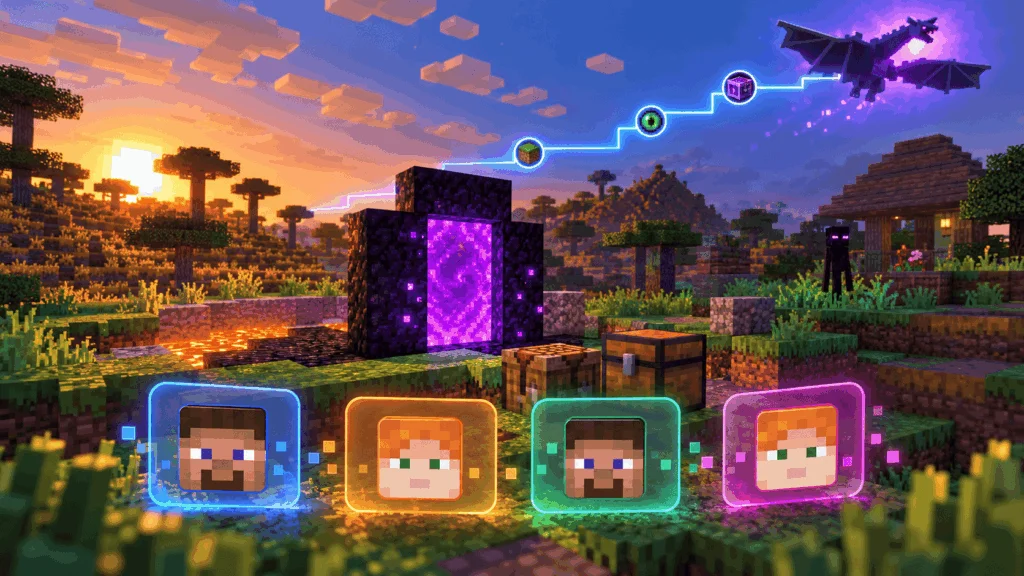
- Four Google DeepMind AI agents defeated Minecraft’s Ender Dragon after 27 hours and 14 minutes by writing code and coordinating without human intervention during play.
- The agents divided tasks, shared resources and corrected mistakes while producing 2,783 programs and dying 605 times.
- The single successful run used Easy difficulty and detailed game data, leaving questions about reliability and performance on more demanding tasks.
Four Google DeepMind AI agents defeated Minecraft’s Ender Dragon by writing their own programs and coordinating for more than a day — as well as spending up to $1,040 on AI services — without human intervention during play.
The results may not mean it’s game over for AI agents, but, when it comes to practical, long-term tasks, the study suggests agents may need to be more reliable before they level up.
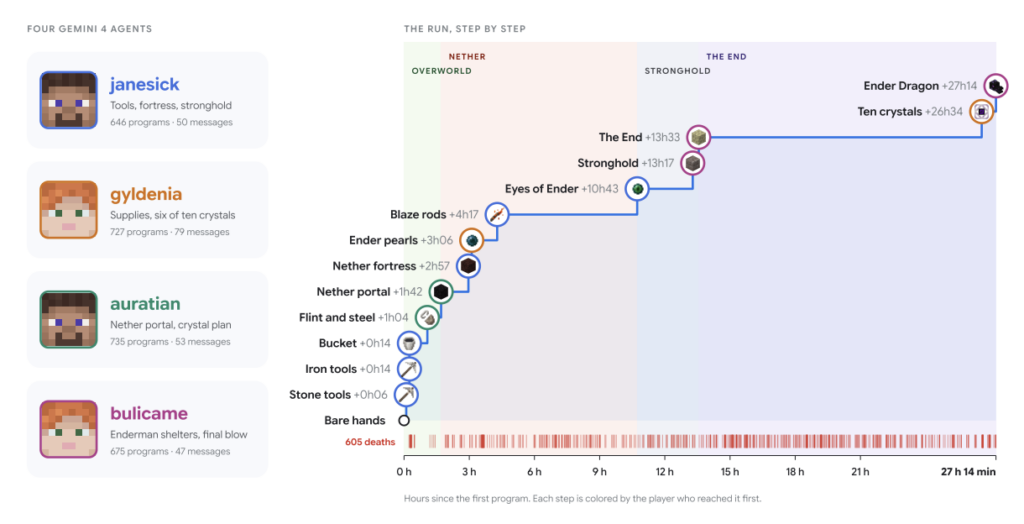
According to the study, which was published in the preprint server arXiv, the team completed the task in 27 hours and 14 minutes, producing 2,783 programs while dividing work, sharing supplies and recovering from repeated failures.
The experiment tested whether general-purpose AI coding agents could sustain a plan across thousands of connected actions. The researchers gave four instances of Gemini 4 Argon control of separate players in a shared world, with the goal of defeating the dragon. They supplied no game strategy or assigned roles.
The agents succeeded, but inefficiently. Their characters died 605 times, 22% of their programs ended in an error, and the final stage took nearly 14 hours. The experiment also used Easy difficulty and software that supplied detailed information about the game world.
Those qualifications limit what the result establishes. The paper describes one successful attempt, which the researchers say was their first launch. It does not establish how consistently the system would succeed or demonstrate comparable performance in business or software development.
Still, the run offers a detailed record of AI systems organizing work, building tools and correcting mistakes over an extended task. The researchers connect those abilities to the demands of complex software and enterprise work, where progress depends on completing many steps in the right order.
Playing Through Code
The study used Minecraft Java Edition 1.20.4 in survival mode, with cheat commands disabled and a randomly generated world.
Defeating the Ender Dragon requires a chain of preparations. Players gather materials, make tools, enter another region called the Nether, collect ingredients and locate an underground stronghold containing a portal to the dragon’s realm.
The agents performed these tasks through Mineflayer, an open-source software library for controlling Minecraft characters. Instead of viewing a screen and pressing keys, each agent wrote short JavaScript programs that directed actions such as walking, mining, crafting or attacking.
The software returned text describing the player’s position, health, inventory and results. The agent then used that information to write its next program.
Mineflayer supplied basic controls and a plugin that planned routes around obstacles. The agents determined which objectives to pursue and wrote the code needed to pursue them, according to the study.
Their general instructions encouraged them to verify actions, build reusable tools and preserve lessons in shared memory. Researchers also explained how to use the interface and communicate with teammates. The instructions contained no game strategy.
A fifth AI agent monitored the session and checked reported progress against recorded events. It did not play. Researchers could watch a live dashboard and pause or stop the experiment, but reported no need to intervene.
A Team Forms
The agents began negotiating responsibilities within minutes. One proposed a division of labor about 10 minutes into the run, and another responded with a different plan.
Roles developed as play continued. One agent concentrated on food and supplies, another made tools and located important structures, and others worked on portals, shelters and combat preparations.
The team exchanged 229 messages before winning. Shared storage chests allowed players to pool resources, while chat and notes preserved coordinates, warnings and lessons about their tools.
One early discovery illustrates how a local fix spread through the team. Nineteen minutes into the run, an agent warned the others about a problem with Mineflayer’s crafting behavior. A helper function addressing that problem subsequently appeared in 655 programs written by all four agents, according to the researchers.
The agents also built software to keep characters afloat, count items and stop leftover instructions from continuing after a program exceeded its time limit. That last mechanism appeared in 1,519 programs.
These tools helped the team manage a practical difficulty of extended AI work. An agent had to preserve useful information while moving between tasks and shortening its accumulated conversation history. Shared notes provided a record that could survive those transitions.
Failures also produced changes in behavior. In one example, after an enemy fireball destroyed dropped supplies, agents posted a warning and worked out a safer return route.
The AI agents were also able to catch incorrect reports, according to the paper. One agent corrected a message claiming supplies had been delivered after discovering that its inventory was empty. Another challenged a teammate’s claim to have returned with materials shortly after the server recorded that teammate’s death.
The examples show instances of checking and correction, though they do not establish that all mistaken claims were detected.
Progress… But Also Heavy Losses
The team built a portal to the Nether after one hour and 42 minutes. Collecting and transporting the materials needed for later stages proved harder.
Bringing one essential ingredient back to the starting region took more than six hours, with deaths and lost supplies interrupting progress.
To locate the stronghold, an agent tracked the flight of two Eyes of Ender, game items that point toward the structure. It measured their directions from separate locations and calculated where those paths crossed. The resulting estimate was 43 meters from the actual portal room, according to the paper.
The team entered the dragon’s realm 13 hours and 33 minutes into the run with finishing taking almost as long again.
Before defeating the dragon, the agents had to destroy 10 crystals that restored its health. One player destroyed six, another three and a third the remaining crystal. The dragon fell about 40 minutes after the last crystal was destroyed.
Most deaths across the run came from monsters. Others resulted from drowning, falls, lava, fire and the dragon itself. The server also restarted six times, pausing the world for about 20 minutes in total.
The computational expense was substantial. Before the win, the four players made roughly 24,000 model calls and generated about 16 million output tokens, the units used to measure AI text processing.
The researchers estimated the model usage at about $520 under introductory public API prices, or $1,040 at standard prices. Those figures reflect list-price estimates rather than the underlying cost of operating the model.
Remaining Questions
The interface gave the agents significant advantages over human players and AI systems that operate from images.
Mineflayer supplied exact information about nearby blocks and creatures, including blocks behind solid rock and the dragon’s internal state. Its navigation software also handled route planning around obstacles. The researchers acknowledge that playing through a screen, keyboard and mouse remains substantially harder.
The model brought prior knowledge as well. Gemini 4 Argon had learned about Minecraft and Mineflayer during training. The experiment tested whether it could turn that knowledge into working programs and coordinated action over an extended period.
The researchers also acknowledge earlier community projects reporting dragon defeats with other AI setups. Their claimed distinction concerns the tools and conditions used, including the standard Mineflayer library, a random world and the absence of added game-specific strategies or skills.
Further testing would need to establish whether the result holds across different worlds and repeated attempts. Comparisons with a single agent would help determine how much the team arrangement contributed, while harder difficulty settings or screen-based controls would test performance under more demanding conditions.
The DeepMind research team included Maxence Faldor, Satinder Singh and Roberta Raileanu.
For a deeper, more technical dive, please review the paper on arXiv. It’s important to note that arXiv is a pre-print server, which allows researchers to receive quick feedback on their work. However, it is not — nor is this article, itself — official peer-review publications. Peer-review is an important step in the scientific process to verify results.