Insider Brief
- Nvidia expanded its Isaac robotics platform with new training data, simulation tools, runtime software and safety technology, while showcasing the update alongside Agile Robots’ new Agile ONE SN reference humanoid.
- The update includes the SimReady Central Library with more than 2,000 assets, the Human 1M Dataset, Isaac Lab 3.0, Isaac OS and new DGX Station workflows for GR00T, dexterous manipulation and Cosmos world-model training.
- Nvidia said companies including ABB Robotics, KUKA, Sereact, Humanoid, Toyota Material Handling Europe, Franka Robotics and Neura Robotics are already using parts of the stack for simulation, training, perception, safety and deployment.
Nvidia has expanded its Isaac robotics platform with new training data, simulation tools, runtime software and safety technology aimed at moving robot development more quickly from training to real-world deployment.
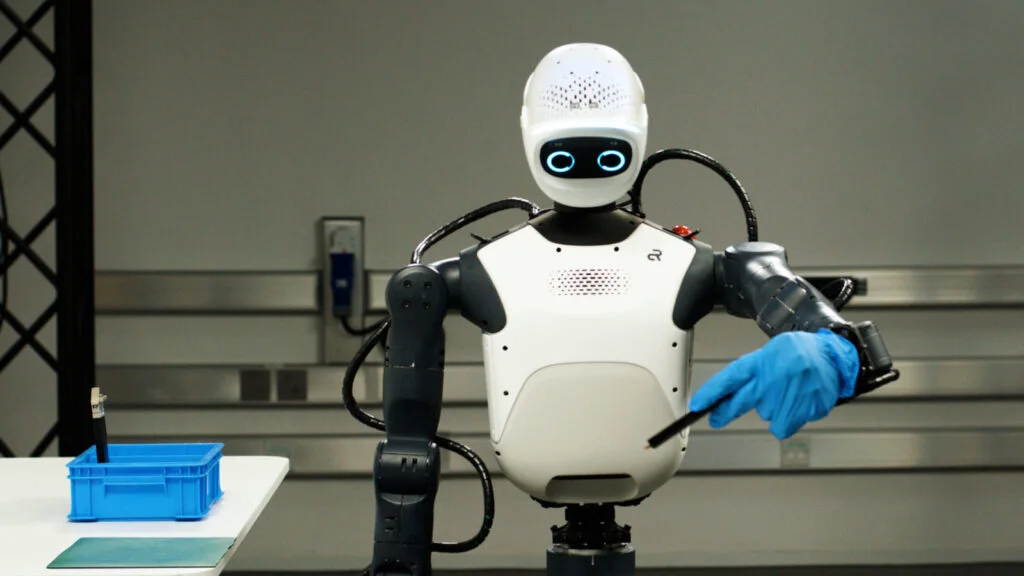
The company showcased the expansion at GTC Berlin alongside Agile Robots’ new Agile ONE SN reference humanoid, which comes preconfigured with Nvidia Isaac GR00T and runs on Jetson Thor. Agile said the system is designed to give researchers a ready platform for developing, training and validating humanoid capabilities.
The Nvidia update adds new datasets and simulation assets, makes Isaac Lab 3.0 generally available and introduces Isaac OS, an open-source runtime that connects AI models with sensors, controls and robot hardware. Nvidia also released new reference workflows for DGX Station and highlighted expanded use of its robotics stack across industrial automation, humanoids and autonomous mobile robots.
According to Nvidia, the additions are designed to give developers a more direct path from generating training data and building robot policies to testing them in simulation and running them on physical machines.
“General-purpose robotics is advancing at extraordinary speed — the ChatGPT moment for robotics is fast approaching,” Nvidia founder and CEO Jensen Huang said. “With Nvidia Isaac, our full-stack open robotics platform, we are giving developers the models, data, simulation tools and computing systems to bring physical AI to the world’s largest industries.”
New Data and Robot-Learning Tools
The SimReady Central Library includes more than 2,000 simulation-ready robotics and factory assets. Nvidia also released the Human 1M Dataset, which contains synchronized three-view video and 3D hand tracking across a range of human activities. Both are available through Hugging Face, with the full Human 1M Dataset accessible to Cosmos Coalition partners.
Isaac Lab 3.0 is now generally available as an open-source framework for training and refining robot policies from desktop systems to data centers. It supports multi-GPU workflows and physics engines including Newton and Nvidia PhysX.
Nvidia also introduced Isaac OS, an open-source runtime built on Holoscan that connects AI, sensors, controls and robot hardware for deterministic, real-time operation as developers move systems from simulation onto physical robots.
The company released three open-source DGX Station workflows covering reinforcement-learning refinement of GR00T 1.7 models, dexterous-manipulation training in Isaac Lab and post-training of Cosmos world models for synthetic data generation.
Safety is another part of the update. Nvidia said Halos, its full-stack safety platform built on IGX Thor, is designed to help autonomous vehicles and robots move from development into real-world deployment. Robotics companies including Agility, Dexory, Fort Robotics and KION are integrating Halos into their safety systems, while SICK is evaluating the technology for industrial robots operating beyond fixed safety zones.
Industrial and Robotics Deployments
Nvidia said companies are already using the expanded stack across factory automation, humanoids, mobile robots and research platforms.
ABB Robotics and KUKA: ABB is integrating Omniverse libraries with RobotStudio HyperReality to simulate and virtually commission robotic systems before installation. KUKA is using Omniverse libraries in Visual Components FactoryLens to add real-time rendering to factory simulation.
Sereact: The company is using Isaac GR00T with Cosmos Transfer to train and post-train its Cortex platform for goods handling on Universal Robots industrial arms.
Humanoid, Hexagon Robotics and Bear Robotics: Humanoid is using Jetson Thor, Holoscan Sensor Bridge, Halos and Isaac OS to develop and validate robot behaviors ahead of industrial pilots. Hexagon Robotics is building perception capabilities for AEON, while Bear Robotics is using Jetson and GR00T to improve perception and model execution for its KR1 platform.
Toyota Material Handling Europe and SoftServe: The companies are using Omniverse and Isaac Sim to develop autonomous material-handling systems, with Nvidia reporting deployment-time reductions of as much as 50%.
Idealworks and Analog Devices: Idealworks is developing memory capabilities for autonomous mobile robots using Nvidia open models and Jetson. Analog Devices is using Jetson AGX Orin and the cuVSLAM library to build autonomous mobile robots.
Hugging Face and Pollen Robotics: The companies are using Isaac Lab, Isaac Sim and Newton to build Microduck, a small open-source robot intended to let developers and students train, modify and share physical behaviors.
Franka Robotics: Franka is combining Nvidia NIM microservices with Isaac Sim to turn natural-language requests into actions on its FR3 Duo robot system.
Bellboy: The company is using Jetson and GR00T for Billie, a service robot already deployed at hotels operated by Marriott, Hilton, IHG and OYO.
Flexion and Schaeffler: Flexion is using Isaac Lab and Newton to scale learning for Reflect, its robot intelligence model for reasoning and whole-body movement. Schaeffler is contributing actuator technology as a foundational component for Newton while using Isaac Lab and Isaac Sim for humanoid development.
Neura Robotics: Neura is using Isaac Sim and Isaac Lab to generate synthetic training data and train robot skills in simulation for Neuron AI, its multimodal foundation model.
Nvidia said the combination of training data, simulation, robot-learning software, runtime tools and safety systems is intended to cover more of the development process from model training through deployment on physical machines.