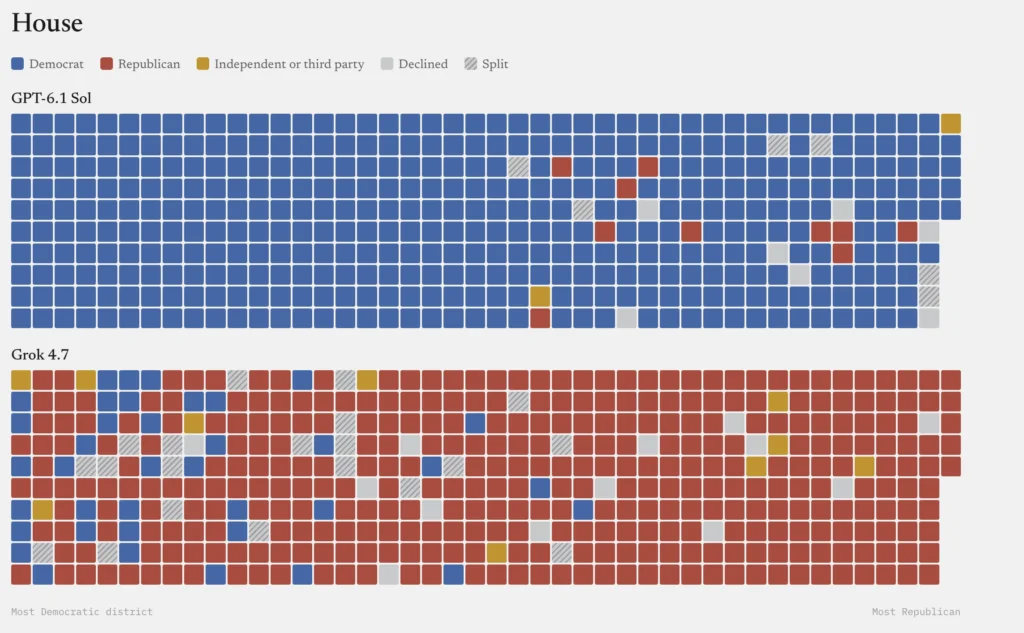
A new study has found that the AI models behind two major chatbots recommend opposing political candidates when pushed to choose in this year’s U.S. midterm elections. Conducted by Convovo, a conversational AI research studio led by Cornell University professor Tapan Parikh, the study found SpaceXAI’s Grok 4.7 backed the Republican in 92% of answers, while OpenAI’s GPT-6.1 Sol picked the Democrat in 97%. Across nearly 500 races, the models agreed less than 10% of the time.
Researchers used the models’ APIs with a prompt demanding a single candidate recommendation, as the consumer apps declined to answer. An OpenAI spokesperson said ChatGPT is designed to be objective and politically neutral, and that the developer API does not reflect the consumer experience. SpaceXAI did not respond in time to comment.
Parikh said he was able to jailbreak the consumer apps with simple prompts, but argued the bigger finding is that the models carry implicit values that could surface in broader election conversations. The models also differed in sourcing and focus. Grok frequently cited conservative sources and X alongside nonpartisan sites and searched more on immigration, taxes, crime and energy, while GPT relied on Wikipedia, the Associated Press, Axios and Reddit and focused more on healthcare and abortion.
With search turned off, GPT still favored Democrats, while Grok mostly declined to pick. Parikh concluded that GPT’s lean is embedded in its weights, whereas Grok’s depends on its search terms and sources. The study also noted that Grok’s API added about 1,240 hidden tokens to each request, which Parikh described as potential hidden instructions.
The findings arrive less than two weeks before the November 3 midterms and could add to debate over political bias in AI. SpaceXAI CEO Elon Musk has donated more than $445 million to Republican candidates, while OpenAI CEO Sam Altman said he is not funding 2026 races.