AgiBot Introduces Worken Metric to Measure Productive Robot Labor
 By Greg Bock · · 3 min read
Insider Brief
- AgiBot introduced Worken, a proposed metric designed to measure productive robot labor based on active robots, autonomous working hours and output efficiency.
- The company also unveiled its AHA3 humanoid hardware architecture, GO-3 Preview embodied-AI model, WITA-Omni interaction model and G2 Max industrial robot.
- AgiBot released Link-U OS 1.0 for selected partners and plans to make the embodied-intelligence operating system fully open source by the end of 2026.
AgiBot has introduced a proposed metric for measuring how much productive work robots perform after deployment.
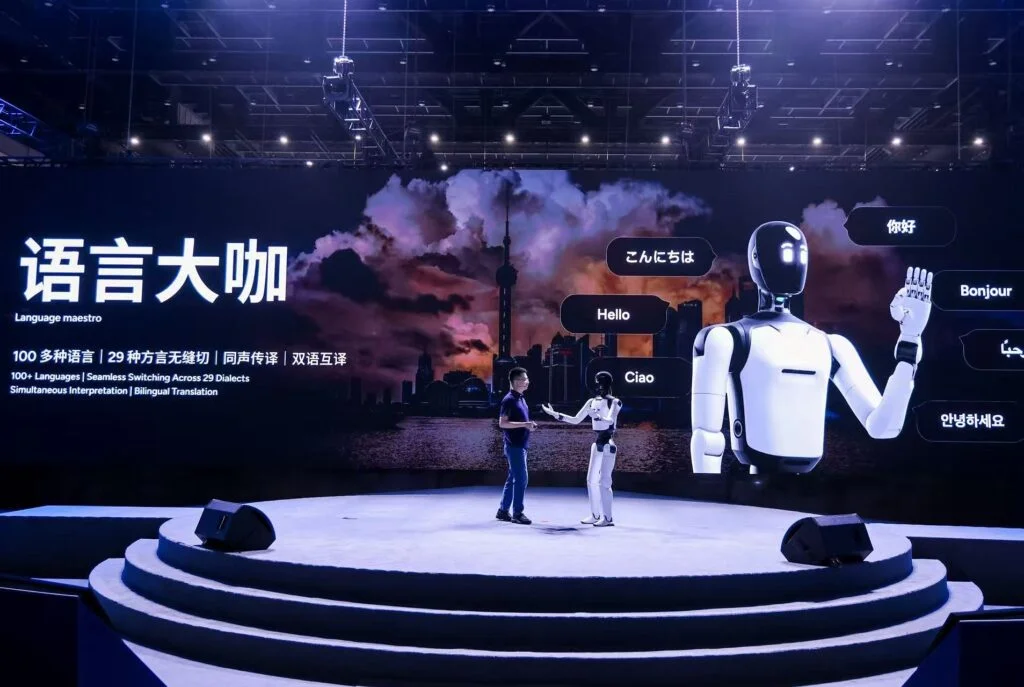
The Chinese robotics company unveiled the framework, called Worken, at AgiBot Innovation Day 2026 in Shanghai. The name combines “work” and “token,” and AgiBot said the metric is intended to measure what robots accomplish in real operating environments rather than simply how many machines are in service.
AgiBot defines Worken as the number of active robots multiplied by autonomous working hours and an output-efficiency ratio. That last measure compares completed work with a reference benchmark for a defined task, such as acceptable output from a human worker under established operating standards.
“Over the past few years, the robotics industry has made remarkable progress in hardware, AI models and large-scale manufacturing,” co-founder, president and CTO Peng Zhihui said in the announcement. “But as robots begin working in factories, warehouses and service environments, we need to answer a more practical question: how much productive work are they actually delivering?”
The company said the framework is still being developed and will be refined using data from real-world deployments. AgiBot ultimately wants the measure to help companies compare robot productivity across applications including industrial handling, logistics, inspection and commercial services.
New Hardware and AI Models
AgiBot also used the event to introduce new robot hardware, AI models and software aimed at industrial and service deployments.
AHA3 — The company unveiled its third-generation humanoid hardware architecture, which combines hardware for locomotion, interaction and task execution. AgiBot said the platform includes integrated computing, high-speed connectivity and a liquid-cooling system intended for sustained operation.
GO-3 Preview — AgiBot introduced a new embodied-AI foundation model designed to combine reasoning, prediction and action. The company said the model is intended to help robots anticipate the effects of their actions, adapt to changing environments and perform tasks beyond previously learned sequences.
WITA-Omni — The interaction model combines vision, speech, real-time dialogue, facial expressions and physical movement. AgiBot said it supports full-duplex conversation and coordinated speech and movement, including on-device operation.
G2 Max — AgiBot formally launched the heavy-duty industrial robot with 21 degrees of freedom and a dual-arm handling capacity of up to 40 kilograms. The company is targeting manufacturing, logistics and material-handling work.
AgiBot highlighted existing deployments of its G2 family in tablet manufacturing, semiconductor packaging and testing, CNC machine tending and logistics. It also pointed to service deployments at Guangzhou Metro and the Chimelong tourism complex.
Link-U OS Goes to Partners
The company also released Link-U OS 1.0, an operating system designed to connect robot hardware with higher-level AI applications.
AgiBot said selected partners are already testing the software and that it plans to make the operating system fully open source by the end of 2026. The company also donated the project to the OpenAtom Foundation and joined the organization as a platinum-level sponsor.
AgiBot said its robotics ecosystem now includes 255 universities, 511 companies and more than 80,000 developers.