South Korea Opens Humanoid Robot Data Factory to Train AI Models on Real-World Tasks
 By Greg Bock · · 3 min read
Insider Brief
- South Korea has opened its first dedicated humanoid robot data factory, according to KIMM, using 12 robots to collect training data from household and industrial tasks to help develop more autonomous AI systems.
- Developed by the Korea Institute of Machinery and Materials and the Electronics and Telecommunications Research Institute, the facility uses remotely operated robots to gather movement data, train AI models and test their performance on physical machines.
- The project aims to reduce South Korea’s reliance on foreign AI models and training data, with plans to expand robot operations and gradually open the facility to domestic companies, universities and researchers beginning in late 2027.
South Korea has opened a humanoid robot data factory that uses 12 robots performing everyday and industrial tasks to generate training data for AI models designed to help robots work autonomously.
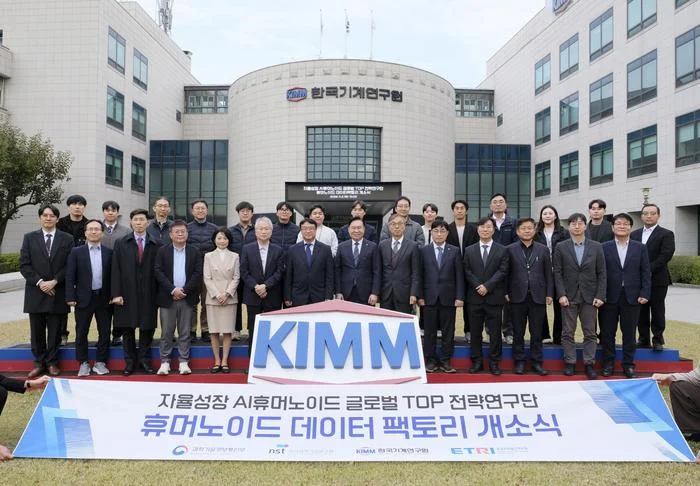
The facility, unveiled Nov. 3 at the Korea Institute of Machinery and Materials (KIMM), was developed in collaboration with the Electronics and Telecommunications Research Institute (ETRI). KIMM describes it as the country’s first dedicated data production facility for bipedal humanoid robots, capable of collecting information about arm, leg and full-body movements.
Human operators remotely control the robots as they perform different activities, recording their movements and task-related information. The data is then used to train AI models to understand human instructions and their surroundings, with the eventual goal of allowing robots to perform tasks on their own.
According to KIMM, the trained models are tested on physical robots, and data from those tests is used to improve subsequent versions. The institute wants to develop AI systems that can work across different robot platforms, including South Korea’s K-Humanoid standard platform.
At the opening ceremony, robots demonstrated data collection during household tasks such as retrieving items from a refrigerator, handling laundry and arranging a sofa. Industrial demonstrations included operating buttons and levers inside a vehicle.
The event also featured KAIROS, a Korean-developed humanoid robot, demonstrating precise object manipulation and full-body motion imitation.
Building Domestic Robot Training Capabilities
The facility is part of the Global TOP Strategic Research Group for Self-Growing AI Humanoids, led by KIMM researcher Chan Hun Park. KIMM said the project is intended to give South Korea the ability to produce large amounts of its own robot training data, reducing dependence on overseas datasets and AI models.
The institute plans to increase the number of robots and expand the range of tasks used for data collection. Beginning at the end of 2027, it expects to gradually open the facility to domestic companies, universities and research organizations.
“Securing large volumes of high-quality robot task data is essential to national technological competitiveness, and the establishment of this Data Factory marks an important starting point for building Korea’s own robot AI training data and technological assets,” KIMM president Seog-Hyeon Ryu said in the announcement. “Through industry-academia-research collaboration, we will accelerate the development of Korea’s KAIROS humanoid robot and gradually open the Data Factory beginning at the end of 2027, thereby contributing to the competitiveness of Korea’s physical AI industry.”
The Ministry of Science and ICT is supporting the project and plans to coordinate research through its K-Moonshot AI Humanoid Mission, which aims to develop domestic humanoid AI technology and strengthen South Korea’s robotics industry.