
Volvo Cars Begins Training Hexagon Humanoid Robots for Factory Work
 By Greg Bock · · 2 min read
Insider Brief
- Volvo Cars has begun training Hexagon Robotics’ Aeon humanoid robots at its Ghent, Belgium, factory, ahead of a 2027 pilot aimed at introducing the robots into vehicle production.
- The robots are learning tasks through imitation learning, beginning with precision component placement before progressing to handling multiple parts, navigating production areas and interacting with automated systems.
- Aeon stands 1.65 meters tall, moves on wheels and can carry up to 10 kilograms, with Volvo targeting deployment in regular vehicle production by mid-2027 to help reduce physically demanding work for employees.
Volvo Cars has begun training humanoid robots from Hexagon Robotics at its manufacturing plant in Ghent, Belgium, ahead of a planned factory pilot in 2027 that could lead to their use in vehicle production.
According to Volvo, the automaker is introducing Hexagon’s Aeon robots to perform repetitive and physically demanding tasks alongside employees and existing automation.
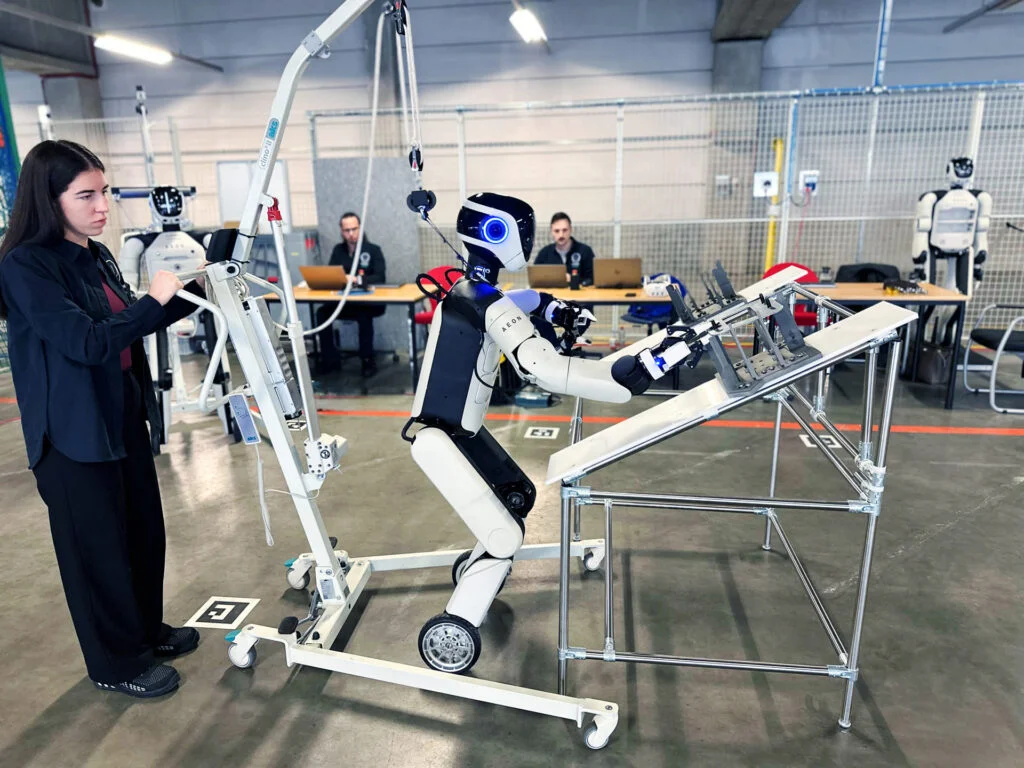
Ghent is the first Volvo Cars plant to test humanoid robots and Volvo’s manufacturing team is working with Hexagon Robotics, a division of Swedish technology group Hexagon, to train the robots through imitation learning, in which they learn tasks by copying how people perform them.
Their first assignment involves placing components into two fixtures with high precision, according to Volvo. As the robots demonstrate they can complete each task, training will expand to handling multiple parts, moving through production areas and interacting with automated systems.
While robotics isn’t new to car manufacturing, Vovlo pointed out that unlike conventional , fixed-location industrial robot arms, Aeon is designed to perform different jobs within existing manufacturing environments.
“AEON’s humanoid design means it can fit into our production as it is today, alongside our teams and existing automation,” says Volvo’s chief manufacturing officer Magnus Nilsson said in the announcement. “Our aim is for humanoid robots to take on some of the most physically demanding tasks and help make work more ergonomic for our people.”
Aeon
The robot stands 1.65 meters tall, weighs 60 kilograms and uses cameras and sensors to perceive its surroundings and handle components. It moves on wheels rather than feet, reaching speeds of up to 2.4 meters per second, and can carry loads of up to 10 kilograms.
Additional Aeon units are scheduled to arrive in Ghent for a factory pilot in the first half of 2027, when the robots will begin training on a wider range of tasks. Volvo is looking to put them to use in regular production beginning in mid-2027, and said the project is part of its overall investment in advanced manufacturing.
“The purpose of humanoid robotics is to deliver business value to our customers,” Hexagon Robotics president Arnaud Robert said. “Working closely with Volvo Cars’ teams allows us to ensure Aeon performs real-world tasks that support their manufacturing process.”