
Insider Brief
- The A-Lab, an autonomous system combining AI and robotics, has successfully synthesized 41 new inorganic materials, potentially useful in batteries and solar cells, completely autonomously.
- Google DeepMind’s AI system, GNoME, has predicted 381,000 new inorganic compounds by training on existing materials databases and applying advanced tactics like partial ion substitutions.
- The A-Lab’s contributions to the Materials Project database are expected to be its greatest legacy, providing a detailed map of the reactivity of common solids and accelerating future materials discovery.
Combining Google DeepMind’s tools, which predicts nearly 400,000 stable substances, with an autonomous system learns to make them in the lab, scientists say that they’re creating an advanced tool to tackle the world’s biggest scientific challenges.
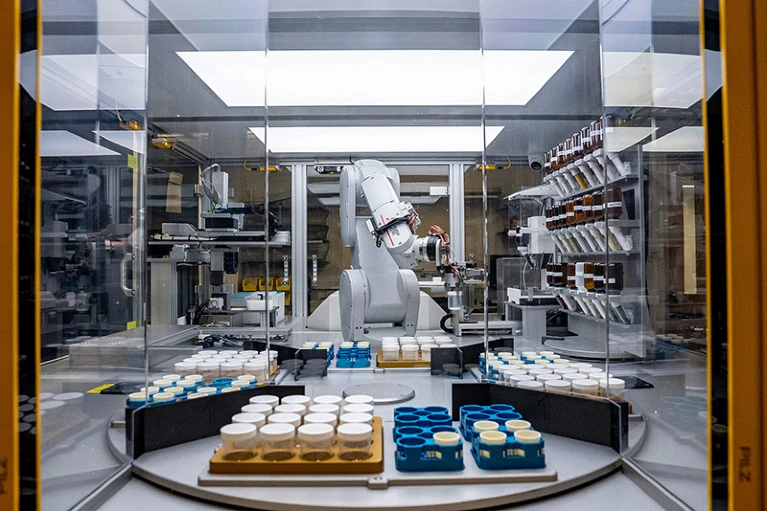
According to a story and a recent paper in Nature, A-Lab, an autonomous system that combines robotics with artificial intelligence (AI), revealed its first discoveries in material synthesis. Using the ingredients from Google DeepMind’s investigations, the system autonomously develops recipes for new materials, including those potentially useful in batteries and solar cells, and then synthesizes and analyzes these products without human involvement.
As reported in Nature, these technological strides, led by Ekin Dogus Cubuk, of Google DeepMind, signify a significant acceleration in the discovery of materials vital for clean energy, electronics, and other applications.
“A lot of the technologies around us, including batteries and solar cells, could really improve with better materials,” Cubuk told Nature.
Historically, chemists have synthesized several hundred thousand inorganic compounds. Yet, it’s estimated that billions of such materials remain undiscovered. Projects like the Materials Project at the Lawrence Berkeley National Laboratory (LBNL) have computationally simulated and predicted the stability of about 48,000 new inorganic materials.
Taking this approach further, Google DeepMind’s AI system, Graph Networks for Materials Exploration (GNoME), has proposed 2.2 million potential compounds after training on existing materials databases. After stability checks and crystal structure predictions, GNoME added 381,000 new inorganic compounds to the Materials Project database. GNoME’s advanced tactics include partial ion substitutions and exploring a wide range of atom swaps, learning from unsuccessful attempts.
The A-Lab, situated at LBNL, represents a significant leap in material synthesis. Costing $2 million and taking 18 months to build, this robotic setup autonomously plans experiments, interprets data, and refines synthesis processes. Gerbrand Ceder, who led the A-Lab team, emphasizes the AI-driven autonomy that guides the system.
The A-Lab has successfully produced 41 new inorganic materials in 17 days, 9 of which were synthesized after its ‘active learning’ algorithm refined the process. However, some materials required human intervention due to experimental challenges.
More work remains, researchers acknowledge. For example, more capacity will be required because the volume of computational predictions outstrips the current capacity of autonomous labs.