Wednesday · September 30, 2026  ·  Daily  ·  Newsletters

Resonance network: Quantum InsiderSpace Insider

Cambridge Researchers Develop Flexible, Meltable Electronic Skin to Give Robots Sense of ‘Human Touch’

Insider Brief

  • Researchers from the University of Cambridge and UCL have developed a meltable, flexible electronic skin capable of sensing and processing multiple types of physical contact across its entire surface.
  • The skin detects over 860,000 conductive pathways, enabling it to recognize taps, pressure, temperature changes, and physical damage, using machine learning to identify the most relevant signals.
  • Potential applications include humanoid robotics, prosthetics, automotive systems, and disaster relief, with findings published in the journal Science Robotics.

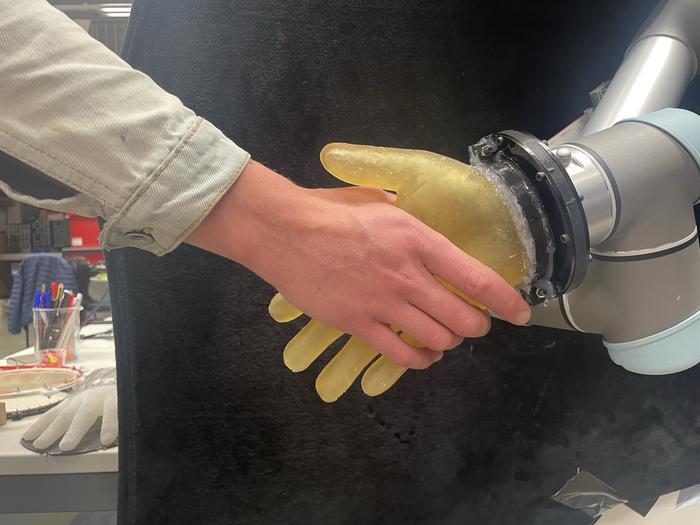
PRESS RELEASE – The researchers, from the University of Cambridge and University College London (UCL), developed the flexible, conductive skin, which is easy to fabricate and can be melted down and formed into a wide range of complex shapes. The technology senses and processes a range of physical inputs, allowing robots to interact with the physical world in a more meaningful way.

Unlike other solutions for robotic touch, which typically work via sensors embedded in small areas and require different sensors to detect different types of touch, the entirety of the electronic skin developed by the Cambridge and UCL researchers is a sensor, bringing it closer to our own sensor system: our skin.  
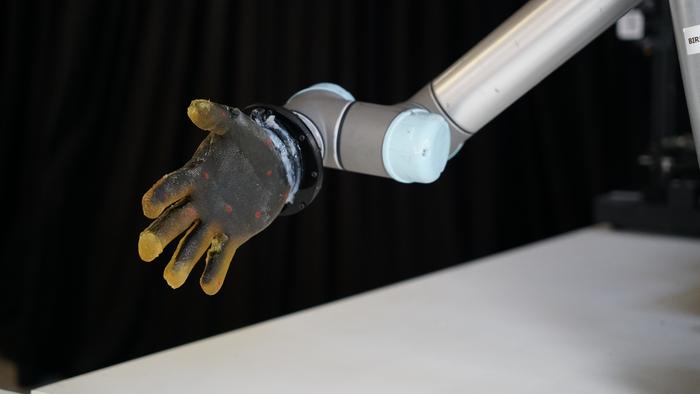
Scientists have developed a low-cost, durable, highly-sensitive robotic ‘skin’ that can be added to robotic hands like a glove, enabling robots to detect information about their surroundings in a way that’s similar to humans. (Credit: University of Cambridge)

Although the robotic skin is not as sensitive as human skin, it can detect signals from over 860,000 tiny pathways in the material, enabling it to recognise different types of touch and pressure – like the tap of a finger, a hot or cold surface, damage caused by cutting or stabbing, or multiple points being touched at once – in a single material.

The researchers used a combination of physical tests and machine learning techniques to help the robotic skin ‘learn’ which of these pathways matter most, so it can sense different types of contact more efficiently.

In addition to potential future applications for humanoid robots or human prosthetics where a sense of touch is vital, the researchers say the robotic skin could be useful in industries as varied as the automotive sector or disaster relief. The results are reported in the journal Science Robotics.

Greg Bock
About the author
Greg Bock

Greg Bock is an award-winning investigative journalist with more than 25 years of experience in print, digital, and broadcast news. His reporting has spanned crime, politics, business and technology, earning multiple Keystone Awards and a Pennsylvania Association of Broadcasters honors. Through the Associated Press and Nexstar Media Group, his coverage has reached audiences across the United States.

Trending today

Business & Markets

Seligman Ventures Doubles Deployable Capital to $1B to Back AI Infrastructure Startups

Technology & Infrastructure · Data centres & compute

Crusoe Ends $1.25B Turbine Deal With Boom Supersonic for AI Data Centers

Business & Markets

The Week Ahead in AI: OpenAI Halts Training, Amodei Dines with Trump, China Considering Nvidia Chip Greenlight, Plus Micron Earnings & Upcoming Events

a blurry photo of a colorful object
Technology & Infrastructure · Applications & agents

Google Expands Gemini’s Agentic Reach With AI Calling and a Virtual Closet in Google Photos

Business & Markets · Enterprise

AMD to Acquire World Labs in $8.2B All-Stock Deal

The AI economy, every weekday morning

The daily briefing on LinkedIn. Free, one tap to follow.

Exclusives

National Strategies

South Korea’s AI G3 Strategy: Decoded

Startups

10 Switzerland-Based AI Scale-Ups You Need to Know in 2026

network, blockchain, digital, hand, web, community, artificial, intelligence, steering, interfaces, bokeh, future, digitization, transformation, change, blockchain, blockchain, blockchain, blockchain, blockchain, transformation
Data centres & compute

Why Crypto Could Be AI’s Payment Layer: BlackRock Sees Stablecoins Connecting Commerce and Compute

AI Predictions
Enterprise

Why AI Predictions Often Get The Technology Right But The Timeline Wrong

Startups

10 CEE & Baltics-Based AI Scale-Ups You Need to Know in 2026

More in Technology & Infrastructure

Latest from the same section
Physical AI · Wearables

PrismML Brings Its 1-Bit Bonsai LLM to Qualcomm-Powered AI Smart Glasses

1 day ago
Physical AI

Light Origins Launches Light-O1 Foundation Model for Robot Learning

3 days ago
Technology & Infrastructure · Models & LLMs

Anthropic Says Claude Discovered New CRISPR-Like Enzyme System in Its Biology Lab

5 days ago
Technology & Infrastructure · Models & LLMs

Anthropic Launches Claude Opus 5.5 With Stronger Coding Performance and Lower Pricing

6 days ago

The AI economy, every weekday morning

The daily briefing plus the weekly Scale-ups to watch edition. Free, no spam, unsubscribe any time.