Insider Brief
- IIT, backed by JOiiNT LAB in Bergamo, unveiled Frasky—an autonomous vineyard robot that navigates rows, maps plants, detects grape clusters, and applies targeted treatments to reduce waste and ease labor needs, according to IIT.
- Designed for precision farming amid labor shortages and climate pressures, the system uses modular navigation, perception, and manipulation software with an operator interface, and the team plans to expand tasks and autonomy, IIT said.
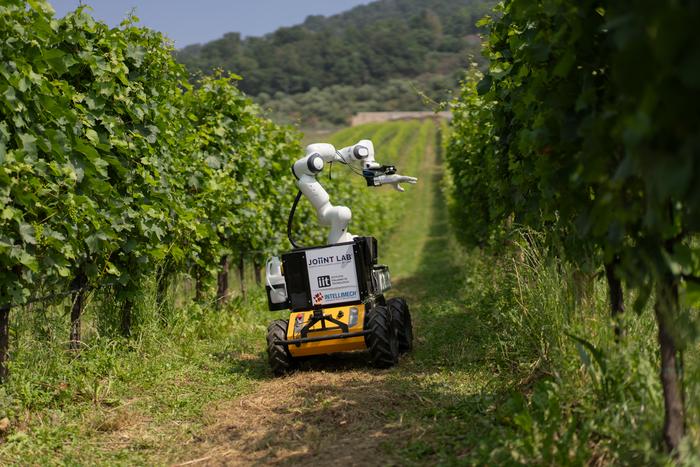
- Frasky was initially tested in the lab and then validated in a real vineyard in Bergamo: “Le Corne” vineyard in Grumello del Monte. These tests demonstrated the platform’s ability to move, map the environment, and autonomously apply treatments.(Photo Credit: IIT-Istituto Italiano di Tecnologia)
Backed by JOiiNT LAB—the research-industry initiative linking the Italian Institute of Technology (IIT) with partners in Bergamo’s industrial ecosystem—IIT researchers in Genoa unveiled Frasky, a prototype robot that autonomously navigates vineyard rows, maps plants, identifies grape clusters and applies selective treatments to reduce waste and ease labor pressure, according to IIT.
Don’t expect Frasky to be stomping any grapes.
Frasky is built to move and work inside real vineyards rather than laboratory test beds. The system combines a four-wheel mobile platform for outdoor navigation with a robotic arm and dexterous hand designed to interact with vines and fruit. An integrated camera inside the arm feeds software that recognizes obstacles and detects grape clusters with precision, IIT reported.
“Integrating robotics and artificial intelligence in agriculture allows us to develop increasingly advanced models of precision farming,” noted Manuel G. Catalano, IIT researcher and JOiiNT LAB coordinator. “For instance, it enables more efficient and targeted use of resources, reduces environmental impact, and offers concrete support to farmers and wine producers.
The end-effector is modular; a built-in nozzle can deliver targeted sprays for disease or pest control. In demonstrations that followed lab trials on an artificial vineyard, the robot traversed rows at the Le Corne vineyard in Grumello del Monte (Bergamo), built environmental maps and executed autonomous treatment applications. IIT said the approach supports more precise crop monitoring, assistance with repetitive tasks, and tighter dosing—benefits aimed at sustainability and worker safety by limiting exposure to chemicals.
Implications
The project addresses two mounting pressures in agriculture: a shortage of skilled labor and climate-driven variability that requires more timely, precise interventions. By combining robotics and AI, IIT and JOiiNT LAB partners aim to advance precision farming—reducing inputs, curbing environmental impact and giving growers tools to maintain productivity when staffing is tight. The consortium structure is meant to accelerate transfer from research to practice, with regional industry involvement to speed adoption beyond manufacturing into agriculture, IIT noted.
Methods
Frasky’s software stack centers on three modules, according to IIT. A navigation module handles localization, path planning and obstacle avoidance; a perception module analyzes the environment and recognizes grape clusters; and a manipulation module coordinates arm motions for grasping, inspection and treatment. Perception data support both mapping and manipulation so the system can target individual bunches or canopy zones.
Operators use a graphical interface to issue commands and monitor progress in real time. Hardware and software are modular to let farmers swap tools or extend functions by task and season. Development progressed from controlled lab testing on an artificial vineyard to outdoor validation at a commercial site in Bergamo, IIT said.
Challenges
Vineyards pose difficult conditions for autonomy. Uneven terrain, changing weather and seasonal growth reduce visibility and constrain motion; dense foliage can occlude targets and complicate path planning. Handling grapes requires gentle, precise contact because the fruit deforms and bruises easily.
Frasky was first tested on an artificial vineyard, then field-validated at the Le Corne vineyard in Grumello del Monte, Bergamo. The trials showed it can navigate rows, map the environment, and autonomously apply treatments.
“We are currently working to make Frasky even more flexible, autonomous, and capable of adapting to various agricultural contexts, which present high complexity by their nature,” Francesca Negrello, IIT researcher and Technology Manager of JOiiNT LAB, added. “Our goal is to expand the robot’s perception and manipulation capabilities to other tasks beyond those already validated, so that it can operate alongside viticulturists, supporting them in production monitoring and in more repetitive and burdensome activities.”