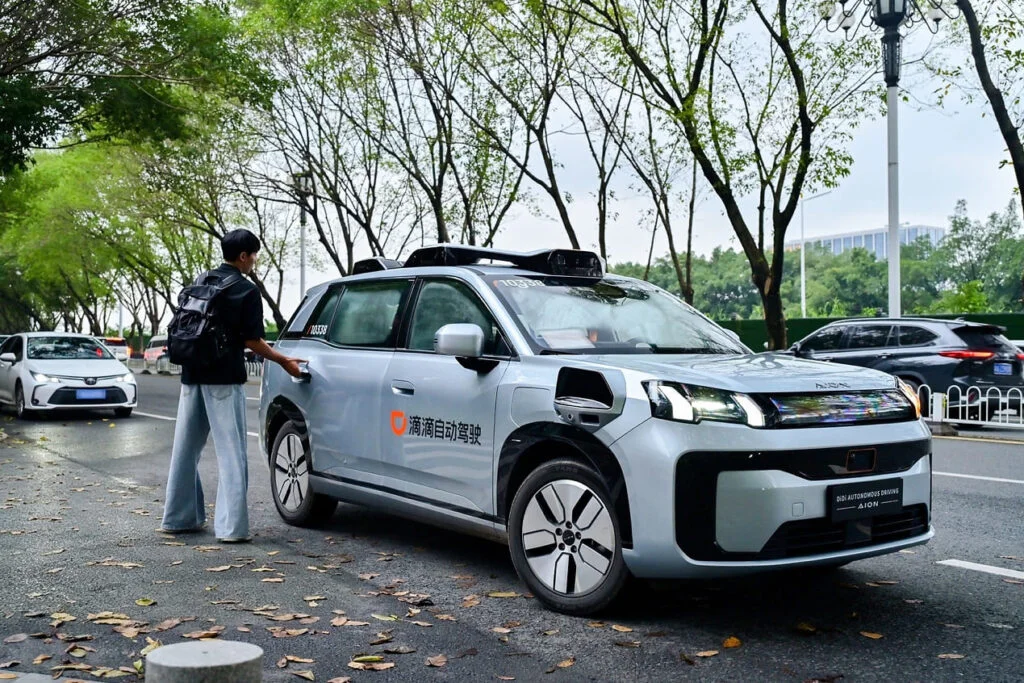
Insider Brief
- DiDi Autonomous Driving has begun fully driverless passenger-service trials with its R2 robotaxi in selected areas of Beijing and Guangzhou, with rides available through the DiDi app.
- The R2 was jointly developed with GAC Aion and uses DiDi’s Level 4 software and hardware stack, 33 sensors, a triple-domain computing platform and a multi-layer redundancy system.
- DiDi said the purpose-built robotaxi also includes a 17.3-inch passenger display, AI voice controls and added rear-passenger space, with more cabin and vehicle-locating features planned.
China’s DiDi Autonomous Driving has begun fully driverless passenger-service trials with its latest robotaxi in selected areas of Beijing and Guangzhou.
According to the company, the R2 robotaxi was jointly developed by DiDi and GAC Aion and can be booked through the DiDi app in designated demonstration areas. The R2 has been undergoing public-road testing since its delivery in January, with vehicles operating in Guangzhou, Beijing, Shenzhen and other cities, DiDi reported.
The company said the vehicle, designed specifically for robotaxi operations, also incorporates multiple layers of redundancy and meets five-star safety standards under both China’s C-NCAP and Europe’s Euro NCAP programs.
R2 at a Glance
- Autonomy: DiDi Level 4 full-stack software and hardware
- Sensors: 33
- Computing: Triple-domain fusion central computing platform
- Safety: Multi-layer redundancy system
- Passenger display: 17.3-inch ceiling-mounted screen
- Voice controls: Trip verification, air conditioning, windows and ambient lighting
DiDi said the R2 was designed with additional rear-passenger space and high-angle adjustable seats. Its AI voice system allows passengers to verify a PIN and start a trip as well as adjust cabin settings through voice commands.
Before reaching a pickup location, the vehicle can automatically open its windows to ventilate the cabin, and according to DiDi, the company plans to add features including an exterior interaction screen, preset cabin temperature and ambient-lighting settings, and tools that use the horn and voice prompts to help passengers locate the vehicle.
Image credit: Didi Autonomous Driving