
Insider Brief
- A KAIST-led research team used machine learning to develop a 3D-printable elastomer that can stretch to more than six times its original length, with potential applications in soft robotics, wearables and custom medical devices.
- The researchers used experimental data on material formulations to train a machine-learning model that identified a recipe balancing the flow needed for Digital Light Processing 3D printing with high stretchability and durability.
- The team demonstrated the material in soft actuators and a robotic hand that lifted a 1-kilogram bottle and grasped objects including eggs, glass bottles, an egg carton and a computer mouse.
A KAIST research team reports using machine learning to develop a material that can stretch like rubber but is also 3D-printable.
“This research is significant as it shows that combining researchers’ experimental data with artificial intelligence can efficiently identify optimal material combinations that were previously difficult to find,” said professor Seungchul Lee, who led the research by KAIST and Seoul National University of Science and Technology. “We expect it to be used to more rapidly develop 3D-printing materials with the performance needed across a range of fields, including soft robots, wearable devices, and custom medical devices.”
The work, published in Nature Communications, was supported by South Korea’s Ministry of Trade, Industry and Resource through its Machinery and Equipment Industry Technology Development Program and by the Ministry of Science and ICT through two research programs.
The Challenge
Researchers noted the process could overcome a longstanding tradeoff in a type of 3D printing known as Digital Light Processing. DLP uses light to cure liquid material into solid structuresthe technique can quickly produce complex shapes, but materials that are made more durable and stretchable often become too thick to flow properly during printing. Making the liquid thinner improves printability but can reduce strength and stretchability, researchers pointed out.
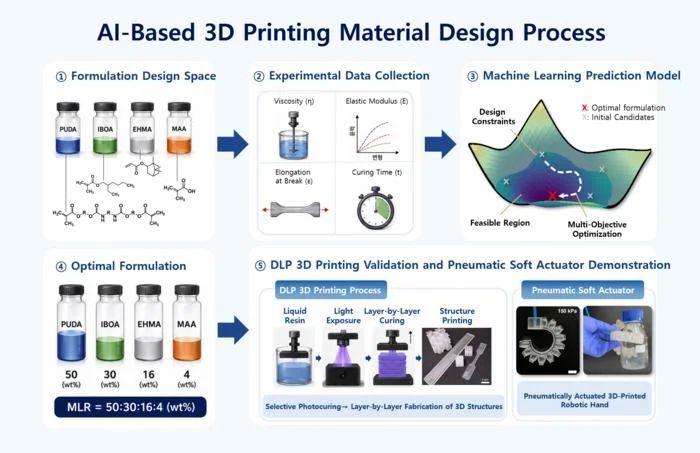
To tackle the problem, researchers used AI to search for a material formulation that could satisfy both requirements and reported the resulting material printed reliably using DLP and could stretch to more than six times its original length without easily tearing. The researchers then tested it by printing soft actuators, devices that use air pressure or other forces to produce flexible, muscle-like movement.
When inflated, the actuator expanded and bent in a motion similar to a human finger, according to the study. The team combined several actuators into a soft robotic hand that lifted a 1-kilogram water bottle and grasped objects with different shapes and levels of rigidity, including eggs, glass bottles, an egg carton and a computer mouse.
AI Searches for the Material Recipe
Rather than testing material combinations only through trial and error, the researchers cured a range of liquid formulations in small molds and measured their stretchability, hardness, response to light and ability to flow. WIth those results, they built a dataset linking different formulations to their physical properties and notably, the dataset included both materials that were easy to print and highly viscous formulations that were difficult to print.
The team then trained a machine-learning system to identify relationships between the material recipes and their performance. Using those patterns, the model selected a formulation expected to provide both DLP printability and high stretchability.
The researchers said the approach could reduce the amount of experimental trial and error required to develop new 3D-printing materials. Instead of manually testing large numbers of formulations, scientists could use experimental data to train models that first identify promising candidates for laboratory verification.
Potential for Soft Robotics and Wearables
KAIST indicated the work addresses growing demand for materials that can form complex structures while remaining soft and flexible. Those properties are important for technologies that physically interact with people or need to conform to irregular surfaces, including soft robotic systems, body-worn devices and patient-specific medical equipment.
The robotic-hand demonstration provided a test of the material under contact-heavy conditions. The hand had to deform while handling objects ranging from fragile eggs to rigid bottles and heavier loads.
According to the researchers, the main takeaway of the study is the method used to find the material rather than only the formulation itself. The same machine-learning approach could be applied to searches for other printable materials with different combinations of mechanical and manufacturing properties.
Featured image: Figure 1. AI-based material design framework proposed in this study and its application to soft robotics (Credit KAIST)