Anthropic’s S-1, Dissected, Part 1: Mission and Vision
 By James Dargan · · 14 min read
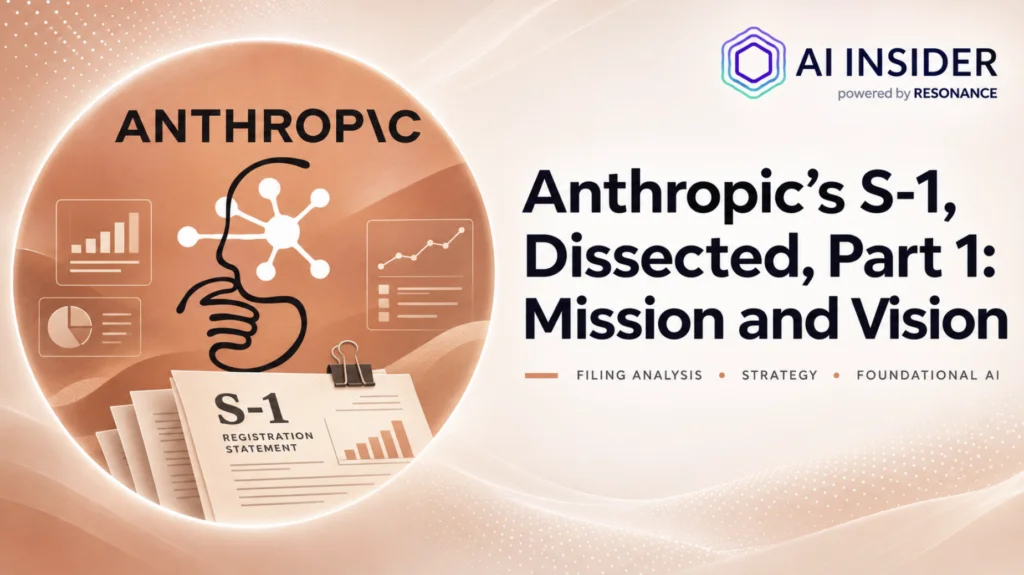
A summary of what Anthropic’s registration statement says about the company’s mission, the advantages it claims, its view of where AI is heading, its culture, its public benefit commitments and its governance structure.
Source: Form S-1/A, Amendment №2, filed Nov. 10, 2026
IMPORTANT NOTICE: NOT INVESTMENT ADVICE, NOT AN OFFER, NOT AN ANALYSIS. This article summarizes statements made by Anthropic PBC in its preliminary prospectus on Form S-1, as amended on Nov. 10, 2026. It is provided for general information only. It is not investment, financial, legal, tax or accounting advice, and it is not a recommendation to buy, sell or hold any security. It is not an offer to sell, or a solicitation of an offer to buy, any security. The registration statement has not yet become effective, its information is incomplete and may change, and no securities may be sold until it is effective. The AI Insider reports the content of the filing as written, has not independently verified it and does not add its own estimates, forecasts or opinions. See the full disclaimer at the end of this article.
Insider Brief
- Anthropic’s latest S-1 amendment describes the company as first and foremost a research lab whose mission is the responsible development and maintenance of advanced AI for the long-term benefit of humanity.
- The filing lists five core advantages, mission and focus, talent and culture, frontier and safety research, its approach to compute, and its enterprise strategy, and puts aggregate committed spend, substantially all on compute and infrastructure, at about $900.9 billion.
- After the offering, the Long-Term Benefit Trust will generally elect a majority of the board, and a co-founder vehicle will hold 50.1% of the votes on matters put to shareholders generally.
Anthropic PBC filed Amendment №2 to its registration statement with the U.S. Securities and Exchange Commissionon Nov. 10, 2026. It follows Amendment №1 of Nov. 2 and the original filing the company announced on Oct. 26. The prospectus remains preliminary and subject to completion. This article, the first in a five-part series, summarizes how the filing presents the company itself. The offering terms are covered in Part 2.
A NOTE ON TERMINOLOGY
The prospectus states that it uses the terms super intelligence, SI, artificial intelligence and AI interchangeably. It explains that on Sept. 29, 2026, the President of the United States issued Executive Order 14434, which directs federal executive departments and agencies to use Super Intelligence and SI in place of Artificial Intelligence and AI. Several passages summarized below therefore appear in the filing with SI rather than AI. This article uses AI throughout.
HOW DOES THE S-1 DESCRIBE ANTHROPIC?
The prospectus summary opens with the company’s view that intelligence has, for the first time, become something humans can build, producible at scale and accessible on demand. Anthropic states that it believes this will transform every sector of the global economy in ways greater than the impact of industrialization, electricity, semiconductors and the internet, provided the risks are well managed.
According to the filing, Anthropic was founded in 2021 by researchers responsible for many of the breakthroughs that define AI, and it describes itself as first and foremost a research lab. It states that members of its team originated advances including reinforcement learning from human feedback, Constitutional AI, GPT-2 and GPT-3, and mechanistic interpretability, developed the first Responsible Scaling Policy formally adopted by a frontier lab, and authored the foundational paper on scaling laws.
The company delivers its frontier model, Claude, through models, a platform and applications. The filing claims Claude has experienced the fastest enterprise adoption of any technology in history, citing revenue that grew from zero at commercial launch in the first quarter of 2023 to $17.0 billion for the three months ended Sept. 30, 2026.
WHAT DOES THE S-1 SAY ABOUT THE MISSION?
The filing describes Anthropic’s mission as the responsible development and maintenance of advanced AI for the long-term benefit of humanity. The same wording is the company’s specific public benefit purpose under its certificate of incorporation as a Delaware public benefit corporation, which the prospectus calls the Company Purpose.
The S-1 states that the mission directs the company’s focus and counts it among its core advantages. In the company’s framing, achieving the mission means the world gains the benefits of frontier AI while the most significant risks are mitigated, which it believes requires safety and capability to advance together.
WHAT ADVANTAGES DOES ANTHROPIC CLAIM?
The prospectus lists five core advantages.
Mission and focus. The filing says a singular focus on the mission lets Anthropic concentrate talent, research and compute on what it considers the highest-value work and avoid conflicting priorities. Elsewhere, in describing its research philosophy, the company states that it does not currently focus on video and image generation models and directs that compute to coding, agentic skills and safety research instead.
Talent and culture. The company describes a low-ego, truth-seeking culture in which frontier capability and safety reinforce each other, and says that culture has driven its talent density as it has scaled.
Frontier and safety research. Anthropic states that its capabilities and safety research are integrated and shape model design, training and deployment. It describes a dynamic it calls closing the loop, in which each version of Claude helps build the next by running experiments, generating and processing training data, automating evaluations and safety audits, and writing and reviewing code. According to the filing, more than 90% of contributions to Anthropic’s codebase in September 2026 were written by Claude, and average daily code volume per engineer in the third quarter of 2026 was over 45 times the 2024 average.
Approach to compute. The S-1 says Anthropic manages compute as a single, fungible pool drawn from multiple strategic partners and directs it between workloads, training and serving Claude across AWS Trainium, Google TPUs, NVIDIA GPUs and AMD GPUs. As of and subsequent to Sept. 30, 2026, the company reports purchase commitments and lease agreements, including short-term commitments and leases not yet commenced, with aggregate committed spend of approximately $900.9 billion, substantially all related to compute and infrastructure. About $451.6 billion is expected to be incurred before Dec. 31, 2030, substantially all of the remainder between 2031 and 2045, and about $70.7 billion falls due in the 12 months following Sept. 30, 2026. Amendment №1 had reported the aggregate figure as about $895.4 billion.
Enterprise strategy. The company states that it has organized its research priorities, product roadmap, and go-to-market and Applied AI teams around enterprise use cases, on the basis that enterprise deployment is where economic impact is greatest and customer feedback is richest.
The filing also describes two self-reinforcing loops. In the improvement loop, feedback from enterprise deployments is used to improve the models, platform and applications. In the investment loop, revenue from enterprise adoption helps fund the compute, research and talent used to improve Claude.
WHAT DOES THE S-1 SAY ABOUT WHERE AI IS HEADING?
Anthropic states that it believes a form of frontier intelligence it calls Powerful AI will become widely available within a few years. It defines Powerful AI by five attributes: cognitive capabilities matching or exceeding top human experts across most professional and scientific disciplines; the ability to navigate all interfaces available to a human working virtually, including text, audio, video and direct computer control; the ability to reason through complex tasks autonomously over hours, days or weeks; the ability to coordinate across multiple instances and collaborate with humans and other systems; and the ability to interface with the physical world by controlling laboratory equipment, robotic systems and other machines.
The prospectus lists potential applications including compressing decades of scientific progress into years, accelerating drug discovery and disease detection, individually tailored education and expert financial and legal advice, improved power grids and battery design, and extending capabilities to the developing world.
On the near-term opportunity, Anthropic states that it believes the work performed by knowledge workers represented more than $40 trillion in economic value globally in 2025, a figure it derives from its own calculations using third-party data. It cites an IDC estimate that investment in AI solutions and services will yield a cumulative global economic impact of $22.5 trillion by 2031, an IDC estimate that the knowledge-worker population will exceed one billion in 2028, and an IQVIA estimate that global pharmaceutical spending will exceed $2 trillion in 2026.
WHAT ARE VIRTUAL COLLABORATORS?
The S-1 uses the term Virtual Collaborators for AI systems that work alongside humans on complex, multistep work at professional levels, carrying the access rights, system connections and context their organizations grant them.
The filing describes Claude Code, its coding agent released as a research preview in February 2025, as the clearest current example. It states that Claude Code plans, writes, tests and debugs code, and that NASA engineers used it to plan and write navigation commands for the Mars Perseverance rover, resulting in what the filing describes as the first AI-planned drive on Mars.
Claude Cowork, released as a research preview in January 2026, extends the same agentic architecture to knowledge workers by reading files, navigating applications and executing multistep workflows on a user’s desktop. According to the filing, Cowork’s adoption as of Sept. 30, 2026, outpaced what Claude Code achieved at the equivalent point after its own preview release, and in September 2026 Anthropic began merging Cowork and Claude.ai into a single application.
The company says it is building toward Claude taking on open-ended tasks lasting hours, days or weeks, with millions of Virtual Collaborators running in parallel, which it describes as a country of geniuses in a data center.
WHAT DOES THE FILING SAY ABOUT SAFETY?
The prospectus states that rapid AI advancement could cause significant disruption if the technology is not developed and deployed responsibly. It names AI-enabled cyberattacks, misuse in domains including biology, the concentration of power and wealth within and between countries, and misaligned models that could cause large-scale harm through autonomous actions.
Anthropic states that it believes safety, alignment and ethical behavior resonate strongly with enterprises, where rigorous safeguards, predictable model behavior and accountability have become decisive criteria in choosing a partner for mission-critical workloads.
The filing describes the company’s Responsible Scaling Policy, which requires it to publish risk reports and a Frontier Safety Roadmap. It says mitigation steps have included delaying the release of new models and limiting their initial availability, including the initial release of Mythos through Project Glasswing. The amendment also states that Anthropic is considering updates to the policy to keep humans in control of frontier model development, including by requiring human review and approval of certain research and development decisions.
The S-1 also describes Claude’s constitution, which is used in training and sets four priorities: being broadly safe, being broadly ethical, complying with Anthropic’s guidelines and being genuinely helpful. The company states that publishing the values it intends Claude to hold increases customer trust.
The filing names Google and OpenAI as its primary competitors among developers of frontier models for third-party developers and enterprises.
WHAT DOES THE S-1 SAY ABOUT CULTURE AND VALUES?
According to the filing, all seven co-founders remain active leaders in the company. Employees are known internally as Ants, and Anthropic had about 5,300 employees as of Sept. 30, 2026, a majority of them in research, engineering and product development.
The prospectus lists seven values: act for the global good; hold light and shade; be good to our users; race to the top on safety; do the simple thing that works; be helpful, honest and harmless; and put the mission first. It states that the mission acts as the arbiter when tradeoffs arise between speed and safety, short-term revenue and long-term trust, and competitive pressure and responsible development.
WHAT PUBLIC BENEFIT COMMITMENTS DOES THE FILING DESCRIBE?
According to the S-1, Anthropic contributed 846,840,960 shares of Class N common stock to the Anthropic Public Benefit Fund, a wholly owned subsidiary dedicated to the Company Purpose. The shares represent 5% of fully diluted shares as of June 30, 2026, assuming full conversion of the company’s convertible notes held by Amazon. The board has also approved a framework under which it may, at its discretion, issue up to an additional 2% of then-outstanding shares to the fund each time the share price rises 50% above the prior milestone, starting from the IPO price. A milestone counts only once the closing price has exceeded the threshold on at least 90 of the trailing 120 trading days.
The filing states that each co-founder has pledged to dedicate 80% of their personal equity in Anthropic to philanthropic causes. Its risk factors describe these pledges as voluntary, revocable expressions of intent rather than legally binding obligations. The company separately runs a donation matching program under which it matches employee equity pledges with Class N shares.
HOW IS ANTHROPIC GOVERNED?
The S-1 describes three elements of the governance structure.
Public benefit corporation status. As a Delaware PBC, Anthropic’s directors must balance the pecuniary interests of stockholders, the best interests of those materially affected by the company’s conduct, and the Company Purpose. The board will measure public benefit performance against five mission pillars: that the technical problems of AI safety are solved, that AI safety is a universal practice backstopped by law, that AI strengthens democracy and global stability, that AI expands prosperity and human flourishing, and that AI’s benefits are shared by everyone. It will publish a progress statement at least every two years. The filing notes that its governing documents do not require measurement against an objective third-party standard.
The Long-Term Benefit Trust. Created in 2023, the Long-Term Benefit Trust is intended to operate as an independent body of five financially disinterested trustees with expertise in AI safety, national security, public policy and social enterprise. One of the five seats is currently vacant. The current trustees are Neil Buddy Shah, who chairs the trust, Richard Fontaine, Ben S. Bernanke and Christopher Stubbs. Through a single share of Class T common stock, the trust generally elects and removes the Class T directors, who will make up a majority of the board. The filing states that the trust has no decision-making authority over day-to-day management or strategy, that trustees are paid a fixed cash amount and that trust policies bar them from holding company securities.
Founder voting. Immediately before the offering, Anthropic will issue one share of Class F common stock to a limited liability company whose members will initially be the seven co-founders: Dario Amodei, Daniela Amodei, Tom Brown, Jack Clark, Jared Kaplan, Sam McCandlish and Christopher Olah. That share will carry 50.1% of total voting power on matters put to stockholders generally, including the election of directors other than the Class T directors. The Class F share is redeemed after a 450-day transition period that begins once there have been fewer than three continuing founder members for 90 consecutive days. Together, the trust and the founder vehicle will be able to elect every board member.
The S-1 lists five classes of common stock after the offering:
| Class | Votes | Economic rights | Holder or purpose |
|---|---|---|---|
| Class A | One vote per share | Yes | Sold in the offering |
| Class N | None, except as required by law | Yes | Converts to Class A on sale to an unaffiliated third party |
| Class T | Elects the Class T directors | No | One share, held by the Long-Term Benefit Trust |
| Class F | 50.1% of voting power | No | One share, held by the Founder LLC |
| Class E | One vote per share on limited matters | No | Employees other than co-founders; none outstanding at the offering |
As of Oct. 31, 2026, the filing lists six directors. Dario Amodei, chief executive officer; Daniela Amodei, president and chairperson; and Yasmin Razavi are elected by the Class A and Class F holders. Reed Hastings, who serves as lead independent director, Christopher Liddell and Vas Narasimhan are Class T directors. After the offering, the board will have seven authorized seats, with one Class T seat vacant. The board has a safety and risk committee alongside its audit, compensation, and nominating and corporate governance committees.
Anthropic states that it will be a controlled company under Nasdaq rules and expects to rely on that status only for its nominating and corporate governance committee, which will not consist entirely of independent directors.
Among its risk factors, the S-1 states that the capital structure may effectively eliminate the ability of Class A holders to influence important decisions, including a change in control, and that the directors’ duty to balance stockholder interests with the Company Purpose may conflict with short-, medium- or long-term financial interests.
FULL DISCLAIMER
Not investment advice. This article is for general information only. It is not investment, financial, legal, tax or accounting advice and does not take into account any reader’s objectives, financial situation or needs. Nothing in it is a recommendation to buy, sell or hold any security. Readers should consult a licensed financial adviser before making any investment decision.
Not an offer. This article is not an offer to sell, or a solicitation of an offer to buy, any security in any jurisdiction. Any offer will be made only by means of a final prospectus. The registration statement summarized here had not become effective as of the date of the filing, its information is incomplete and may change, and the securities may not be sold until it becomes effective.
Company statements, not facts verified by The AI Insider. Everything in this article reflects statements made by Anthropic PBC in its filing. The AI Insider has not independently verified any of it. Many of these statements, including those about future capabilities, markets, commitments and plans, are forward-looking statements that involve substantial risks and uncertainties, and actual results may differ materially. Readers should review the full prospectus, including the sections titled Risk Factors and Special Note Regarding Forward-looking Statements.
Accuracy and timeliness. This article reflects Amendment №2 to the Form S-1, filed Nov. 10, 2026. The filing may be amended again, and later amendments or the final prospectus may change the information summarized here. Readers should consult the latest version on SEC EDGAR. The AI Insider accepts no liability for any loss arising from reliance on this article.
Disclosure. [CONFIRM BEFORE PUBLISHING: The author and The AI Insider hold no position in Anthropic securities and received no compensation from Anthropic or any underwriter in connection with this article.]
Trademarks. Anthropic, Claude and related names are trademarks of Anthropic PBC. Other names may be trademarks of their respective owners.
REFERENCES
- Anthropic PBC, Form S-1/A, Amendment №2, filed with the SEC on Nov. 10, 2026: Prospectus Summary; Business; Our Governance Structure and Its Goals; Management; Risk Factors. https://www.sec.gov/Archives/edgar/data/2130357/000162828026072484/anthropicpbc-sx1ax2.htm
- Anthropic PBC, Form S-1/A, Amendment №1, filed with the SEC on Nov. 2, 2026. https://www.sec.gov/Archives/edgar/data/2130357/000162828026068676/anthropicpbc-sx1ax1.htm
- Anthropic, announcement of the Form S-1 filing, Oct. 26, 2026. https://www.anthropic.com/news/s1-sec
- Anthropic, Project Glasswing. https://www.anthropic.com/glasswing
- SEC EDGAR, Anthropic S-1 filings index. https://www.sec.gov/cgi-bin/browse-edgar?action=getcompany&company=anthropic&CIK=&type=S-1&dateb=&owner=include&count=40