Beijing Eyes Annual Production Capacity of 200,000 Robots Under New Industry Plan
 By Greg Bock · · 4 min read

Insider Brief
- Beijing has unveiled a 2026–2028 robotics action plan targeting annual production capacity of 200,000 robots, at least five world-class humanoid robot manufacturers and 10 domestically leading manufacturers.
- The plan calls for more than 1 million hours of robot training data across at least 100 real-world scenarios, computing capacity exceeding 50,000 petaflops and new performance targets for robots and critical components.
- Beijing also plans to establish at least 50 industrial, service and specialized application scenarios, support 200 technology companies and expand robotics standards, testing and safety certification.
Beijing plans to build annual production capacity for 200,000 robots and develop at least five world-class humanoid robot manufacturers by 2028 under a new government plan to expand the city’s embodied AI industry.
The Beijing Municipal Bureau of Economy and Information Technology released the 2026-2028 action plan on Nov. 11, outlining goals for robot manufacturing, AI development, training infrastructure and commercial deployment. The action plan took effect immediately and remains valid through Dec. 31, 2028.
The city also wants to cultivate at least 10 domestically leading humanoid robot manufacturers and develop three to five internationally competitive robotic platforms.
Under the plan, the Beijing-Tianjin-Hebei region is expected to account for 25% of China’s embodied robotics production capacity, with more than 60% of key components sourced through the regional supply chain.
To reach those targets, Beijing plans to boost both contract manufacturing and companies building their own production lines. The government also wants to establish at least five manufacturing and testing platforms and 10 shared component-processing facilities across the Beijing-Tianjin-Hebei region. The facilities would help manufacturers test new designs and shorten the time needed to produce revised component samples to as little as one or two days.
Robot Performance and AI Training Targets
Beijing’s plan establishes performance targets for robotic platforms, including:
- Carrying capacity: More than 40% of the robot’s own weight.
- Operating time: More than four hours of continuous battery-powered operation.
- Reliability: More than 2,000 hours between failures.
- Lifespan: More than five years of designed service life.
Beijing will also prommote the development of vision-language-action models, world models and reinforcement learning systems to improve how robots interpret their surroundings, manipulate objects and carry out complex tasks.
The plan calls for collecting more than 1 million hours of high-quality training data across at least 100 real-world scenarios. It also proposes dedicated computing clusters exceeding 50,000 petaflops and a testing facility for evaluating embodied AI models in practical environments.
Robot Component Performance Targets
The plan also sets technical goals for critical robot components, including motors, sensors, dexterous hands and batteries. The targets include:
- Motors: Torque density of 60 newton-meters per kilogram.
- Precision reducers: Rated service life exceeding 15,000 hours.
- Integrated joints: Torque density of 100 newton-meters per kilogram and transmission efficiency above 85%.
- Tactile sensors: Force resolution of 0.01 newton or better and spatial resolution of 1 millimeter or better.
- Dexterous hands: Rated load life of 1 million cycles, fingertip force-control resolution of 0.1 newton and unit cost below 10,000 yuan.
- Batteries: Energy density of 350 watt-hours per kilogram and cycle life of 1,500 cycles.
The plan also identifies six-axis force sensors and biomimetic faces among the components slated for further development.
Developing Commercial Applications
The government wants to establish at least 50 demonstration scenarios to test robots in practical settings.
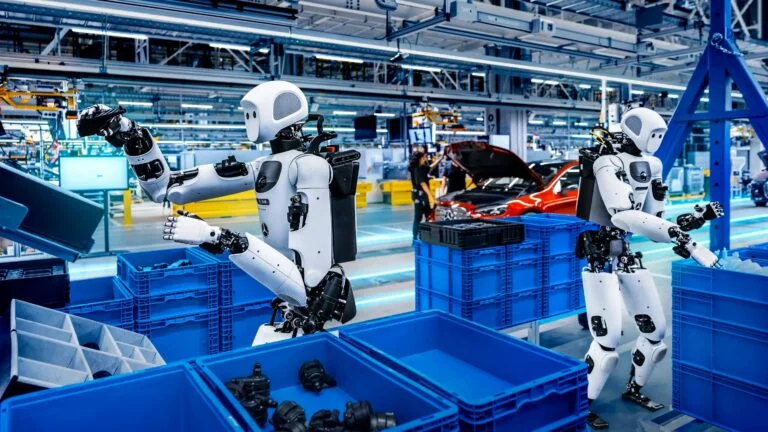
These include 20 industrial uses covering manufacturing and warehousing, 20 service applications involving healthcare, elderly care, retail and public services, and 10 specialized for emergency response, safety inspections and urban security.
The plan also calls for developing at least 15 scalable robotics solutions for commercial and household uses and indicated Beijing will support projects involving robots performing food preparation, cleaning and entertainment in restaurants, hotels and tourist attractions.
The city indicated it will foster the development of at least 200 technology companies and establish 100 robotics research teams at universities and research institutions. Additional measures include expanding open-source robotics software, developing industry standards and encouraging collaboration among manufacturers and research organizations.
Standards and Robot Safety
Beijing also wants local organizations to help develop at least eight international, 30 national and 70 industry standards, along with group standards, with participation in drafting more than 90% of relevant national standards.
The action plan includes a proposed safety and certification framework covering robotic hardware, AI models and data with the establishment of independent testing and certification facilities and the introduction of a system that assigns each robot a unique identification code.
The system is expected to provide tracking and safety oversight throughout a robot’s life, from development and manufacturing through disposal and recycling.