
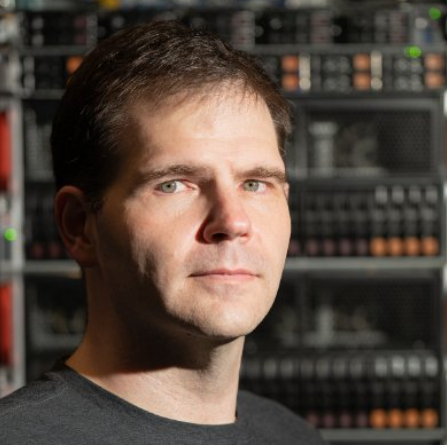
Jonathan Ross stands as a pioneering figure in AI. As the inventor of the Tensor Processing Unit (TPU) at Google and the founder/CEO of Groq, Ross is pushing the boundaries of what’s possible in computing speed and efficiency. In a recent candid interview with Matthew Berman, Ross shared his journey from Google to founding Groq, his insights on the future of AI, and the potential societal impacts of this transformative technology.
Ross’s departure from Google was driven by a desire to explore new horizons beyond the constraints of a large corporate environment. He reminisced about his time at Google.
“I loved my time at Google and then I was in Google X in the Rapid Eval Team, which is the team that comes up with the next things to do,” he said. However, the realization that being more ambitious and bold was easier outside the confines of Google spurred his decision to start Groq. Ross’s vision for Groq was clear from the outset, aiming to simplify AI software usability, which he saw as a significant barrier in the field.
At the heart of Groq’s innovation is its unique approach to chip design, optimizing for inference speed.
“You can’t build something different without doing some things that are a little bit counterintuitive,” explanied Ross, drawing attention to the strategic decision to accept lower memory per chip to achieve unparalleled processing speeds. This design philosophy has positioned Groq as a leader in the AI space, capable of executing hundreds of tokens per second, which is critical for powering the next generation of AI applications.
Looking towards the future, Ross articulated a vision where compute capability becomes the limiting factor in AI’s advancement, echoing the sentiment that “compute is the new oil.” This perspective highlights the increasing demand for efficient, high-speed computing as AI models become more complex and widespread. Ross believes that the value in the AI ecosystem will increasingly shift towards companies that can provide the infrastructure and hardware to support these advanced computational needs.
Central to Ross’s outlook on AI is the concept of agents — intelligent systems capable of making decisions and acting autonomously. He sees a future where AI agents become an integral part of our daily lives, assisting with a range of tasks and decisions. The speed at which Groq’s chips can process information is a key enabler for these agentic systems, allowing for rapid decision-making and interaction with the world in ways previously unimaginable.
However, Ross also acknowledges the challenges ahead, particularly regarding the societal implications of AI. He accentuated the importance of ensuring that AI technologies broaden our understanding of the world and each other, rather than narrowing our perspectives. Ross’s commitment to supporting AI models that promote a more nuanced and expansive view of the universe reflects a hopeful vision for the technology’s impact on society.
Ross’s journey from Google to Groq sums up the dynamic and transformative nature of the AI industry. His wisdom into the importance of speed, the potential of AI agents and the ethical considerations surrounding AI deployment offer a glimpse into the future of technology. As we stand on the cusp of what Ross describes as “the greatest transformation of humanity ever,” it’s clear that AI will play a central role in shaping our world in the years to come. With visionaries like Ross at the helm, the possibilities are both exciting and boundless.
Featured image: Credit: Jonathan Ross X profile