
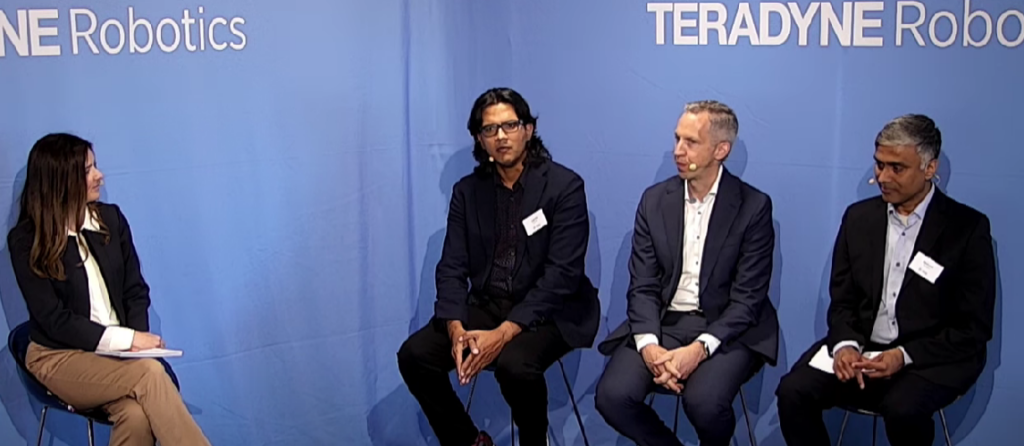
In a captivating panel discussion, leaders from NVIDIA, Siemens and Teradyne converged to unravel the future of advanced robotics. As industries brace for seismic shifts, this powerful trifecta is pioneering groundbreaking technologies that will reshape the automation landscape.
The trajectory of AI and robotics is poised for an unprecedented transformation, driven by the convergence of two pivotal forces, as Deepu Talla of NVIDIA elucidated: “The advent of generative AI in the last twelve months coupled with the simulation and digital twin technology — both of those things are really at a tipping point right now and the combination of that, I think for the next five years, is going to change the trajectory of robotics.”
This sentiment was echoed by Rainer Brehm of Siemens, who expressed his fascination with “how we bring those things together to solve the last remaining tasks to be automated.” Collaboration lies at the core of this effort.
“No one company has all the technologies needed to solve this problem, and we’ll need to work together to understand the problems and solve them at a very fast pace,” said Ujjwal Kumar of Teradyne.
NVIDIA, a platform computing company, exemplifies this collaborative spirit.
“We don’t build robots. We work with every company in the world that’s building robots or robot platforms,” Talla explained. Their contributions lie in providing the AI core capabilities that integrate into the platforms of countless robotics companies.
Siemens, too, has embraced this synergistic approach, partnering with Universal Robots to develop a standard robot command interface. As Brehm detailed: “We collaborate and say, can we access the robot from the PLC program seamlessly, and we just brought that together out of the market.”
Expanding the robotics ecosystem is a critical priority, as Kumar outlined: “We have one of the largest ecosystems in the robotics world by a huge margin. Number one is bringing in bigger players who can help us open up our ecosystem to new customer problems.”
Deploying AI in the operational technology world presents challenges, but the potential rewards are vast.
“To do that, you need to go deep into problem by problem,” Talla advised. “There isn’t one AI yet, maybe someday in the future, but not yet today that generalizes across every particular task.”
The concept of “physical AI” is particularly compelling, as it adds new capabilities, enhances intelligence, and bolsters safety and reliability. Kumar elaborated: “It is making our collaborative robots, which are known for safety, take our safety and reliability to a whole different level.”
“We need to do that in order to scale. We need to do it, give tools to the hand of our customers where we don’t need to be an expert in order to do AI,” said Brehm, who believes scaling and industrializing AI is paramount.
AI’s impact on human-robot interaction is transformative, enabling natural language speech recognition, emotion detection, and heightened safety. As Kumar noted: “Those AI will bring in emotions detection to take these human-machine interactions to a whole different level.”
For manufacturers grappling with variability and lot sizes of one, collaborative robots combined with AI offer a solution.
“The collaborative robots now combined with AI has the solution for this pain small and medium customers lived with, and the large customers now — it is a new pain for them,” said Kumar.
Siemens’ own factories showcase the integration of collaborative robots, drives, and inverters in fully integrated lines. As Brehm recounted: “We have a fully integrated line where we really could switch off the lights and be using drives and inverters from the beginning of the assembly to the testing, the packaging, putting it into boxes.”
Key drivers for automation in factories include sustainability, as Brehm explained: “If you really want to move forward into sustainable production, keeping industry within developed countries, it’s very, very important to get automation.”
Generative AI and digital twin technology are poised to revolutionize robotics and automation.
“Generative AI is going to change robotics automation in two main ways: one is the user interface, and then the generative AI is more accurate and more generalizable,” Talla highlighted.
The path ahead is rife with possibilities, but collaboration remains the lynchpin. As Kumar concluded: “The opportunity out there for all of us is nearly endless. We have the tools, the skills, the talent. We need to step up, work together, and go solve these problems head-on.”
In this pivotal era, NVIDIA, Siemens and Teradyne are catalyzing a robotic revolution, harnessing the synergies of AI, digital twins, and cross-industry collaboration to forge a future where automation transcends boundaries and unlocks new realms of efficiency, sustainability, and human-machine synergy.
Featured image: Credit: Teradyne