
Insider Brief
- Researchers from MIT and Meta have developed a computer vision technique that could someday enable an autonomous vehicle to navigate in tricky situations — among other innovations.
- The method creates physically accurate, 3D models of an entire scene, including areas blocked from view, using images from a single camera position.
- In addition to improving the safety of autonomous vehicles, PlatoNeRF could make AR/VR headsets more efficient.
- Story Adam Zewe, MIT News (Image MIT News)
Imagine driving through a tunnel in an autonomous vehicle, but unbeknownst to you, a crash has stopped traffic up ahead. Normally, you’d need to rely on the car in front of you to know you should start braking. But what if your vehicle could see around the car ahead and apply the brakes even sooner?
Researchers from MIT and Meta have developed a computer vision technique that could someday enable an autonomous vehicle to do just that.
They have introduced a method that creates physically accurate, 3D models of an entire scene, including areas blocked from view, using images from a single camera position. Their technique uses shadows to determine what lies in obstructed portions of the scene.
They call their approach PlatoNeRF, based on Plato’s allegory of the cave, a passage from the Greek philosopher’s “Republic” in which prisoners chained in a cave discern the reality of the outside world based on shadows cast on the cave wall.
By combining lidar (light detection and ranging) technology with machine learning, PlatoNeRF can generate more accurate reconstructions of 3D geometry than some existing AI techniques. Additionally, PlatoNeRF is better at smoothly reconstructing scenes where shadows are hard to see, such as those with high ambient light or dark backgrounds.
In addition to improving the safety of autonomous vehicles, PlatoNeRF could make AR/VR headsets more efficient by enabling a user to model the geometry of a room without the need to walk around taking measurements. It could also help warehouse robots find items in cluttered environments faster.
“Our key idea was taking these two things that have been done in different disciplines before and pulling them together — multibounce lidar and machine learning. It turns out that when you bring these two together, that is when you find a lot of new opportunities to explore and get the best of both worlds,” says Tzofi Klinghoffer, an MIT graduate student in media arts and sciences, affiliate of the MIT Media Lab, and lead author of a paper on PlatoNeRF.
Klinghoffer wrote the paper with his advisor, Ramesh Raskar, associate professor of media arts and sciences and leader of the Camera Culture Group at MIT; senior author Rakesh Ranjan, a director of AI research at Meta Reality Labs; as well as Siddharth Somasundaram at MIT, and Xiaoyu Xiang, Yuchen Fan, and Christian Richardt at Meta. The research will be presented at the Conference on Computer Vision and Pattern Recognition.
Shedding light on the problem
Reconstructing a full 3D scene from one camera viewpoint is a complex problem.
Some machine-learning approaches employ generative AI models that try to guess what lies in the occluded regions, but these models can hallucinate objects that aren’t really there. Other approaches attempt to infer the shapes of hidden objects using shadows in a color image, but these methods can struggle when shadows are hard to see.
For PlatoNeRF, the MIT researchers built off these approaches using a new sensing modality called single-photon lidar. Lidars map a 3D scene by emitting pulses of light and measuring the time it takes that light to bounce back to the sensor. Because single-photon lidars can detect individual photons, they provide higher-resolution data.
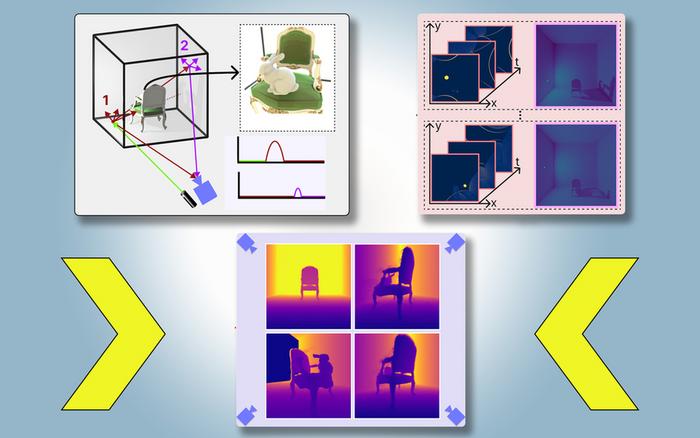
The researchers use a single-photon lidar to illuminate a target point in the scene. Some light bounces off that point and returns directly to the sensor. However, most of the light scatters and bounces off other objects before returning to the sensor. PlatoNeRF relies on these second bounces of light.
By calculating how long it takes light to bounce twice and then return to the lidar sensor, PlatoNeRF captures additional information about the scene, including depth. The second bounce of light also contains information about shadows.
The system traces the secondary rays of light — those that bounce off the target point to other points in the scene — to determine which points lie in shadow (due to an absence of light). Based on the location of these shadows, PlatoNeRF can infer the geometry of hidden objects.
The lidar sequentially illuminates 16 points, capturing multiple images that are used to reconstruct the entire 3D scene.
“Every time we illuminate a point in the scene, we are creating new shadows. Because we have all these different illumination sources, we have a lot of light rays shooting around, so we are carving out the region that is occluded and lies beyond the visible eye,” Klinghoffer says.
A winning combination
Key to PlatoNeRF is the combination of multibounce lidar with a special type of machine-learning model known as a neural radiance field (NeRF). A NeRF encodes the geometry of a scene into the weights of a neural network, which gives the model a strong ability to interpolate, or estimate, novel views of a scene.
This ability to interpolate also leads to highly accurate scene reconstructions when combined with multibounce lidar, Klinghoffer says.
“The biggest challenge was figuring out how to combine these two things. We really had to think about the physics of how light is transporting with multibounce lidar and how to model that with machine learning,” he says.
They compared PlatoNeRF to two common alternative methods, one that only uses lidar and the other that only uses a NeRF with a color image.
They found that their method was able to outperform both techniques, especially when the lidar sensor had lower resolution. This would make their approach more practical to deploy in the real world, where lower resolution sensors are common in commercial devices.
“About 15 years ago, our group invented the first camera to ‘see’ around corners, that works by exploiting multiple bounces of light, or ‘echoes of light.’ Those techniques used special lasers and sensors, and used three bounces of light. Since then, lidar technology has become more mainstream, that led to our research on cameras that can see through fog. This new work uses only two bounces of light, which means the signal to noise ratio is very high, and 3D reconstruction quality is impressive,” Raskar says.
In the future, the researchers want to try tracking more than two bounces of light to see how that could improve scene reconstructions. In addition, they are interested in applying more deep learning techniques and combining PlatoNeRF with color image measurements to capture texture information.