
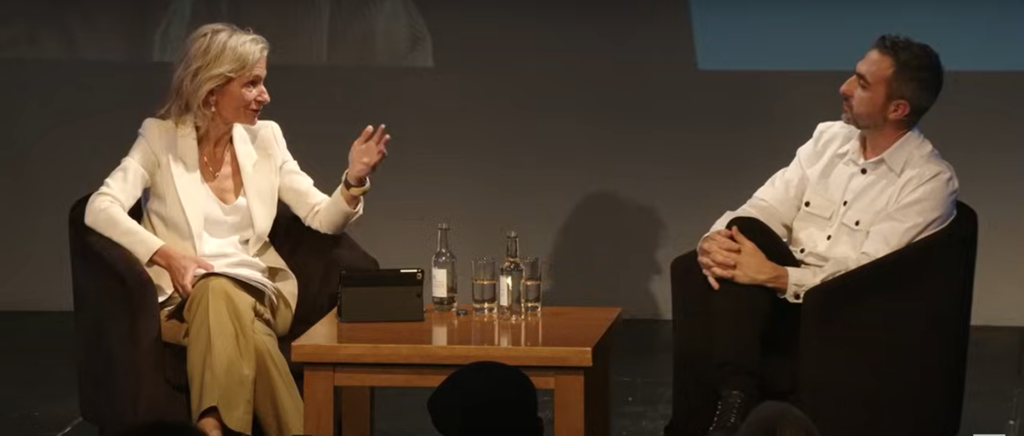
Mustafa Suleyman, co-founder of DeepMind and Inflection AI and currently the CEO at Microsoft AI, is a prominent figure in artificial intelligence (AI). In a conversation with Zanny Minton Beddoes, Editor-in-Chief of The Economist last year, Suleyman discussed his new book, The Coming Wave: Technology, Power, and the Twenty-First Century’s Greatest Dilemma, and shared his views on the transformative potential and inherent risks of AI.
Suleyman sees AI as a “step change in human capability and society,” predicting a future where AI handles complex tasks, operates businesses, runs government services, and maintains infrastructure. He sees a world of DNA printers, quantum computers, robot assistants, and abundant energy, but also warns of human-engineered pathogens and autonomous weapons.
Despite the promise, Suleyman is clear about the challenges.
“We are not prepared,” he said, stressing the dual risks of “unprecedented harms from unchecked AI and the threat of overbearing state surveillance.” According to Suleyman, the challenge is to navigate between too much openness and too much control to avoid disaster. He referred to this as the “containment problem” — maintaining control over powerful technologies, which he views as the ultimate challenge of our times.
Suleyman also touched upon the current capabilities and future trajectory of AI. Reflecting on the rapid advancements.
“The Deep learning revolution enabled us to make sense of raw messy data,” he said. “Now we’re in the generative revolution.” He believes AI will soon reach human-level capability across various tasks, transforming industries and societies.
“The process of innovation becomes much more efficient,” Suleyman explained. He predicts AI will help solve global challenges like climate change and improve healthcare. “Intelligence has been the engine of creation. Everything that you see around you here is the product of us interacting with some environment to make things more efficient,” he added.
However, Suleyman acknowledged the societal implications, particularly the potential for job displacement. While he believes in the historical trend of technological advancements creating new job opportunities, he admitted: “Beyond the next two decades, many people won’t be able to produce things of sufficient value even with an AI.” He stressed the need for society to focus on “radical abundance” and find ways to redistribute the wealth created by AI advancements.
Discussing governance, Suleyman argued that the state must play a crucial role in regulating AI. “Governments have to build technology. We need deeply technical and engineering people in cabinet positions,” he said, also calling for “experimental government structures” to adapt to the fast-paced changes AI brings.
Suleyman’s vision is both optimistic and cautionary. He sees AI as a tool that could lead to unprecedented innovation and efficiency but also warns of the need for careful regulation and ethical considerations. As AI continues to evolve, Suleyman’s insights offer a roadmap for navigating the complex future of this transformative technology.
Featured image: Credit: Intelligence Squared