Insider Brief
- Caleb Rucker and a University of Tennessee team are part of a $12 million ARPA-H funded project to develop fully autonomous surgical robots, using breakthrough concentric tube robot technology that mimics tentacle-like movements.
- The multi-institution project, led by Vanderbilt, involves experts from robotics, AI, and clinical fields, aiming to create robots capable of performing surgeries in hard-to-reach anatomical areas without human intervention.
- Rucker’s team will focus on developing computational models to guide AI training and surgical motion planning, with potential applications including tumor removal and spine procedures, offering less invasive, more effective surgeries.
PRESS RELEASE — Caleb Rucker, an associate professor and B. Ray Thompson Professor in the Department of Mechanical, Aerospace, and Biomedical Engineering, and a team from the University of Tennessee are part of a landmark, multi-institution surgical robot project that received up to $12 million in funding from the Advanced Research Projects Agency for Health (ARPA-H).
The goal of the project is to create a surgical robot capable of performing an entire surgery without human intervention. The advancement is enabled by a new fundamental breakthrough in robot technology called concentric tube robots. These needle-sized robots can bend and elongate like tentacles. They are made from a telescoping collection of curved super elastic tubes that rotate within one another.
Vanderbilt is the lead institution for the project. Robert J. Webster, the Richard A. Schroeder professor of mechanical engineering at Vanderbilt, will lead a team of robotics experts from the University of Utah, Johns Hopkins University, Vanderbilt, as well as surgeons from Vanderbilt University Medical Center, to develop the breakthrough technology that includes hardware and software experts from Virtuoso Surgical.
As a co-Principal Investigator of the project, Rucker will lead the UT team to develop computational models that simulate tissue and robot motion during surgery, and to use these models to give the automated surgery system information during artificial intelligence (AI) training, motion planning, and mapping the surgical scene.
“I’m really excited to work with this team of amazing researchers across the fields of computer science, AI and machine learning, mechanical engineering, electrical engineering, and clinical practice,” said Rucker, who is currently the PI of a National Institutes of Health (NIH) project creating concentric push-pull robotic platform for colon surgery. “It’s the biggest team I’ve ever been a part of, and everyone is at the forefront of their area. I’m further excited to see where the science leads us, and to witness the transformative capabilities of the system we are developing.”
Current surgical robotic technologies rely on one of two automation techniques. The first is known as model-based automation in which procedure sequences and start-stop conditions are pre-programmed. Another method draws on machine-learning algorithms requiring enormous datasets of procedures and task sequences. While each approach has led to advances in surgical robotics, both lack scalability, generalizability, and adaptability. The funded project will leverage cutting-edge advances in automation science to combine model-based and learning-based approaches for the first time in robotic surgery, to make automation adaptable, scalable, robust, and interpretable.
The research team hopes the new surgical robot produces less invasive and more effective surgeries in anatomical locations current surgical robots can’t reach, including removing tumors from the trachea and prostate without the intervention of a surgeon. The team also foresees this research applying to uterine fibroids, bladder tumors, spine procedures, and brain cysts, among other clinical applications.
“This project will endow surgical robots with autonomy, much further than has ever been done before, and with a robot that is an order of magnitude smaller than current commercial surgical robots,” Rucker said. “Surgical robot autonomy can bring many potential benefits to patients by increasing safety and offloading the surgeon’s physical and cognitive workload.”
Provided by University of Tennessee at Knoxville
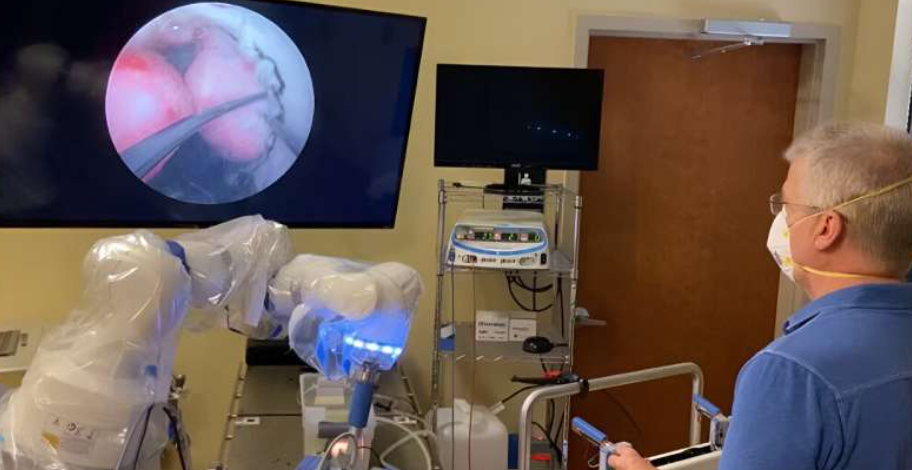
Featured image: Researchers perform robotic surgery. Credit: University of Tennessee