Insider Brief
- Australian researchers tested a machine learning system called LAARMA to detect large animals near roads and alert drivers in real time, aiming to reduce wildlife-vehicle collisions.
- In a five-month field trial in Far North Queensland, the system correctly identified animals in 97% of instances and led to driver speed reductions of up to 10% in areas where cassowaries were present.
- The open-source, self-training system, developed by iMOVE Australia and university partners, could be adapted to other species and locations, offering a scalable approach to improving road safety and wildlife conservation.
A machine learning system tested in Australia could help reduce vehicle collisions with wildlife, offering a new model for road safety and conservation.
Australian researchers have completed a field trial of the AI-driven Large Animal Activated Roadside Monitoring and Alert System, or LAARMA, designed to detect animals near roads and alert drivers in real time, according to iMOVE, the national center for transport and smart mobility R&D in Australia.
The system was designed to identify large animals within 200 meters in all weather and lighting conditions. Using a self-supervised learning approach, the system improves its accuracy over time with both field data and synthetic data.
Animal-vehicle collisions are a growing hazard across Australia as road infrastructure cuts deeper into natural habitats. While fencing is often used to prevent crossings, it can be costly to maintain and disrupt wildlife movement. LAARMA aims to address these issues with a scalable and adaptable system that uses sensors and artificial intelligence to detect animals and notify drivers via roadside signs.
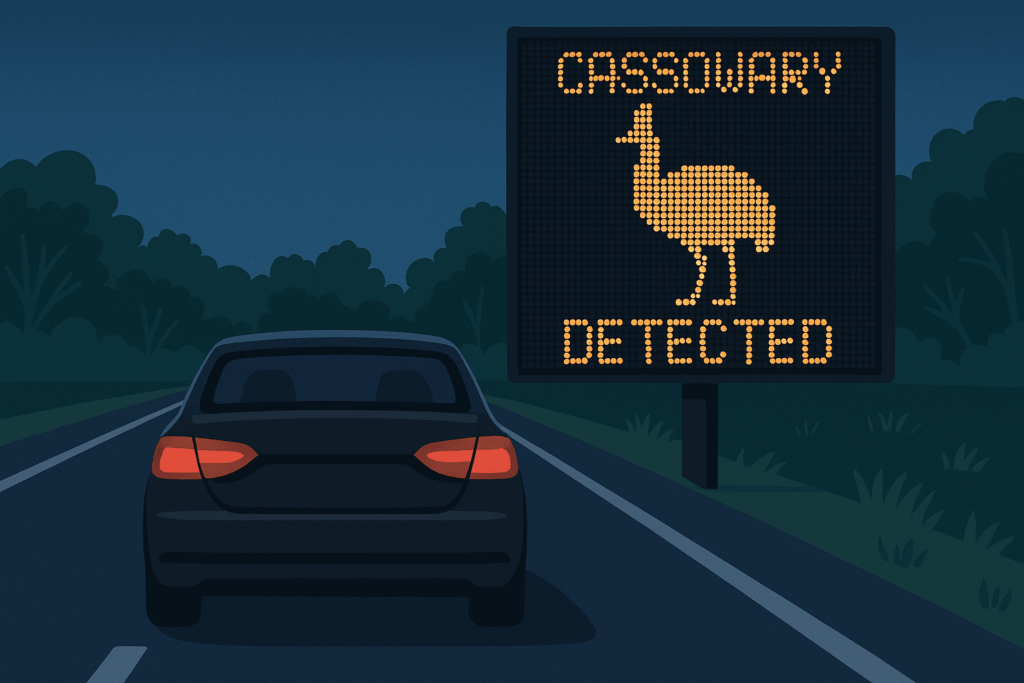
A key component of the project was understanding how drivers respond to warnings. Researchers pointed out they conducted focus groups, surveys, and a driving simulator study to test different versions of roadside variable message signs (VMS). Messages were more effective when they named the animal species, conveyed urgency, and were clearly presented as real-time alerts. Drivers in the simulator reduced their speed when encountering the signs, though the effect was more pronounced in approach zones than near the virtual animals themselves.
“The simulator study found that drivers responded positively to the VMS messaging by reducing their speed in the approach zone,” researchers wrote. “However, speed reductions in the event zone were less significant, possibly because participants were aware that the simulation did not present a real risk of collision with a cassowary. Nevertheless, the study provided valuable insights into how drivers interpret and respond to VMS messages and helped to provide further validation of the messaging content for use in the subsequent field trial.”
The five-month test focused on cassowaries, a large flightless bird native to Queensland, and was conducted in partnership with iMOVE Australia, Queensland’s Department of Transport and Main Roads, the University of Sydney’s Australian Centre for Robotics, and the Queensland University of Technology.
In the field, the LAARMA system recorded 287 verified cassowary sightings, according to the study. When the system activated its roadside alerts, drivers reduced their speed by up to 10% compared to the posted speed limits. In areas closest to the animals, speeds dropped by an average of 6.3 km/h and 5.06 km/h at two separate sites.
The AI system itself achieved strong performance, triggering correctly in 97% of cases where cassowaries were present and maintaining a precision score of 0.77, meaning most alerts involved actual animals. The results suggest the system is both reliable in detection and effective at altering driver behavior, iMOVE noted.
Researchers say the system could be adapted to other large animals by expanding the training dataset and refining the sensor design to increase detection range. They also note that messaging content may need to be tailored for different species, as driver responses could vary.
Future studies will evaluate how the system performs over time and in different geographic areas. With further development, the LAARMA platform could be deployed more broadly to mitigate risks to both wildlife and motorists.
Researchers noted it uses open-source software, allowing deployment in various locations with minimal reconfiguration, which could help protect endangered secies such as red pandas in Nepal, giant anteaters in Brazil, pangolins in Southeast Asia, and snow leopards in Central Asia, all vulnerable to getting killed on roadways.
According to iMOVE Australia, the trial offers a viable pathway for integrating machine learning into roadside safety systems. As countries grapple with balancing infrastructure development and ecological preservation, systems like LAARMA may provide an effective, low-intervention solution.
The study was a joint effort between the University of Sydney, QUT, and the Department of Transport and Main Roads Queensland with researchers from the Australian Centre for Robotics (University of Sydney) and the Centre for Accident Research and Road Safety Queensland leading the project.