Rendezvous Robotics Raises $20M in Seed Funding for Self-Assembling Spacecraft
 By Greg Bock · · 3 min read
Insider Brief
- Rendezvous Robotics raised $20 million in seed funding to develop modular spacecraft designed to autonomously assemble and reconfigure themselves after reaching orbit.
- MaC Venture Capital and Toyota Ventures led the round, which will support spacecraft development, flight demonstrations and team expansion ahead of a planned orbital test no earlier than April 2028.
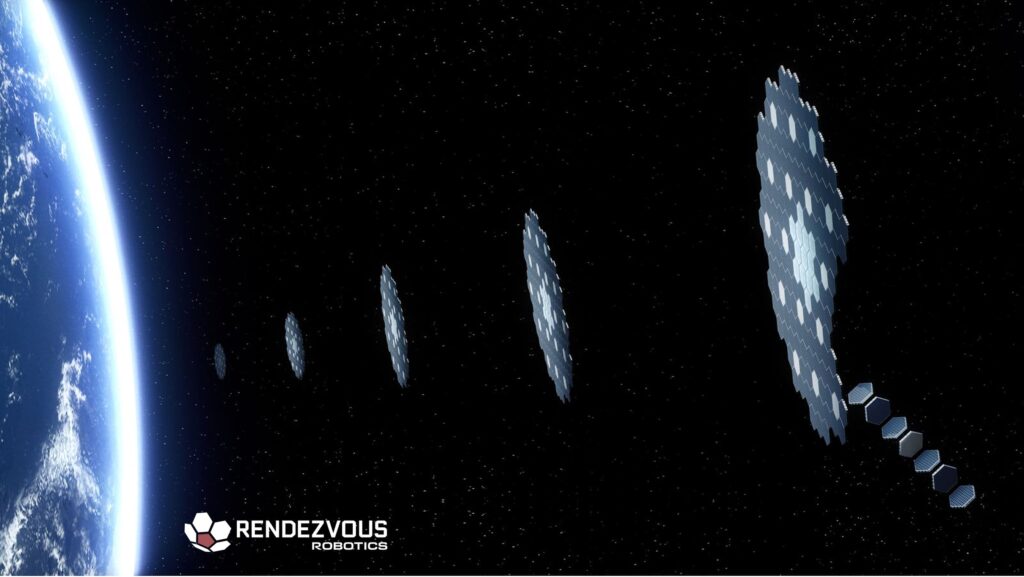
- The 2028 mission is expected to deploy seven spacecraft tiles that will assemble into a larger spacecraft, separate and then reconnect in a different configuration without external robotic assistance.
Rendezvous Robotics has raised $20 million in seed funding to develop modular spacecraft designed to assemble and reconfigure themselves after reaching orbit.
According to the Colorado startup, MaC Venture Capital and Toyota Ventures led the round, with participation from the University of Michigan Endowment, Astera, Industrious Ventures, Aurelia Foundry, ATX Venture Partners and Mana Ventures. The company, co-founded by Ariel Ekblaw and CEO Joe Landon, indicated the financing will support development of its spacecraft, flight demonstrations and team expansion.
Rendezvous is preparing for an orbital demonstration no earlier than April 2028 in which seven independently launched spacecraft tiles are expected to maneuver toward one another, connect into a larger spacecraft, separate and then assemble into a different configuration in order to work around the size limits imposed by rocket fairings.
According to the company, each tile is designed to operate independently before using autonomous navigation, alignment and connection systems to join with other units. The resulting spacecraft could later be rearranged as mission requirements change without relying on an external robotic system.
From Research to Flight Testing
The technology traces back to TESSERAE, a modular spacecraft research project developed by Ekblaw at MIT and later through the Aurelia Institute.
Earlier versions of the technology have flown aboard Blue Origin’s New Shepard rocket and on two missions to the International Space Station, according to Rendezvous. Those tests focused on demonstrating elements of self-assembly in microgravity.
“The vision behind TESSERAE was never simply to connect tiles in space. It was to rethink how we build beyond Earth,” noted Ekblaw. “For decades, the way we build spacecraft has been shaped by what we can fit inside a rocket. We’re challenging that constraint. What began as an experiment in self-assembly is now becoming a new way to build spacecraft in orbit.”
The company said ground testing is underway ahead of a parabolic flight campaign planned for November 2026. That test will evaluate electromagnetic actuation and movement under brief periods of microgravity.
A separate International Space Station experiment is scheduled for December using fifth-generation TESSERAE hardware. Rendezvous said 32 tiles will attempt to autonomously assemble into a three-dimensional structure inside a controlled microgravity environment. That experiment remains part of the earlier TESSERAE research program, while the 2028 mission is planned to test Rendezvous’ newer free-flying spacecraft architecture in orbit.
Reconfiguring After Launch
For the planned 2028 demonstration, seven tiles will deploy independently from a reserved rideshare mission and attempt autonomous assembly in free space. Rendezvous said the spacecraft will then separate and reconnect in another arrangement, testing whether a spacecraft can change its physical configuration after launch.
The company indicated it is ultimately working toward developing larger spacecraft structures that could provide more room for power generation, communications equipment, sensors and computing hardware than can be launched as a single conventional spacecraft.
“We’re changing what it means to build a spacecraft,” added Landon. “Imagine spacecraft with megawatt-scale power generation, enormous communications and sensing apertures, and the ability to expand or reconfigure as mission needs change. Rendezvous is building spacecraft on an entirely different scale, with the ability to add capabilities after launch and take on missions that simply aren’t practical with the way we build spacecraft today. We’ve brought together a world-class engineering team with the experience, ingenuity and technical expertise to make that vision a reality.”