Insider Brief
- University of Arizona researchers have developed an AI-enabled wearable sleeve that continuously monitors gait and leg motion to detect early signs of frailty, aiming to shift elder care from reactive treatment to preventative intervention.
- The soft, lower-thigh device uses edge AI to analyze acceleration, symmetry, and step variability in real time, transmitting only summarized results to reduce data use, extend battery life, and enable long-term remote monitoring without high-speed internet.
- Published in Nature Communications, the research positions the technology as a scalable solution for early clinical intervention, particularly in rural or under-resourced settings where frailty is often identified only after falls or hospitalization.
Researchers at the University of Arizona have developed a wearable, AI-enabled device designed to detect early physiological signals of frailty, offering a preventative approach to a condition that significantly increases the risk of falls, disability, and hospitalization among older adults. According to the University of Arizona, the work, led by the Gutruf Lab and published in Nature Communications on Dec. 20, was supported by academic research funding and focuses on shifting elder care from reactive intervention to continuous monitoring and early risk identification.
“The current model of care is lagging behind,” said Philipp Gutruf, associate department head of biomedical engineering and senior author on the study. “Right now, we often wait for a fall or hospitalization before we assess a patient for frailty. We wanted to shift the paradigm from reactive to preventative.”
The device takes the form of a soft, lightweight mesh sleeve worn around the lower thigh, the university noted. Using embedded sensors and on-device artificial intelligence, it continuously analyzes leg acceleration, gait symmetry, and step-to-step variability — metrics closely associated with frailty but often missed during periodic clinical assessments. Frailty affects an estimated 15% of U.S. adults aged 65 and older and is typically identified only after a major event such as a fall or hospital admission, according to prior gerontology research cited by the team.
Rather than streaming raw motion data, the system processes information locally using edge AI, transmitting only summarized analytical results via Bluetooth to a paired smart device. This design reduces data transmission requirements by approximately 99%, eliminates the need for high-speed internet access, and dramatically extends battery life. The sleeve also incorporates long-range wireless charging, removing the need for manual recharging or battery replacement and improving usability for elderly patients.
The technology builds on prior work from the Gutruf Lab in wearable biosensing, including earlier research into adhesive-free devices capable of monitoring skin gases and stress-related biomarkers, the university said. In this iteration, the researchers focused on comfort, invisibility under clothing, and long-term wear, enabling continuous monitoring without disrupting daily life.
According to the study, the system’s architecture makes it particularly suitable for remote patient monitoring in rural or under-resourced settings, where access to frequent clinical evaluation is limited. By embedding laboratory-grade sensing and analysis directly on the patient, the approach aims to enable earlier clinical intervention, reduce preventable adverse events, and lower healthcare costs associated with late-stage frailty.
“Continuous, high-fidelity monitoring creates massive datasets that would normally drain a battery in hours and require a heavy internet connection to upload. We solved this with Edge AI,” said Kevin Kasper, lead study author and biomedical engineering doctoral candidate.
The AI-enabled technology is “an ideal solution for remote patient monitoring in rural or under-resourced communities,” he added. “We are effectively putting a lab on the patient, no matter where they live.”
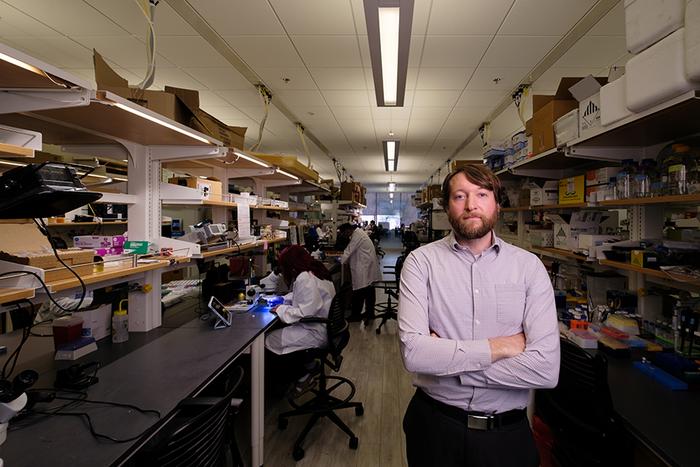
Credit: University of Arizona College of Engineering