- Beijing Innovation Center of Humanoid Robotics (X-Humanoid) launched Embodied Tien Kung 3.0, a general-purpose humanoid robot platform built on its Wise KaiWu embodied AI system, featuring upgraded balance, motion control, tactile interaction and fully autonomous operation.
- The platform emphasizes hardware and software openness, supporting expansion interfaces, low-code development tools and mainstream protocols such as ROS2, MQTT and TCP/IP, while open-sourcing key components including motion frameworks, AI models and datasets.
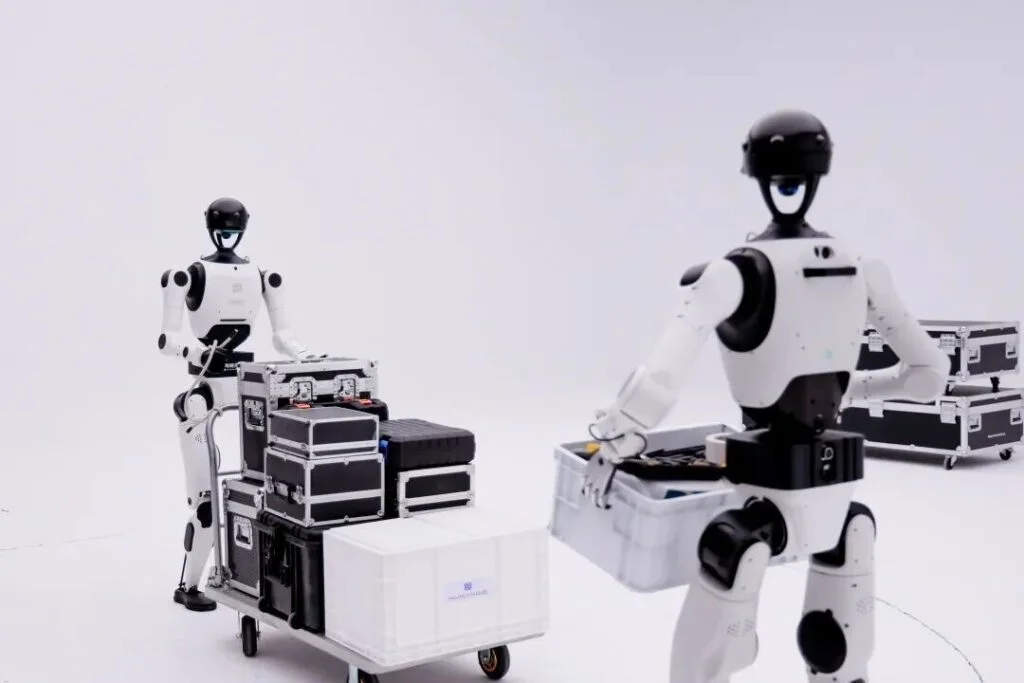
- Embodied Tien Kung 3.0 integrates high-torque joints, millimeter-level calibration and a perception–decision–execution AI loop to enable industrial-grade precision, complex dynamic movement and multi-robot collaboration for commercial and industrial deployments.
PRESS RELEASE — Beijing Innovation Center of Humanoid Robotics (X-Humanoid) officially launched its latest general-purpose robot platform, the Embodied Tien Kung 3.0. Designed with a focus on enhanced openness and usability, the system leverages X-Humanoid’s proprietary Wise KaiWu general-purpose embodied AI platform to deliver significant upgrades in balance, motion control, embodied brain-cerebellum coordination, and fully autonomous operation. It is also the industry’s first full-size humanoid robot to achieve whole-body, high-dynamic motion control integrated with tactile interaction.
Additionally, Embodied Tien Kung 3.0 addresses compatibility and adaptation challenges across the embodied intelligence industry’s development and deployment layers. It offers more accessible software and hardware interfaces, helping to reduce development costs and technical barriers for developers and system integrators. As a next-generation platform that balances practical performance with an open ecosystem, Embodied Tien Kung 3.0 is designed to accelerate real-world adoption of embodied intelligence, facilitate the integration of humanoid robots into commercial and industrial environments, and improve operational productivity.
Enhanced Openness: Accelerating Development and Simplifying Integration
The humanoid robotics sector currently faces two key challenges in development and application: first, closed hardware interfaces limit rapid adaptation to different operating environments; second, fragmented software tools and incompatible protocols result in redundant R&D, slowing commercial deployment and innovation. Embodied Tien Kung 3.0 addresses these barriers by emphasizing openness and interoperability, enabling research institutions, universities, and companies to develop and adapt solutions more efficiently.
First, on the hardware level, Embodied Tien Kung 3.0 Features multiple expansion interfaces that support flexible integration of various end-effectors and tools. This enables rapid adaptation to diverse scenarios—including specialized operations, industrial manufacturing, and commercial services—while ensuring seamless connectivity with mainstream industry systems.On the software side, the platform, built on the Wise KaiWu ecosystem, offers comprehensive documentation, toolchains, and a low-code development environment. It simplifies complex technical processes into user-friendly workflows and supports widely adopted communication middleware and protocols, including ROS2, MQTT, and TCP/IP. Partners can perform use-case-specific customization without reengineering underlying systems, shortening development cycles and reducing complexity.
To date, X-Humanoid has open-sourced key technologies from its Embodied Tien Kung and Wise KaiWu platforms. These include the robot body, motion control framework, world model, embodied VLM and cross-ontology VLA models, training toolchains, the RoboMIND dataset, and the ArtVIP simulation asset library. By expanding access to these components, an open-source ecosystem helps accelerate the iteration and deployment of humanoid robotics, lower technical barriers, and allows companies, academics, and researchers to develop applications more efficiently. This approach enables humanoid robots to meet a range of industry needs and supports scalable, multi-use implementation.
Improved Usability: Enabled by Wise KaiWu for General-Purpose Deployment
Ease of use remains a central focus for X-Humanoid. This is enabled by two core capabilities: advanced body performance and embodied intelligence, which together allow the robot to perform reliably in real-world tasks.
In terms of physical performance, Embodied Tien Kung 3.0 incorporates high-torque integrated joints that provide strong limb force for high-load applications. Even on uneven terrain or in cluttered environments, sufficient torque output maintains stability, ensuring consistent operation across varying operating conditions. With its high degree of freedom and whole-body coordination control, the robot can execute complex motions such as clearing one-meter obstacles and performing consecutive high-dynamic maneuvers. A flexible torso and wide upper-limb range of motion also make possible dexterous operations—including kneeling, bending, and turning—while maintaining precision in confined spaces or restricted postures.
Moreover, through multi-degree-of-freedom limb coordination, Embodied Tien Kung 3.0 achieves precise joint linkage and fine motion adjustment. Collaborative calibration delivers millimeter-level operational accuracy, meeting use cases that require industrial-grade precision while minimizing errors and ensuring task quality. These capabilities strengthen the robot’s versatility and extend its practical utility in complex environments.
Underlying this advanced body is the Wise KaiWu universal embodied AI platform, which allows Embodied Tien Kung 3.0 to operate with greater autonomy. The platform establishes a continuous perception–decision–execution loop, reducing reliance on remote control and human intervention, while driving a shift from single-unit operation to multi-robot collaboration. For high-level cognition—addressing “what” and “why”—the system uses AI models such as the world model and VLM to interpret visual scenes, understand language instructions, perform reasoning, and break complex tasks into step-by-step plans. For real-time control, the VLA model and full autonomous navigation manage environmental perception, obstacle avoidance, and precise action execution, ensuring stable performance under variable conditions. Finally, the multi-agent collaborative system built on Wise KaiWu provides cross-platform compatibility and asynchronous task coordination with autonomous scheduling. This centralized, multi-robot, multi-function architecture marks the transition of embodied intelligence from research to practical application, providing a scalable and repeatable pathway for real-world deployment.
For more information, please visit https://www.x-humanoid.com/.
Image credit: X-Humanoid