Insider Brief
- Researchers at Jeonbuk National University developed DDINet, a lightweight deep-learning model that predicts drug–drug interactions and their biological effects while using less computational power than many existing approaches.
- The model uses molecular fingerprints of drugs and a streamlined architecture with five fully connected layers, allowing it to predict both whether two drugs will interact and the likely biological mechanism behind the interaction.
- Tested on DrugBank data under realistic evaluation scenarios—including cases where one or both drugs were previously unseen—DDINet matched or exceeded the performance of existing models, particularly in the most challenging real-world conditions.
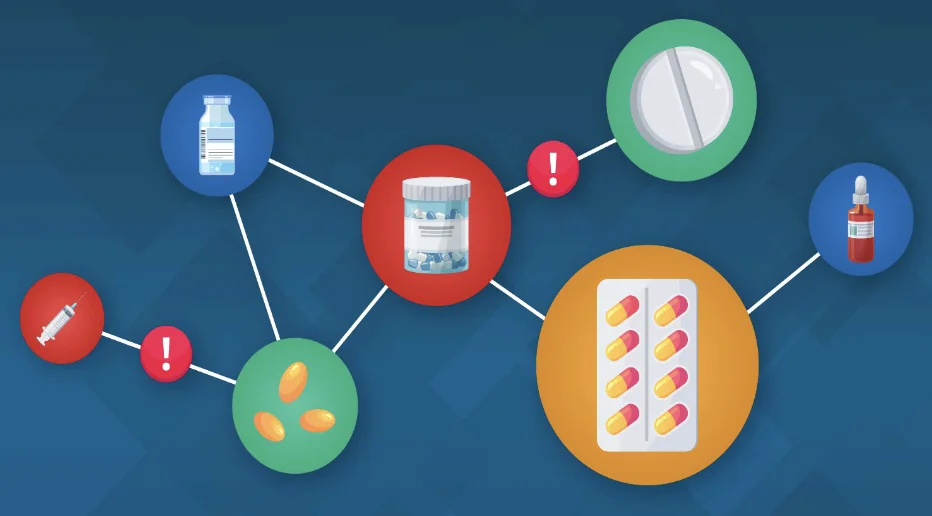
PRESS RELEASE — Managing complex medical conditions often requires the simultaneous use of multiple different drugs, referred to as polypharmacy. While necessary, this significantly increases the risk of drug–drug interactions (DDIs), which can either enhance or decrease therapeutic effects or trigger adverse drug reactions (ADRs), potentially leading to longer hospital stays or even life-threatening outcomes.
In recent years, researchers have increasingly turned to deep learning models to predict DDIs. Although these models often outperform traditional methods, they are usually tested under idealized conditions, in which training and test data are randomly split, failing to reflect real-world clinical settings. As a result, many existing models suffer sharp drops in performance when evaluated on truly unseen drugs. Some also require substantial computational resources, limiting real-world usability.
To overcome these limitations, a research team led by Associate Professor Hilal Tayara from the School of International Engineering and Science at Jeonbuk National University (JBNU), South Korea, has developed DDINet, a lightweight and scalable model, specifically designed to predict interactions for new, unseen drugs.
“DDINet can simultaneously predict whether an interaction will occur and identify its biological effect, while needing significantly less computational power than complex graph-based models,” explains Dr. Tayara. Their study was made available online on November 29, 2025, and published in Volume 333 of Knowledge-Based Systems on January 30, 2026.
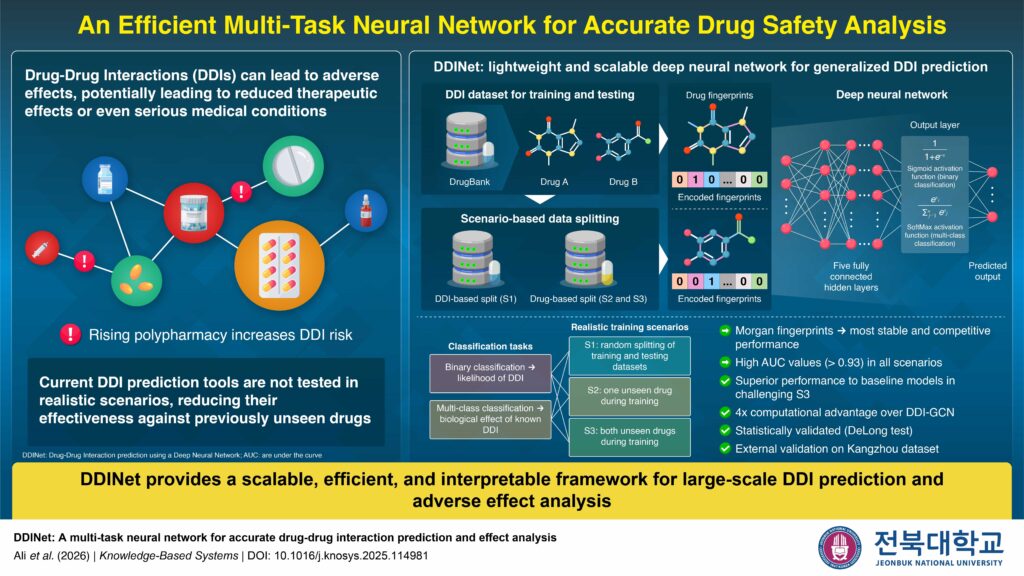
DDINet utilizes a streamlined architecture with five fully connected layers and uses molecular fingerprints of drugs as input. This approach avoids overfitting to training data – a common reason why many models struggle to generalize to unseen drugs. Importantly, it is designed to handle binary classification tasks, which involve predicating the likelihood of whether a given drug pair will interact, and multi-classification tasks, where the goal is to predict the biological effect or mechanisms of a known DDI.
The researchers trained and evaluated DDINet using a large-scale dataset constructed from DrugBank. They also tested five different molecular fingerprinting techniques. To achieve enhanced generalization, the researchers adopted a strict data-splitting protocol during evaluation. Specifically, they created three scenarios for model evaluation. In scenario one (S1), drug pairs were randomly split into training and test datasets. Further, they utilized a DDI-based splitting where 10% of all DDI pairs formed an independent test set, and the remaining were used for training.
Scenario two included DDIs where one drug was known and another unseen, while scenario three comprised DDIs where both drugs were unseen, representing realistic clinical settings. To categorize drugs as unseen and seen, the team applied a strict drug-based splitting protocol based on DrugBank annotations.
Morgan fingerprints were identified as the best performing and were used for the final implementation. Across all evaluation scenarios, DDINet performed as well as or better than existing models, particularly in the most difficult S3. It demonstrated stable performance across a range of metrics in both binary and multi-classification tasks.
“DDINet’s compact and efficient architecture enables large-scale deployment in hospitals, drug discovery pipelines, and pharmacovigilance systems,” concludes Dr. Tayara. “Ultimately, this technology can help accelerate drug development, while improving the safety of patients who rely on multiple medications.”