Insider Brief
- The U.S. National Science Foundation is investing $90 million over five years in three new Science and Technology Centers, including nearly $30 million for a University of Texas at Austin-led center focused on human-robot co-adaptation.
- The Center for Human and Robot Co-Adaptation will study how service and assistive robots can learn from people, understand their needs and preferences, and adjust physically and cognitively to different users and environments.
- The other two centers, led by Michigan State University and Northwestern University, will focus on turbulence research for applications including fusion energy and national security, and 3D genome engineering aimed at understanding and restoring cell function.
The U.S. National Science Foundation is investing $90 million over five years in three new Science and Technology Centers, including a University of Texas at Austin-led center focused on how humans and robots can adapt to one another.
The Center for Human and Robot Co-Adaptation will receive nearly $30 million from NSF under a cooperative agreement led by the University of Texas at Austin, according to NSF. The award begins Sept. 1, 2026, and is expected to run through Aug. 31, 2031.
The Center for Human and Robot Co-Adaptation will bring together 39 researchers from six universities and multiple industry partners to establish a new field of “human-robot co-adaptation,” focused on how people and robots learn from one another over time, according to the university. The work will will combine robotics, AI and people to study long-term interaction in everyday settings including homes, hospitals and assisted-living residences.
“The next leap in robotics is not just getting robots to perform more tasks,” Joydeep Biswas,an associate professor of computer science who will serve as the center’s director, said in the university’s announcement. “It is enabling robots to understand the people around them: their needs, preferences, values and constraints, while recognizing that people also adapt their behavior when they integrate robots into their environment.”
Participating in the research are the Massachusetts Institute of Technology, Yale University, Indiana University Bloomington, the University of Utah, and Tufts University. Industry collaborators include Amazon, Apptronik, Diligent Robotics, Google DeepMind, Hello Robot, MassRobotics, NVIDIA and Robust AI, according to UT at Austin.
The robotics center is one of three new NSF Science and Technology Centers receiving roughly $6 million annually for an initial five-year period. Each center will have the opportunity to compete for as many as five additional years of support.
The other two centers announced by NSF focus on turbulence and genome engineering.
Michigan State University will lead TEMPEST, which will combine experiments, mathematical modeling, high-performance computing and AI to study turbulence in fluids and plasmas for applications including fusion energy and national security. Northwestern University will lead GENIE, which will study how the 3D organization of DNA affects cell function and develop technologies aimed at helping cells and tissues withstand damage or recover lost functions.
The agency’s Science and Technology Centers program has operated since 1987 and is designed to support research that crosses institutions and disciplines while building partnerships with industry and other organizations.
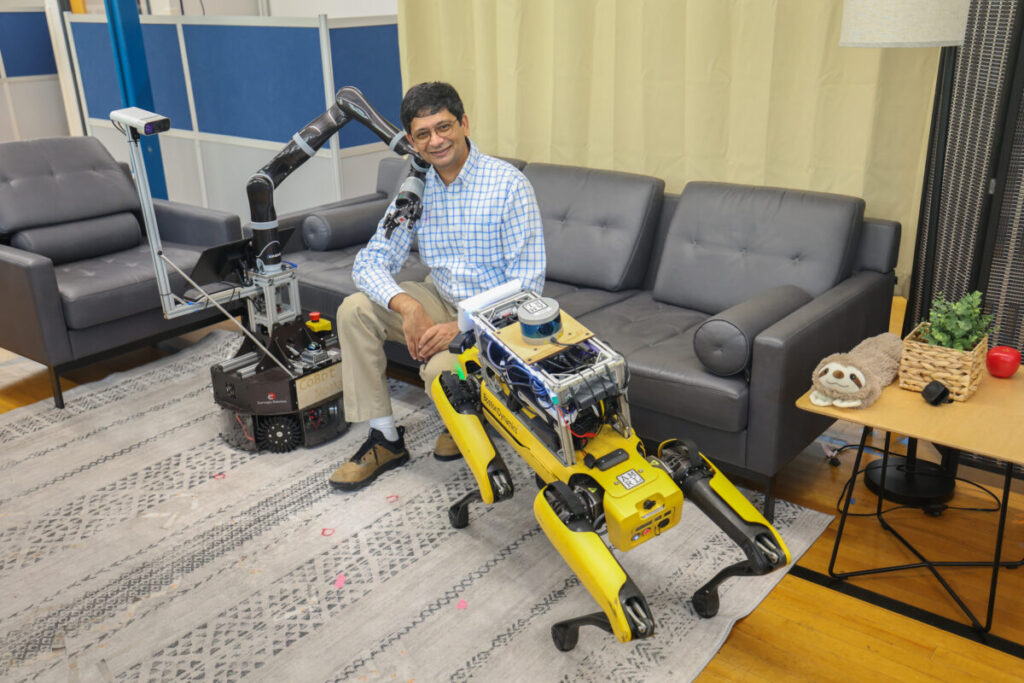
Featured Image: Joydeep Biswas, an associate professor of computer science at UT, will lead the team awarded the NSF grant and will serve as the director of the Center for Human and Robot Co-Adaptation. (Credit: University of Texas at Austin)