
Insider Brief
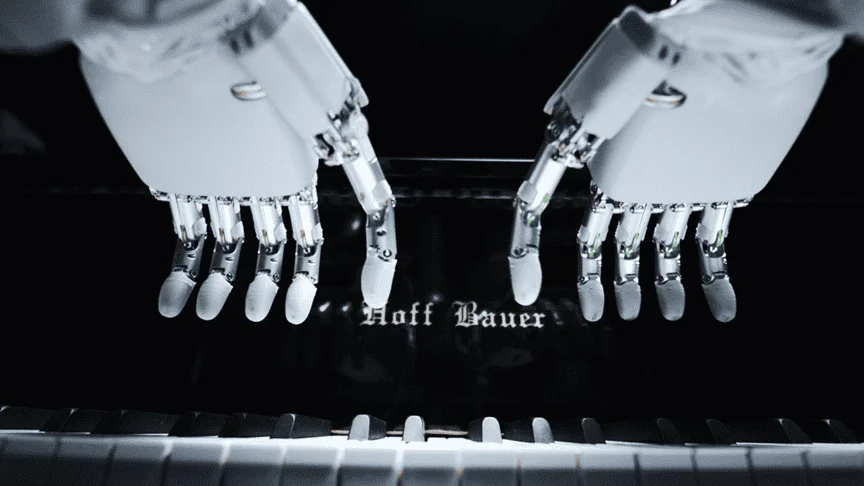
- MirrorMe demonstrated its Viva dexterous robotic hand performing a real-time four-hand piano duet with a human player, using the company’s Cada music embodied foundation model to move beyond pre-programmed note playback.
- The system converts musical intent into fingering, touch, force and timing commands, then uses acoustic and motion feedback to adjust its performance after each run.
- MirrorMe said Viva reaches joint speeds above 1,000 degrees per second and peak fingertip force of 33 newtons, while supporting fast scales, trills and repeated notes.
Shanghai robotics startup MirrorMe Technology unveiled Viva, a dexterous robotic hand the company says can perform a real-time four-hand piano duet with a human player, moving past pre-programmed note playback toward expressive ensemble performance.
The unveiling coincides with a development with MirrorMe’s Viva × Cada combination, according to a company. Viva is the physical hand and Cada is MirrorMe’s self-developed music embodied foundation model, which the company describes as handling music understanding, composition, performance strategy and feedback-driven learning.
How it Works
It starts with a general model that reads natural-language prompts and musical intent and then a generation module builds melodies and arrangements, the company said. A performance strategy model turns artistic choices into fingering, touch, force and timing commands that Viva executes on a piano. After each run, the system compares acoustic signals, kinematics and playback against reference targets, then adjusts strategy, MirrorMe explained.
On hardware, MirrorMe said it used pianist motion data and mechanical optimization to chase power, speed and dexterity at once. The hand uses what the company calls a tendon-linkage hybrid transmission where the tendons move actuators proximally to cut distal mass for finger speed. Rigid linkages keep stiffness and force transfer for fingertip output.
The Specs
Key specs MirrorMe cited include:
- Joint speeds above 1,000 degrees per second
- Peak fingertip force of 33 newtons
- Support for fast scales, trills and repeated notes
The company posted a collaborative Can-Can performance demonstrating a test of simultaneous strength, speed and fine control. A launch piece, Viva la Vida: Nueva Vida, was co-created with human collaborators then practiced and refined by the robot, MirrorMe noted.
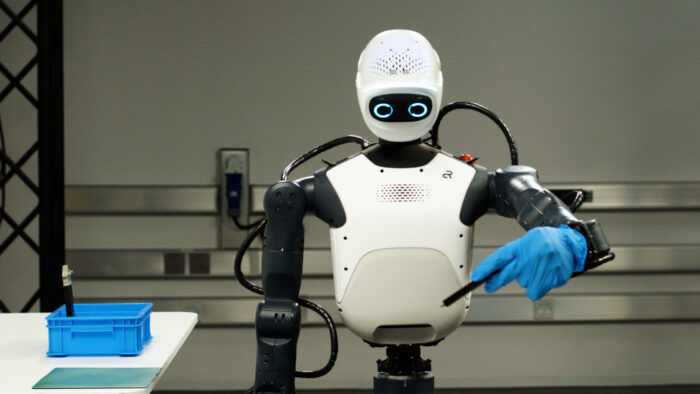
MirrorMe indicated it sees music as a demanding testbed that mixes cognition, creativity, expression and precise manipulation. The firm traces to a Zhejiang University robotics team and is led by Dr. Jin Yongbin. Its product line also includes a full-size humanoid called Bolt that the company says reaches speeds of 10 meters per second. MirrorMe said its products are in mass production and delivery.
Image credit: MirrorMe