Insider Brief
- Amazon Web Services launched the open-source Physical AI Toolchain on AWS to help robotics developers train, simulate, deploy and improve physical AI systems using AWS cloud services and Nvidia’s physical AI software stack.
- The toolchain covers synthetic-data generation, model training, simulation and validation, edge deployment and continuous improvement, while allowing customers to use the full stack or individual components and manage fleets of machines over the air.
- AWS said the toolchain draws on lessons from Amazon’s deployment of more than 1 million robots and comes as one in seven startups is building physical AI, with 72% of those builders considering cloud computing essential to their systems.
Amazon Web Services has launched an open-source toolchain designed to help manufacturers and robotics developers train, simulate, deploy and improve the systems that supply the AI for physical AI.
According to AWS, the Physical AI Toolchain on AWS is designed for everything from industrial automation and autonomous mobility to cobots and humanoid robotics. It combines AWS cloud services with Nvidia’s physical AI software stack to offer architecture guidance, deployment automation and ready-to-use code for every stage of development.
“Physical AI is going to touch every industry that moves, builds or makes things and our customers are moving fast to capture that opportunity,” noted vice president of AWS Industries Uwem Ukpong. “We built the Physical AI Toolchain on AWS because customers told us that too much of their engineering effort was going to infrastructure instead of innovation. We want to flip that.”
What the Toolchain Does for Developers
The toolchain is designed to reduce the amount of engineering work companies spend building underlying infrastructure. AWS stressed that it covers the development process from creating training data through deploying models on physical machines and improving them with operational data.
The platform is organized around five areas:
- Synthetic data generation creates AI-generated environments for training scenarios without relying entirely on physical data collection.
- Model training uses human demonstrations and simulated practice to develop machine behavior.
- Simulation and validation allow systems to be tested in virtual environments before being deployed on hardware.
- Edge deployment moves optimized models onto machines so they can make real-time decisions without constant cloud connectivity.
- Continuous improvement sends operational data from deployed machines back into the training process.
The underlying stack includes Amazon SageMaker for model training, EC2 GPU instances for simulation, AWS IoT Greengrass for edge deployment and Amazon Bedrock AgentCore for orchestration. Nvidia technologies include Isaac Sim for simulation, Isaac Lab for reinforcement learning, Isaac GR00T for humanoid robot training and Cosmos for synthetic-world generation.
Customers can use the complete toolchain through a single control plane or select individual components for simulation, training or deployment and connect them to existing work. AWS said fleet-management capabilities can also provision, secure and update thousands of machines over the air.
Growing Demand for Physical AI Infrastructure
AWS cited a recent Global Startup Trends Report by AWS Startups and Strand Partners found that one in seven startups is building physical AI and that 72% of those builders consider cloud computing essential to their systems.
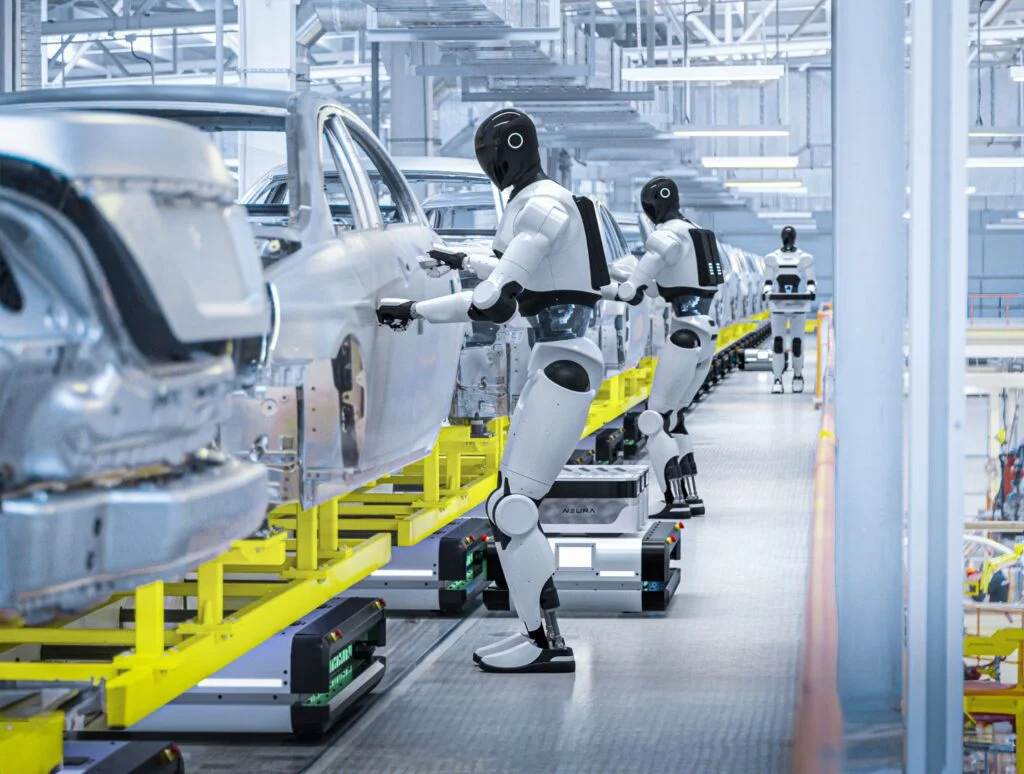
AWS said the toolchain can support applications ranging from collaborative robot arms that adapt to new assembly tasks to autonomous robots, in-vehicle systems and smart factories that monitor and adjust production. The company said manufacturers can use physical AI to increase throughput, reduce downtime and improve quality, while operational data from deployed machines can be fed back into the models to improve performance across a fleet over time.
AWS Infrastructure Already in Use
Several robotics companies are already using AWS infrastructure. Neura Robotics is developing cognitive humanoid robots, while RLWRLD is building an 8.1-billion-parameter foundation model for robotic manipulation. Config has assembled a pipeline containing more than 200,000 hours of robot-action data and uses generative AI to create additional training scenarios.
“The Physical AI Toolchain on AWS helps us accelerate exactly that cycle,” added Neura Robotics founder and CEO David Reger. “By combining Neura’s physical AI stack with AWS’s experience in large-scale infrastructure and deployment, we can move much faster from learning to real-world deployment and ultimately scale physical AI globally.”
The toolchain also draws on Amazon’s own robotics operations. Amazon said it has deployed more than 1 million robots across its network, where they handle millions of packages each day alongside hundreds of thousands of employees. Earlier this summer, Amazon Robotics unveiled its next-generation Proteus autonomous robot for moving items across facilities.
AWS said lessons from those deployments helped shape the toolchain’s architecture guidance, reference code and deployment automation. The company said manufacturers can tailor the stack to their hardware, operating environment and use case, and that the tools can help them launch physical AI systems in weeks rather than the years it could take to build the infrastructure from scratch.
“Building physical AI requires a seamless integration of three computing platforms — training, simulation,
and deployment,” said Amit Goel, head of robotics developer ecosystem and edge AI product at
Nvidia. “The open-source Physical AI Toolchain on AWS brings together AWS services with Nvidia’s
physical AI models, tools, and libraries to provide a scalable, end-to-end workflow that helps developers
accelerate the creation, training, validation, and deployment of intelligent robotics applications.”